
The Trump family, through the investment fund World Liberty Finance, acquired $4.7 million worth of wrapped BTC, the wrapped version of Bitcoin on the Ethereum network. This was reported on January 20 by Arkham Intelligence, a firm that provides data on on-chain behavior through its explorer. So what advantages does the wrapped version of Ethereum's bitcoin offer that the fund, which is geared toward the altcoin and memecoin market, prefers it over BTC on the Bitcoin network?
There are several reasons for this preference for the wrapped version. Currently, the Bitcoin network functions as a store of value and a payment network. While it is true that Bitcoin has second layers such as the Lightning Network, ideal for micropayments, or sidechains such as Rootstock, which offers “smart contracts on Bitcoin,” these solutions are not as popular as those that exist in Ethereum and other networks that use its virtual machine.
It's not just a matter of popularity: it's a fact that Bitcoin's programmability is limited, despite efforts being made to push the introduction of OP_CAT into the protocol, an operational code that would expand the use cases of the world's largest cryptoasset.
WBTC is useful for participating in DeFi
Donald Trump's speculative, price-driven rather than technology-driven approach makes WBTC a tool that would allow WLB to participate in Ethereum DeFi with two advantages: without selling their bitcoin and being able to redeem it for its original mainnet version at any time.
At the time of writing, the Arkham Explorer shows that World Liberty Finance holds 646 WBTC worth over $60 million. After ether (ETH), wrapped bitcoin represents the firm’s second most valuable holding, above its holdings in stablecoins like USDC and USDT.
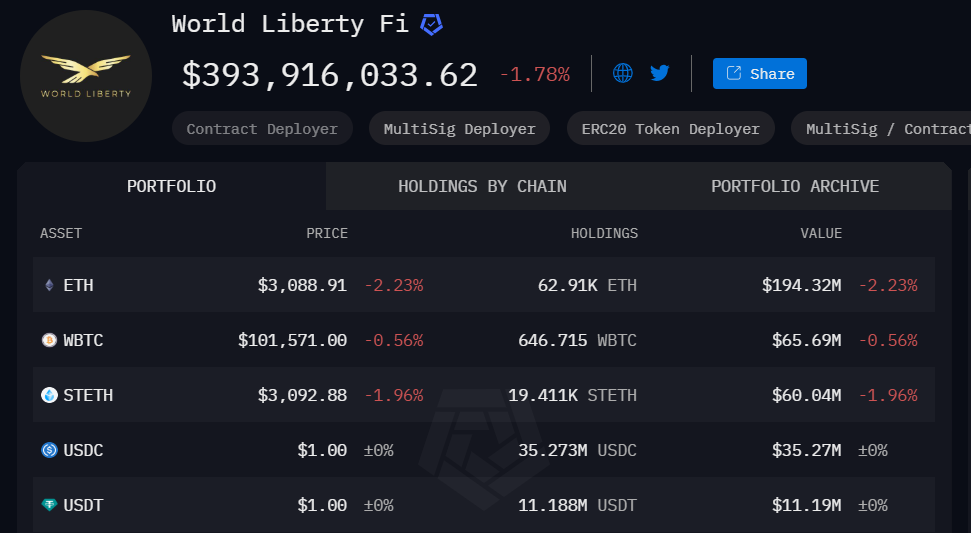 WLF's portfolio shows that WBTC is its second largest token. Source: Arkham Intelligence
A closer look at the WBTC transactions shows that WLF has interacted with only one protocol, using the wrapped token. It is called CoW Protocol, a “meta-DEX aggregator that leverages trading intent and batch auctions to find users the best prices to trade crypto assets.”
The evidence shows that WLF is not yet using wrapped bitcoin, other than to buy and hold it. This suggests two things: either the firm associated with the Trump family is preparing to interact with DeFi in the future, or the purchases and holdings of WBTC serve a very different purpose.
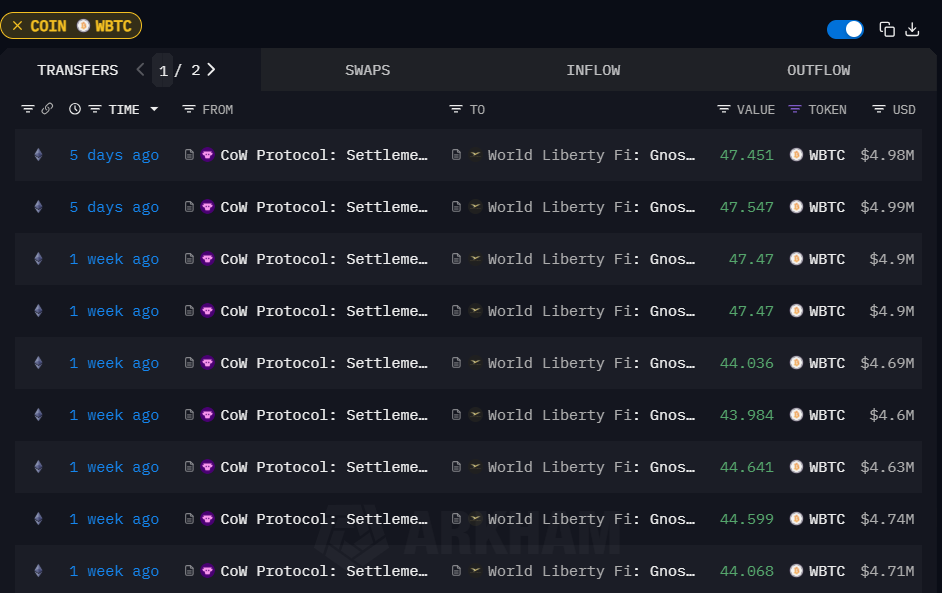 Transfers using WBTC only include CoW Protocol. Source: Arkham Intelligence
WBTC, a centralized version of bitcoin
The definition of WBTC as a wrapped version of bitcoin is simple and understandable, but insufficient. Although this BTC is pegged to the price of bitcoin and backed by holdings of real bitcoin, it is an ERC-20 standard token, created to be used on Ethereum.
Unlike Bitcoin, which is hosted on the cryptocurrency's main network and is kept secure by its decentralized system, WBTC is an ERC-20 token that is held by entities or companies, depending on them. Two of them, exactly: Kyber Network and BitGo.
WBTC, or “Wrapped Bitcoin,” is similar to WETH but with one key difference: it is 100% custodial and centralized. The WBTC initiative is led by Kyber Network in partnership with BitGo. In short, every 1 WBTC minted on the Ethereum network is backed by 1 BTC in a vault controlled by BitGo.
Anthony Sassano, Set Labs writer.
Centralized issuance and custody has certain implications for WLF. The centralization of WBTC, for example, facilitates the implementation of regulatory and judicial measures against responsible entities, which are clearly recognizable.
In this sense, using WBTC can be a way for WLF to expose itself to the price of Bitcoin by covering its back. If something were to happen to BitGo's backings that keep WBTC at par with the price of BTC, WLF could file a lawsuit against the company and, at some point, recover its funds with the intervention of the judicial system. Bitcoin self-custody, although safer, does not have the same privileges.
According to the same writer, the WBTC smart contract, unlike real bitcoin, has a pause function that allows the central operator, i.e. Kyber or BitGo, to freeze WBTC assets at any time.
This pause feature is primarily used to temporarily stop the wrapping or unwrapping of WBTC when the asset's liquidity pool is depleted. Its purpose is to prevent the pool from running out of BTC or WBTC when demand is high and to prevent issues in the settlement and exchange processes.
Some people are concerned that this pause feature will allow issuers to freeze funds in WBTC, a capability that companies like Tether have with its stablecoin USDT.
If WBTC could be centrally controlled in that way (some users say it cannot ) WLF would have an additional way to recover potential funds lost through hacks or protocol vulnerabilities. That is, WBTC issuing companies could help the company associated with the Trump family recover their bitcoins. The BTC mainnet does not provide such privileges either.






