
More than 2.6 million ethers (ETH), valued at around $11.5 billion at current prices, are waiting in the Ethereum staking exit queue, according to data updated as of September 11, 2025. This represents an unprecedented exit movement for staking on this network.
This accumulation of withdrawal requests reflects a worsening of validator behavior on the Ethereum network, where the waiting queue to abandon staking can reach 45 days and 18 hours.
The phenomenon occurs in a bull market context for ether, which is trading above $4,500, and could be driven by the intention to realize profits accumulated during months of locked funds.
The exit queue has grown steadily in recent weeks, rising from figures close to 600,000 ETH in early August to current levels, which represent a significant amount of tied-up capital.
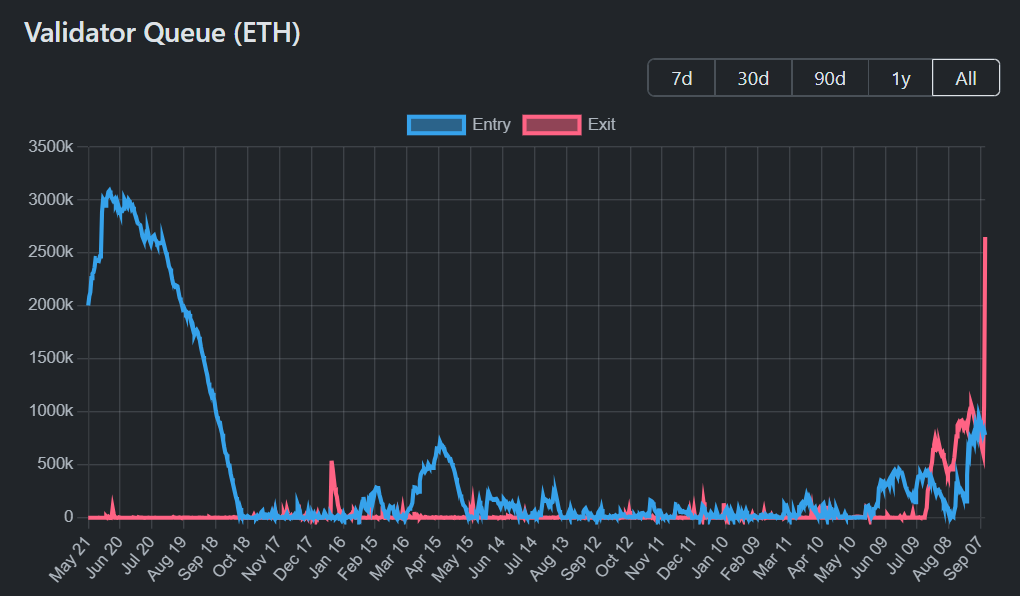 The Ethereum staking exit queue has reached unprecedented levels. Source: https://www.validatorqueue.com/
In contrast, the input queue, with 760,000 ETH pending activation, shows a more moderate wait time of 13 days and 5 hours. This disparity indicates that while there remains interest in staking, the mechanism by which users stake ETH to validate transactions and secure the network in exchange for rewards, the dominant impulse now, by far, is withdrawal.
At the time of writing, Ethereum maintains a solid base of 1,057,472 active validators, representing 29.18% of the total circulating ETH supply, with an annualized yield (APR) of 2.85%.
Staking on Ethereum, implemented after the transition to proof-of-stake in September 2022, requires each validator to stake at least 32 ETH to operate a node that proposes and validates blocks on the chain. This system replaced proof-of-work and attracted over a million participants at its peak, but input and output queues act as a regulatory brake. Designed to prevent sharp fluctuations in the number of validators which could compromise network stability, security, or performance these queues limit the churn rate of validators.
It's expected that the more than 2 million validators in the exit queue won't complete the withdrawal process some may even withdraw. Whenever validators accumulate profitability, they typically withdraw their positions to capture the value of their ethers in fiat, a pattern that is now repeating itself in an environment of appreciating ether. This behavior is due to factors such as profit-taking after prolonged lockup periods, combined with the accumulated yield of rewards.
While the current APR of 2.85% is modest compared to, say, 2023, the rising price of ETH has increased the total value, incentivizing outflows to rebalance portfolios or explore alternatives such as restaking in derivatives protocols.
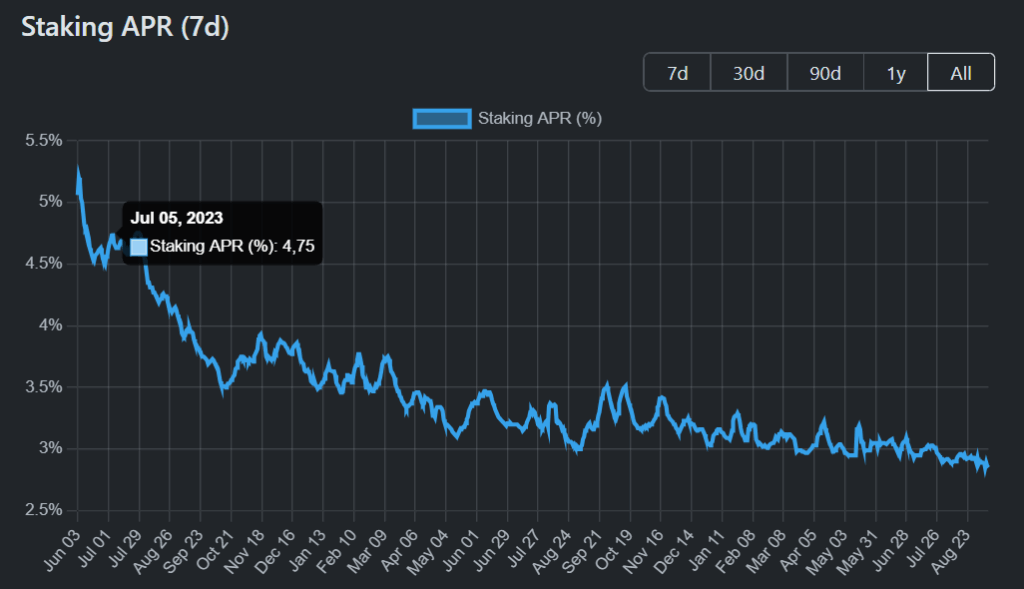 The validator queue has fluctuated sharply recently. Source: https://www.validatorqueue.com/
Despite the pressure from exits, the Ethereum network faces no immediate risks. With over a million validators in operation, the minimum threshold for robust consensus remains intact, and controlled churn ensures a smooth transition.






