
On April 5, the Bitcoin (BTC) network experienced an unusual event: in a span of approximately 3.5 minutes, five consecutive blocks were processed, from 890993 to 890997.
This fact, captured by the mempool.space block explorer, contrasts with the expected average for the network, which indicates a 10-minute interval between each block. What does this phenomenon imply, and what factors could have caused it?
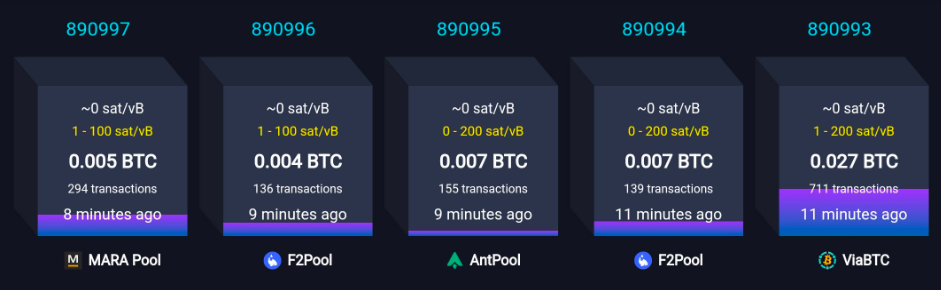 Five blocks were found on the Bitcoin network in less than 3.5 minutes. Source: mempool.space.
An accelerated pace on the Bitcoin network
One of the most likely reasons behind this phenomenon is the natural variability in the Bitcoin mining process. This activity relies on the Proof of Work consensus mechanism, where miners compete with their hashrate to meet the protocol's target nonce and process the next block .
Since this process is random, and the average is set to 10 minutes, lucky streaks can occur where multiple blocks are solved in quick succession. In this case, the blocks were mined by different pools, such as ViaBTC, F2Pool , AntPool , and MARA Pool, suggesting that there wasn't a single dominant player, but rather a coincidence in the solution of those blocks.
However, a key factor in understanding this event is the recent behavior of the network's hashrate. The average Bitcoin hashrate sits at 860 EH/s (exahashes per second), according to mempool.space, but it tends to fluctuate throughout the day for various reasons, such as power availability or the addition of new mining equipment.
On April 4, just one day before the five blocks mentioned here were processed so quickly, the total network hashrate reached 1,025 EH/s for the first time in its history. This increase in computing power could be an indication that a similar situation contributed to blocks being solved more quickly than usual during that brief period, since a higher hashrate increases the probability of finding valid hashes more quickly.
A recent difficulty adjustment and its context
On April 6, one day after the event involving these five blocks, the Bitcoin network adjusted its difficulty upward by 6.81%, a significant increase reflecting the increase in miners' hashrate.
This adjustment, which occurs every 2,016 blocks (approximately every two weeks), coincided with the hashrate spike recorded on April 4, which explains its magnitude. The higher difficulty is intended to offset the increase in computing power to maintain the average block interval of 10 minutes.
In fact, the average block time on the Bitcoin network is currently 10.3 minutes, indicating that blocks are not being processed faster on a sustained basis, suggesting that the April 5th event was a one-off, one-off, likely driven by a hashrate spike and a lucky streak in mining.
Implications for the network and users
Processing 5 blocks in 3.5 minutes is a rare occurrence, but not necessarily alarming and does not indicate a structural problem. The Bitcoin network was designed to accommodate these fluctuations through its difficulty adjustment, ensuring that the 10-minute average per block is maintained over the long term. This episode serves as a reminder of the dynamic and probabilistic nature of mining, where randomness and network activity play a key role.
For users, this event may translate into faster than usual confirmation times for their transactions. In a scenario where the network is lightly congested, as appears to have been the case, a reduced interval between blocks allows the few pending transactions to be processed more efficiently, benefiting those who sent payments or transfers during that period.
In theory, if blocks are generated faster than average over an extended period, the network difficulty adjustment will increase in the next adjustment cycle, which occurs every 2,016 blocks. This will require greater computing power and energy consumption from miners, particularly affecting those with less efficient equipment, whose operating costs could exceed the rewards earned.






