
The release of Bitcoin Core v30 has widened the rift among Bitcoiners: what for some is an appropriate step, for others means a departure from the protocol's original design.
One of the most significant changes in the Core update has been the expansion of the data limit on the OP_RETURN opcode, which has increased from 83 bytes to a threshold of 100,000 bytes. This will be implemented in October with version 30.
This threshold setting will allow much broader entries to be embedded in the network archive, from texts to images or files that some consider superfluous (“spam”).
For some in the community, this innovation betrays the original spirit of Bitcoin, distancing it from its essence as a pure digital currency, while others choose to advocate for expanding Bitcoin's use cases or for allowing users to decide how they use the network.
The truth is that Core's decision has ignited passions, fragmenting Bitcoiners into warring factions and fueling, in recent months, a heated "client war" that has shaken the community's foundations.
Mixed opinions in the Bitcoin community
Gloria Zhao, one of the core maintainers, explained that the most relevant motivation for changing the OP_RETURN limits is to "correct a discrepancy between corruption and standardization of data storage techniques."
According to the contributor, after evaluating the technical arguments for and against, and considering the objections, the change is ready to be implemented, as it aligns OP_RETURN with cuttable options, avoiding UTXO (unspent transaction output) inflation.
Preventing UTXO inflation means preventing the pool of unspent outputs from growing unnecessarily, which preserves network efficiency.
Zhao, in his analysis of the Bitcoin Core proposal, argues:
"Another motivation is to support Bitcoin's public, decentralized market for block space by preventing transaction relay policies from being stricter than what is reliably mined. OP_RETURN limits are among the few policy rules that exist solely to discourage their use. These restrictions push people (e.g., those who don't want to inflate the UTXO set) toward sending directly to miners, which harms mempool utility and creates pressure toward centralization."
Gloria Zhao, Bitcoin Core maintainer.
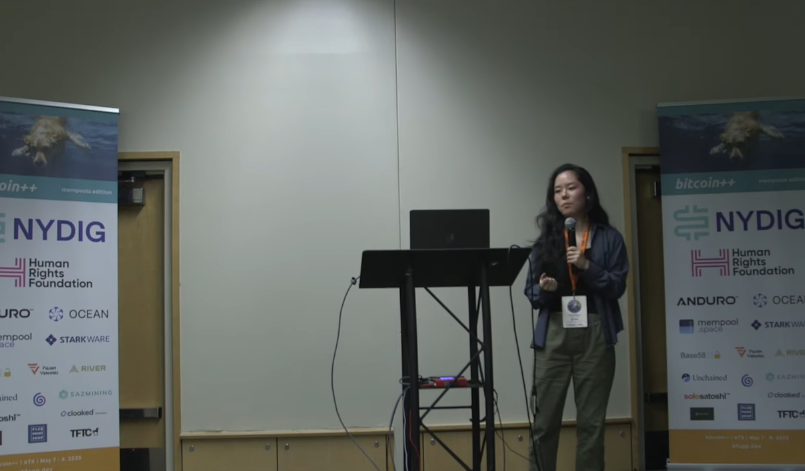 Gloria Zhao is a lead developer on the Core team. Source: Youtube.
Meanwhile, another Core developer, Greg Sanders, stated that removing the limit "generates at least two tangible benefits: a cleaner set of UTXOs and more consistent default behavior." By “more consistent default behavior,” Sanders refers to the way the Bitcoin Core software, by removing the hard limit on OP_RETURN, adopts a more uniform and predictable relay policy for nodes.
This means that nodes will process transactions with pruned data in a standardized manner, avoiding discrepancies that previously required direct submissions or filters, thereby improving network efficiency and consistency. Zhao and Sanders' statements show a consensus among Bitcoin Core developers on the need to update client rules, such as the 83-byte limit on OP_RETURN, to align policies with what they understand to be the current capabilities of the network.
Along the same lines, Adam Back, co-founder of Blockstream, has already warned that he will run the next Core v.30 update. Other collaborators and relevant participants in the Bitcoin ecosystem support Back's position. Parker Lewis, CEO of a Bitcoin (BTC) payments firm, argues that Bitcoin Core does not censor the network by filtering transactions, as any Bitcoin address can validly send funds to another, stating: "Filtering transactions is not censorship." He maintains that this practice does not alter the fundamental definitions of the network. Lewis emphasizes that filtering is a technical configuration that does not prevent valid transactions, maintaining the integrity of Bitcoin.
Voices in favor of Knots
That approach contrasts with the position of Bitcoin Knots enthusiasts, who perceive the changes brought by the new Bitcoin Core update as an amplification of non-monetary uses that could allegedly deviate Bitcoin from its original purpose.
From the MYNODE site, they noted that "with Knots, you get options like strong mempool filters, OP_RETURN limits, and spam-resistant policies, all controllable via configuration. You're not just running Bitcoin, you're defining it."
BitcoinMechanic, a Bitcoiner and node operator for the Knots client, jumped into the fray. In a YouTube stream on August 11, he argued that Bitcoin Core is undermining the integrity of Bitcoin by relaxing spam filters, allowing low-fee transactions (-1 sat/vByte) and arbitrary data (such as runes and inscriptions) that clogs the network.
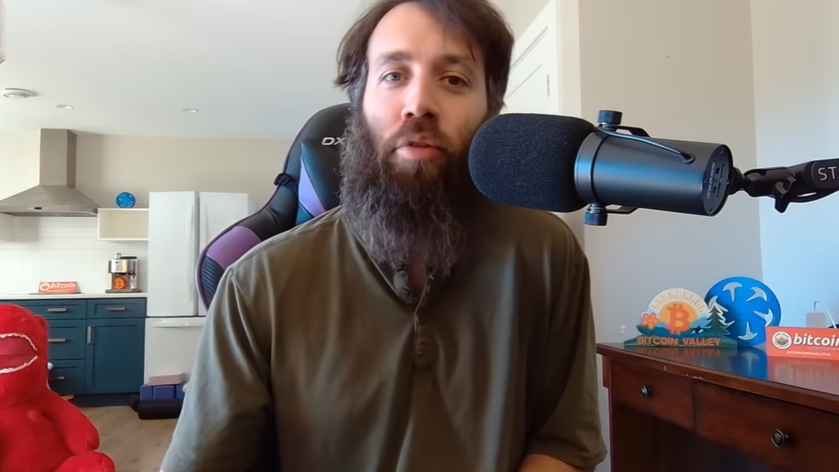 BitcoinMechanichs explains why he opposes Core policies. Source: YouTube.
Mechanic claims that Core allows transactions with fees less than 1 sat/vByte, facilitating spam on the chain, instead of promoting the consolidation of UTXOs (unspent transaction outputs), which would be a legitimate use.
It exposes that nodes that relax these policies, by accepting transactions that do not meet the default minimum of 1 sat/vByte, contribute to half-empty blocks with low-quality content, which affects the efficiency of the network. This decision, he said, reflects a lack of commitment to protecting Bitcoin from non-monetary uses.
He believes that the removal of these filters, along with the lack of action against new forms of spam, is a deliberate decision that benefits spammers and those seeking to monetize the network for non-financial uses, such as storing arbitrary data.
Additionally, Mechanic questions the influence of Core defaults, such as the 83-byte limit on OP_RETURN, which historically set the direction of the network. He warns that removing these filters allows for the inclusion of arbitrary data, which slows block propagation and favors large miners over small ones.
For him, nodes that validate these types of transactions are attacking the network. That's why he proposes strengthening filters and migrating to Bitcoin Knots, an alternative client that has already been adopted by more than 17% of the network's nodes. It's worth remembering that when the Ordinals market exploded in 2023, the Bitcoin network suffered from congestion, allowing fees as high as $30.
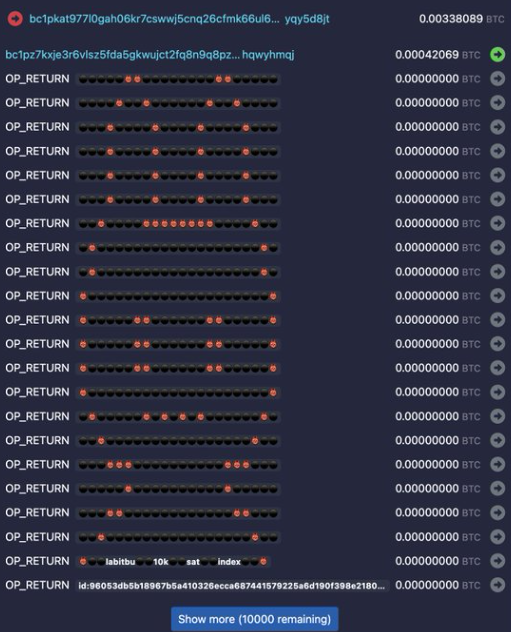 Recently, a user embedded 10,000 OP_RETURN tokens into a Bitcoin transaction.
There was no shortage of emotional arguments.
Criticizing Core, Tomer Strolight stated that “Bitcoin Core unilaterally deciding on updates is more of an attack than any kind of spam.” He also anticipates that version 30 “will likely be the least adopted and perhaps the last.”
On the other hand, a Bitcoin miner pleads on X that “please don’t upgrade to Core 30 when it’s released.” He added, “Please change your node software to Knots. If you believe in Bitcoin and want it to be here for your grandchildren, you have to fight for it.”
Another more direct user declared: "Bitcoin Core 30 is a malicious virus. Run Bitcoin Knots instead." Others take a more maximalist stance: one said they seek to "sustain Bitcoin for the next thousand years" and therefore won't help retransmit "garbage on the chain" using Core v.30.
There were also those who warned that “filling the network with memes, dapps, or NFTs” distances Bitcoin from its purpose and makes its fees more expensive, while another person opined that “it feels strange to praise decentralization and at the same time commit to running Core v30 without supporting solutions that actually empower miners.”






