
During 2023, the United States Securities and Exchange Commission (SEC) filed a total of 47 enforcement actions against companies in the cryptocurrency sector in 2023, almost double those filed in 2022.
This is a trend that has been increasing since 2017, and that in 2023 reached its maximum in ten years, according to statistics presented by the consulting firm Cornerstone Research in a report published this January.
According to the investigation, the number of complaints was the highest since 2013, when barely one sanction was recorded. They add that more than half of the 47 procedures applied last year were related to litigation, followed by administrative procedures.
In this way, not only did the number of actions triple compared to the previous year, but a total of USD 281 million in monetary sanctions derived from agreements and fines were imposed.
Actions taken in 2023 include cases against non-fungible tokens (NFTs) and others related to lawsuits over non-compliance in several initial coin offerings, which were accused of fraud or trading unregistered securities.
The data does not include lawsuits filed last year against Binance, Coinbase, Terraform Labs, Ripple and Kraken because they were ongoing at the close of the investigation. Which suggests that the number of procedures in 2023 and their monetary value will change, depending on the results of these litigations.
Cornerstone noted that about half of the 108 lawsuit cases filed since 2013 have been resolved in court.
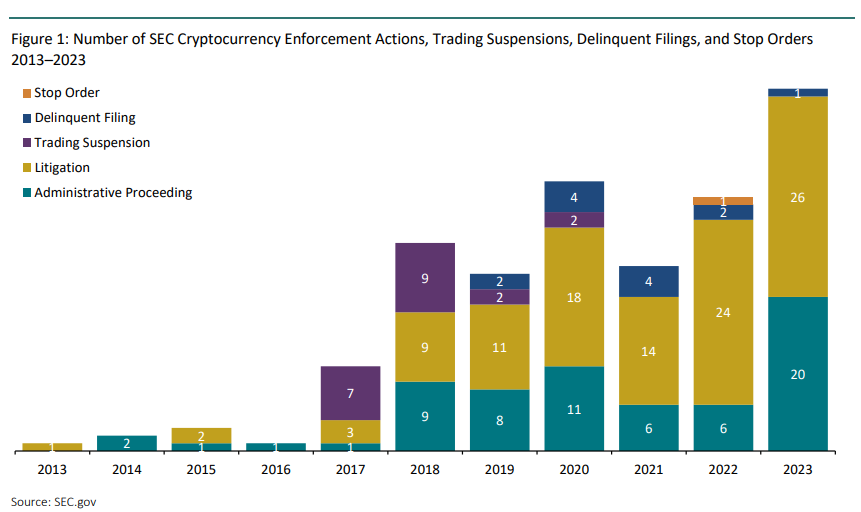 SEC actions against the sector have increased since 2017, peaking in 2023. Source: Cornerstone Research.
An important piece of information from the investigation states that the increase in SEC actions has to do with the importance that the sector has acquired in recent years, with significant progress in the adoption of bitcoin.
However, it is also observed that the growth in litigation against the ecosystem coincides with the arrival of Gary Gensler to the presidency of the organization in 2021.
The number of administrative procedures applied that year was 20, and that date was when Gensler's nomination was confirmed by the United States Senate. Then, once he took office, the SEC's actions on cryptocurrencies rose 50% in 2022 and more than 53% in 2023.
This increase has caught the attention of members of the cryptocurrency community, who expected Gensler to have a friendlier attitude, being an expert in the sector and even teaching classes on Bitcoin at MIT. Expectations pointed to more favorable regulation for cryptocurrencies.
However, Gensler's policy has been viewed as coercive, especially given the significant rise in SEC court activity, which doubled in just one year. Gensler insists on defending his management. Regarding this, the Cornerstone report highlights the words that the official usually uses to argue his actions:
Law enforcement is a tool, not the destination. The goal is to bring cryptocurrency market participants into compliance with the law and regulations, and to protect our customers, American investors.
Gary Gensler, Chairman of the SEC .
Despite his arguments, the official faces criticism from a large majority within the cryptocurrency sector, who consider that his attitude goes against the advancement of the ecosystem. This is because its “regulation by application” approach is considered to generate uncertainty and has been one of the main causes of the flight of many companies from the United States.






