
Security and privacy company Proton, developer of one of the most well-known VPNs in the technology ecosystem, recently launched its latest creation, a self-custody bitcoin (BTC) wallet that allows you to send and receive BTC via email.
According to the Swiss company, this is an implementation designed so that Bitcoin users can operate with this digital asset "without compromising their privacy."
According to Proton, because people must reuse Bitcoin addresses to send or receive funds, the privacy of transactions is compromised.
The company argues that with its new wallet, which is also self-custody and works for desktop, iOS and Android, users can operate with bitcoin while protecting their privacy. To do this, they enabled the sending and receiving of BTC by email, which implies stopping reusing wallet addresses.
It should be noted that other wallets change the address automatically so that the user does not reuse it. The Proton wallet only aims at the convenience of managing different Bitcoin addresses by sharing the same email address.
According to the company's announcement, the wallet will start operating only with Bitcoin (BTC), although they are not ruling out the possibility of integrating other cryptocurrencies in the future. However, currently, to access the wallet and start using it, you have to join a waiting list. Another way is to pay the company, as shown below, around 40 euros per month:
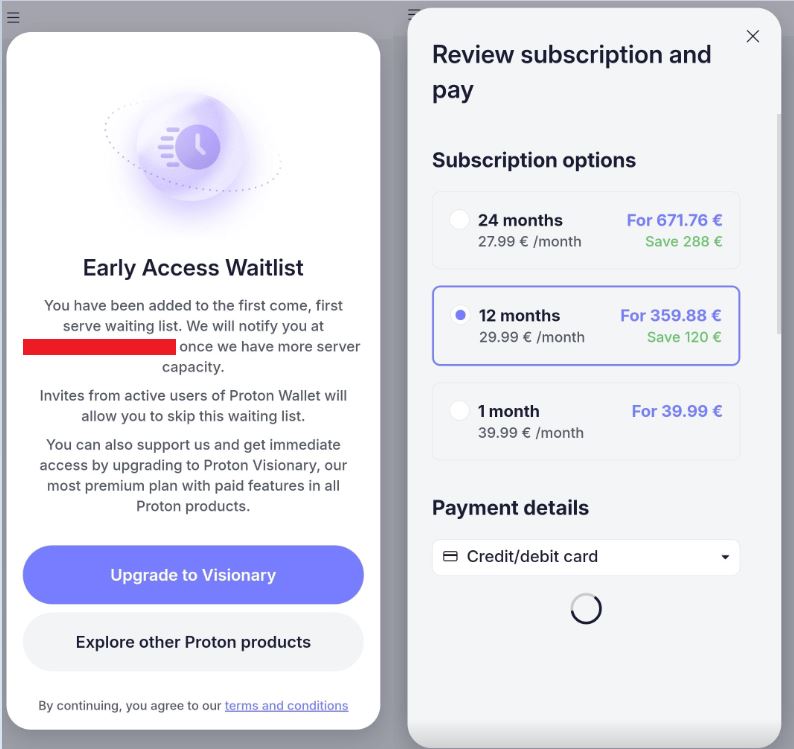 At the moment, to use Proton Wallet you have to wait or pay the company. Source: Proton Wallet.
How to send BTC via email?
As explained by the company, sending BTC via email is done through the integration of Proton Account and Bitcoin, allowing users to register their existing email addresses or create new addresses to receive BTC.
The integration generates a set of unique Bitcoin addresses for each user, which are signed with a PGP private key. In this way, Proton Wallet guarantees the privacy of transactions “and prevents third parties from being able to track or access sensitive information,” they say.
A PGP private key is a fundamental piece of cryptography that is generally used to protect the confidentiality and authenticity of communications and data storage in the digital environment.
When a user wants to receive BTC, they must share their email address registered with Proton Wallet, which does not necessarily have to be part of the Proton Mail service, but must be integrated with that technology firm.
That way, when BTC is sent to that address, Proton Wallet verifies the authenticity of the recipient and encrypts any attached messages end-to-end. It also assigns one of these unique addresses for the sender to send the funds to.
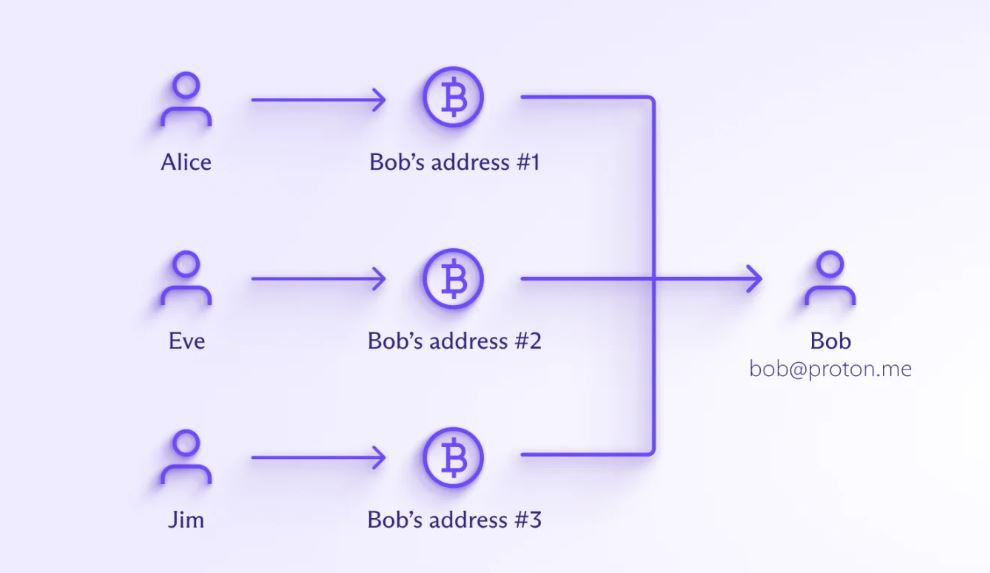 Proton Wallet allows users to generate a pool of unique Bitcoin addresses for each user. Source: Proton.
The Proton Wallet works on-chain, meaning that transactions are executed through the main Bitcoin chain. Therefore, transactions are subject to a confirmation time of 10 minutes. Unlike other wallets, which rely on the scalability solution, the Lightning network, which allows payments to be made almost instantly.
This is not the first time that the possibility of sending bitcoin by email has been invented. In 2023, a tool called AcceptLN was developed, which allows anyone with an email address to receive BTC.





