
Over the past 90 days, OP_RETURN transactions and registrations have remained prominent in Bitcoin. According to the mempool.space developer known on X as Orangesurf, these transactions represent "40% of total transactions."
During that same period, Orangesurf stated that these types of transactions accounted for "10% of the fees paid on the network and that their weight is equivalent to 28% of the total processed in Bitcoin."
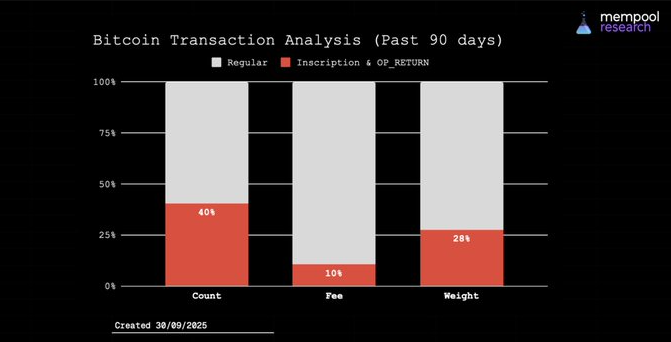 “Analysis of Bitcoin transactions over the past 90 days.” Source: Orangesurf / X.
OP_RETURN in Bitcoin is an opcode that allows you to include arbitrary data in a transaction, such as messages, text, or images.
The current representativeness of OP_RETURN transactions in Bitcoin has been maintained since at least April of this year, when almost half of all transactions were non-monetary. Other reports, from June and July, reflected that this trend continued.
Technical debate on Bitcoin registrations
The importance of transactions involving data via OP_RETURN or registrations, as reflected in the data described above, has revived technical discussions within the Bitcoin community.
Several developers believe that these uses increase pressure on block space and can affect both costs and network performance.
In this context, on September 22, developer Mike Schmidt, who is also the CEO of Brink, a non-profit organization that funds Bitcoin Core, reported on X:
I've opened a pull request (PR) on Bitcoin Core to remove the deprecation of the datacarrier and datacarriersize options. I realize this is a sensitive topic for Bitcoin Core users…
Mike Schmidt, Bitcoin developer.
The expression "opening a PR" means proposing changes to the source code for other contributors to review and eventually integrate.
In this case, Schmidt submitted his PR to the Bitcoin Core repository to revert the deprecation (or marking as deprecated) of the "datacarrier" and "datacarriersize" options.
These options allow nodes to decide whether to accept transactions with embedded data and to set the maximum size of that data.
The developer explains in the repository that his goal is to eliminate this "obsolescence" status in version 30 of Core, to avoid confusion among users, after the OP_RETURN limit was increased to 100,000 bytes in that client, thus increasing the amount of non-monetary information that can be included in each transaction.
For Schmidt, clarifying and keeping these options available would help reduce confusion surrounding the handling of non-monetary transactions, precisely at a time when their volume remains high (as detailed by Orangesurf).
Following the announcement of Schmidt's PR, some developers expressed distrust about the true scope of the proposal. For example, Léo opined:
This looks like damage control. After that, Core developers can say, "Look, we heard you, and you can still configure datacarrier." Meanwhile, the default is still outrageously high, and -datacarrier is still broken.
Léo, bitcoin developer.
With this phrase, Léo suggests that the PR's opening would be merely a maneuver to give the impression that criticism is being addressed, without actually changing the parameters in question.
In the same thread, Luke Dashjr, lead maintainer of the Knots client, joined the discussion by asking, “What do you call it when someone tries to make you believe they changed something, but they actually didn’t?”
His comment reinforces the suspicion that Schmidt's proposal would not represent a substantial change.
For his part, Adam Back, co-founder of Blockstream and who has already announced that he will use Bitcoin Core version 30, defended Schmidt's move:
Datacarrier isn't broken, you've read some misinformation. There are differing opinions from sensible people with technical understanding about which parameter is best. There are also side effects to consider. Allowing users to set their preference is a reasonable approach.
Adam Back, Blockstream co-founder.
Back sought to nuance the discussion and emphasize that there are diverse technical criteria on how to manage these parameters.
Léo replied to Back:
You remind me of the Core developers telling me that DataCarrier wasn't broken with the registration bypass because they updated (vandalized) the documentation.
Léo, bitcoin developer.
With this, Léo insisted that, beyond the explanations received, the modifications introduced in Bitcoin Core would have practically changed the system's behavior regarding the use of OP_RETURN and registrations.
This exchange reveals that while OP_RETURN entries and data still occupy a significant fraction of block space, there is still debate about how the parameters controlling these uses should be managed.
In this context, the figures shared by Orangesurf reflect that registrations and OP_RETURN are not a marginal phenomenon.
Its persistence, along with the discussions about datacarrier, show that Bitcoin Core's design remains subject to technical reviews and disagreements over how to balance flexibility and efficiency in block usage.






