
Bitcoin Core developer and contributor Antoine Poinsot posted on X on August 5th criticizing a growing trend among Bitcoin miners: “Congratulations 'Summer -1sat/vb', you managed to ruin compact blocks.”
His comment points to a recent shift in miner behavior, which in recent weeks has seen transactions with fees below 1 satoshi per virtual byte (sat/vB), a unit that measures the cost users pay to process their transactions on the Bitcoin network.
This phenomenon, known on social media as the “sub-1sat/vB summer,” has challenged node relay policies and, according to Poinsot, exposes vulnerabilities in the compact block protocol, an optimization introduced in 2016 by Bitcoin Improvement Proposal 152 (BIP -152).
 Poinsot (medium) commented on operations with fees under 1 sat/vB that miners add. Source: YouTube.
What are Bitcoin compact blocks and how would they be affected?
Compact blocks are a mechanism designed to speed up the propagation of new blocks in Bitcoin.
Before BIP-152, nodes transmitted entire blocks, which consumed bandwidth and time.
Compact blocks solve this by sending a summary of transaction hashes, assuming nodes already have many of them in their mempool ( the space where pending transactions are stored). If data is missing, nodes request what they need, thus reducing network traffic.
However, this system relies on nodes' mempools being similar. Current miner behavior, which includes sub-1 sat/vB transactions, violates this premise.
Traditionally, miners prioritize high-fee transactions for profitability. Now, faced with high demand for space, some miners fill blocks with cheap transactions, possibly due to external economic agreements or maximization strategies.
Since many nodes reject these transactions due to relay policies (such as a minimum of 1 sat/vB), they do not have them in their mempool , forcing additional requests and affecting the efficiency of the system.
The damage pointed out by Poinsot
Poinsot warns that this "sub-1sat/vB summer" has "ruined" compact blocks. The damage lies in increased latency and resource usage . Typically, a compact block requires less than 0.2 MB of additional data to rebuild.
Currently, according to the Bitcoiner contributor, nodes must download up to 0.8 MB per block , eliminating the advantage of reduced propagation time. This adds communication rounds between nodes, countering BIP-152's goal of minimizing delays.
The following chart, provided by Antoine Poinsot, shows the average transaction size that Bitcoin nodes must request daily to rebuild compact blocks, measured in kilobytes (kB).
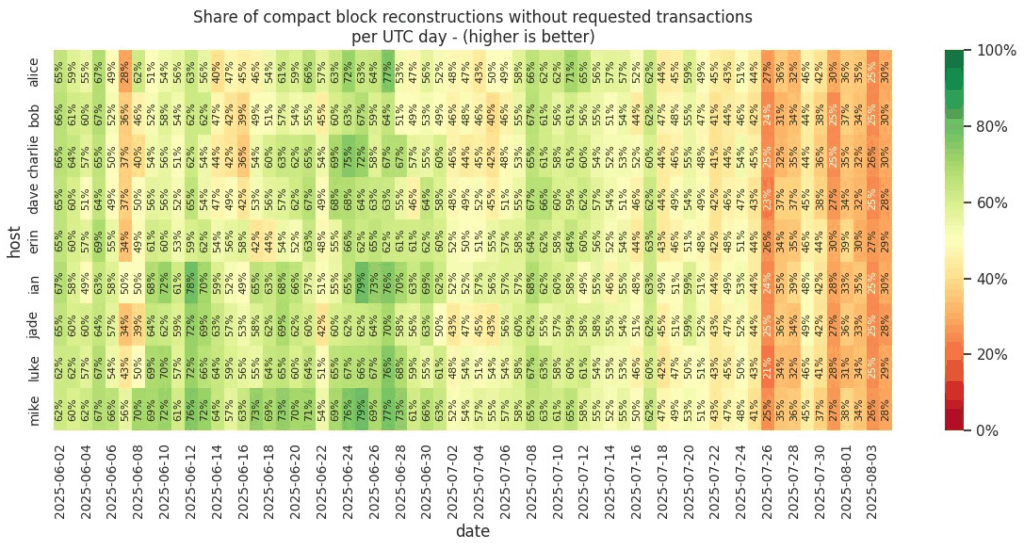 Poinsot believes that the miners' new behavior is detrimental to the network's efficiency. Source: Antoine Poinsot / X.
The data in the image above spans from May 1 to August 6, 2025, with each cell representing a day and each row a specific node in the network. The color scale ranges from green (low, ideal values) to red (high, problematic values), indicating that a smaller size is preferable for efficiency.
In May and June, most cells are green, with average sizes below 100 kB, reflecting efficient operation of the compact blocks.
Starting in July, especially in recent weeks, yellow and red hues have predominated, with peaks reaching nearly 800 kB (0.8 MB) per day. This coincides with the "sub-1 sat/vB summer," where miners have included transactions with fees below 1 sat/vB.
This situation negates the expected efficiency, where compact blocks reduced traffic to fractions of a megabyte, and now matches or exceeds the traditional method of sending all instructions. In other words, the network is working harder than necessary, as if it were requesting complete instructions instead of a summary.
Network impact and possible solutions
The problem primarily affects miners and node operators. The former see their blocks propagate more slowly, reducing competitiveness, while the latter face increased bandwidth consumption.
For ordinary users, who send transactions with standard fees, the direct impact is limited, but in the long term it could lead to congestion and fee increases.
Poinsot suggests adjusting the relay policy, as proposed by Bitcoin Core PR #33106, which lowers the minimum to 0.1 sat/vB, aligning nodes with mining reality. However, this measure requires consensus, and the "sub-1 sat/vB summer" could reflect experiments or pressure for structural changes.
The situation underscores the need to adapt the protocol to emerging economic dynamics, a continuing challenge for Bitcoin






