
According to Michael Saylor, founder and director of the publicly traded company with the most bitcoin (BTC) in the world, MicroStrategy, a blow is coming for the Ethereum and altcoin markets.
“At the end of May, you will know that the Ethereum ETF [exchange-traded fund] will not be approved” in the United States, he said yesterday. The comment took place in a conference he gave at his event called Bitcoin for Corporations .
With such disapproval, the businessman maintains that it will be very clear to everyone that Ethereum is considered a security, not a commodity like bitcoin. After that, he foresees other altcoins, such as BNB, Solana, XRP, and Cardano, also being viewed in the same way. Therefore, he believes that none will be accepted as ETFs, at least in the near future.
For Saylor, this event will reinforce the idea that there is no second best crypto asset and that bitcoin is the only digital commodity. “It is increasingly clear that no other cryptoasset will achieve institutional acceptance in this decade."
These statements come three weeks before the deadline for the SEC, the US securities regulator, to decide whether to approve the VanEck company's Ethereum ETF proposal. This one, which has a deadline of May 23, is the first to expire of the seven on the table, as seen below.
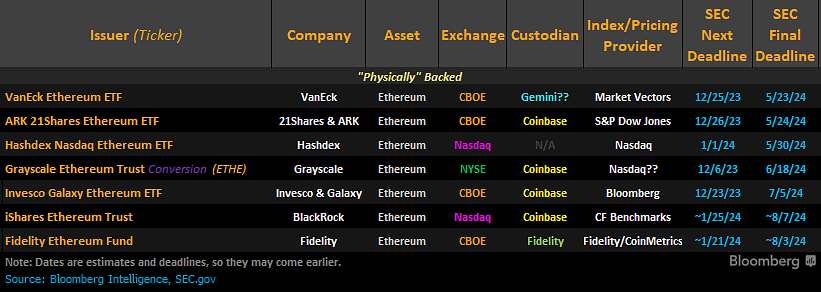
“The Ethereum ETF is likely not to be approved in May,” analyst Michaël van de Poppe also commented today. However, in his opinion, the markets are undervaluing a possible approval in August . In that month, the review of the proposal from BlackRock, the company with the most assets under management in the world, expires.
Even if VanEck's proposal does not get the green light from the SEC, it could later authorize those of other companies. “I think the chances of approval in August are positive, so I expect Ethereum to outperform,” van de Poppe said.
Both bitcoin and ether (ETH), Ethereum 's cryptocurrency , show similar performance so far in 2024, with an increase of around 35%. However, in the long term, they mark a stark contrast. The first is trading at USD 59,000, 19% below the all-time high recorded almost two months ago, while the second is at USD 2,900, which is 38% below its record recorded in 2021.
On the other hand, according to exchange-traded fund analyst James Seyffart, there is a 25% chance of approval. The reason is that the SEC does not show commitment to issuers on the details of the products unlike it did with bitcoin.
The US regulator approved bitcoin ETFs in January on the final date on which the first proposal expired. This came after years of rejections, raising hopes among some that it will do the same this month for ether.
Approval of Ethereum ETFs could trigger an altseason
Trading specialists like Karan Singh Arora have expressed hope for approval given SEC review delays, issuer amendments and the recent inclusion of Ethereum ETFs in the DTCC. The latter is an entity that provides clearing and settlement services for operations with financial securities to guarantee their effectiveness.
Being listed on the DTCC is a preparatory step that allows ETF issuers to be ready to begin operations once they are approved. However, this move does not mean that they will be authorized.
“Once the ether ETF is approved, we will possibly see a massive altseason!” said Karan Singh Arora. With this, he referred to a season in which altcoins show higher returns than bitcoin.
Historically, an altseason has occurred due to an increase in demand for bitcoin followed by that of ether, something that has begun to be seen this week.
This panorama reflects the coexistence of diverse opinions about Ethereum ETFs in the United States, in a week in which these products along with those based on bitcoin were approved in Hong Kong. Therefore, it will be necessary to see if this move by the Chinese financial center influences the SEC's decision.
Regarding the impact on the price, exchange-traded fund analyst Eric Balchunas clarified that, although the inclusion of ETFs in other countries may be a driver, it does not have the magnitude of the US market. Therefore, although the approval of such products in Hong Kong is positive for the ecosystem, their development in the American power is seen as key.






