
The first government in the world to adopt strategic reserves was El Salvador, which has more than 5,800 bitcoins stored. Now, it seems that the world is heading towards a new stage of bitcoin (BTC) adoption, and questions are being raised about the practicality of these strategies.
It is known, for example, that the United States already has reserves of the currency, although Donald Trump promises to further strengthen this government strategy during his term in office. It is also known that Ukraine, the United Kingdom, Georgia and Bhutan have reserves, and that there are proposals to do the same in Surinam, China, and even Venezuela.
Given this international scenario, the question arises: how will countries protect their strategic bitcoin reserves?
Initially, governments and states' transparency about their custody strategies is low, at least as of today. These custody practices may even be, in some cases, unsophisticated, considering that many of the bitcoins held by these entities come from digital asset seizures.
Nations that intend to enter the market by buying bitcoin directly will, on the other hand, scale up their custody methods, since active and planned safekeeping of the currency requires more sophisticated practices.
How does the first country with bitcoin reserves safeguard its currencies?
It is more than a rumor that the bitcoins in El Salvador's possession are held by a third party : BitGo, a North American digital asset security and trust company based in Palo Alto, California.
This entity offers “regulated and qualified” custody, storing its clients’ private keys offline, also called cold storage, in third-degree bank vaults . This company’s custody is done in a multi-party manner with three private keys, all held by BitGo. One of those keys is reserved for emergency recoveries. Together with the client’s private key, both give access to the last key.
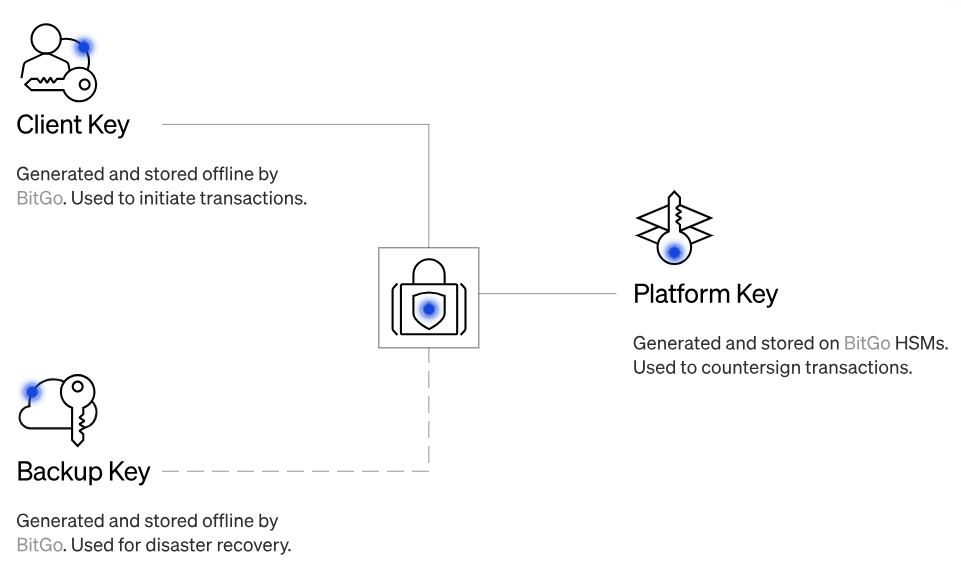 BitGo performs custody with three keys. Source: BitGo
According to the standard operation of BitGo’s escrow process, every time the Bitcoin reserve holder in El Salvador wants to make a transaction of their coins “they must initiate a transaction [using the “client key”] with the BitGo team and pass a series of security checks.”
According to the company, its customers can request withdrawals 24 hours a day, 7 days a week.
Ukraine: A Case of Bitcoin Self-Management in a War Situation
Since the start of the Russian invasion in 2022, Ukraine has been using bitcoin and cryptocurrencies, mainly ether, as a means of receiving donations.
Ukraine's official profile on the X network has revealed its official public addresses for bitcoin (BTC), polkadot (DOT) and ERC-20 tokens on Ethereum to receive contributions.
Today, a block explorer can be used to see how much bitcoin and cryptocurrencies Ukraine owns, as well as the equivalent of its holdings in dollars, at these addresses. It should be noted that this information does not provide any insight into the country's methods of cryptocurrency custody.
However, the contextual conditions of a war make simple and direct methods of self-custody with hardware and hot wallets conducive. A changing war environment, which impacts services such as electricity and the internet, makes self-custody the most suitable means of storing cryptocurrency reserves.
A ceded custody would be overly dependent on communications and their stability, which is why it is unlikely that Ukraine would cede custody of its bitcoins, like El Salvador, to a foreign company.
Other reports indicate that there were a number of addresses associated with volunteer initiatives and other non-governmental organisations to finance the war in Ukraine. Associations such as Come Back Alive work directly with the Ukrainian military.
This suggests that custody of funds could be distributed among several entities or digital wallets, and that the financing of these groups' war could be coordinated, with their funds disseminated and placed at the service of the central government and its strategies.
United Kingdom: A regulatory framework for institutional custody
Although there is no clear information on how the UK government is holding bitcoins, it can be deduced that the security practices employed by the government would follow cutting-edge industry standards, both with the confiscated bitcoins and those hypothetically destined for a strategic reserve. These include institutional custodian services that comply with regulatory compliance.
In this regard, it is likely that the United Kingdom will in the future employ a third-party safeguarding model similar to that of El Salvador, although prioritizing companies on British soil.
This follows from the fact that the UK has been working on establishing a regulatory framework for cryptocurrencies, including custody and exchange. This legal framework contemplates the trading of cryptoassets as a regulated financial activity, which implies that the sector would favour third-party custody, by bodies and entities that are licensed and supervised by the State.
Of course, not all companies offering escrow services will follow the three-key model that BitGo employs. The form and style of escrow of bitcoins will depend on each product and technological solution.
Bhutan: The ideal prospect for self-custody of bitcoin without intermediaries
The case of the state of Bhutan, a country that buys and accumulates bitcoin, is one of the most transparent today in terms of strategic reserves. Even the entity in charge of the coins is known: it is called Druk Holding & Investments (DHI).
The purpose of this entity, which is connected to the Royal Government of Bhutan (which operates as a constitutional monarchy) is to “safeguard and enhance national wealth for all generations of Bhutanese through prudent investments.” DHI has been identified as an entity that has engaged in bitcoin mining and cryptocurrency investment.
 Bhutan is a country that has been mining bitcoin since 2019. Source: Pixabay
DHI is thus Bhutan’s “sovereign investment” arm, and is understood to hold the private keys to the country’s Bitcoin funds. This follows from the bankruptcy proceedings of BlockFi and Celsius, which revealed that DHI held accounts directly with these service providers.
The nature of the transactions they were involved in (deposits, withdrawals, and loans) indicate that DHI was not just a passive client, but directly managed its digital assets from other wallets external to the platforms. According to Forbes, DHI has been mining bitcoin since 2019, when the currency was trading around $5,000. Bitcoin mining requires a high level of technical expertise, meaning Bhutan is a clear prospect for self-custody without intermediaries for Bitcoin.
United States: Bitcoin is better off in the hands of “professionals”
Currently, the handling of confiscated bitcoin in the United States falls to several official entities. In principle, the country relies on the participation of the Department of Justice (DOJ), specifically the MIMF division, in charge of prosecuting cases of fraud and market manipulation related to cryptocurrencies. If the United States were to decide to buy bitcoin for a strategic reserve, as Donald Trump promised, the Treasury Office would probably be the supervisory entity.
However, the day-to-day management and custody of such assets would likely be outsourced to professional custodians, following a line of action similar to that of El Salvador and similar to that expected to be followed by the United Kingdom.
Coinbase Custody is the US-based custodian for these services. It operates as a trust entity under New York State banking law and has SOC 1 Type II and SOC 2 Type II audits. Coinbase is currently the custodian of the bitcoins backing 9 of the 12 BTC ETFs on the US financial market.
 Coinbase Custody supports over 30 assets. Source: Coinbase
For Bitcoin ETFs, Coinbase uses segregated accounts. This means that the ETFs’ backed bitcoin is not mixed with other assets held by users of the platform. This is in contrast to custody for retail users, which employs “omnibus accounts” where all funds are combined. Among other security features, Coinbase uses multi-party keys for its wallets, in addition to safeguarding funds using cold (offline) storage. BitGo, the company that safeguards El Salvador's funds, and Anchorage Digital, a platform that offers financial services with cryptocurrencies, are also competing to be guardians of a possible strategic reserve of bitcoin in the United States.






