
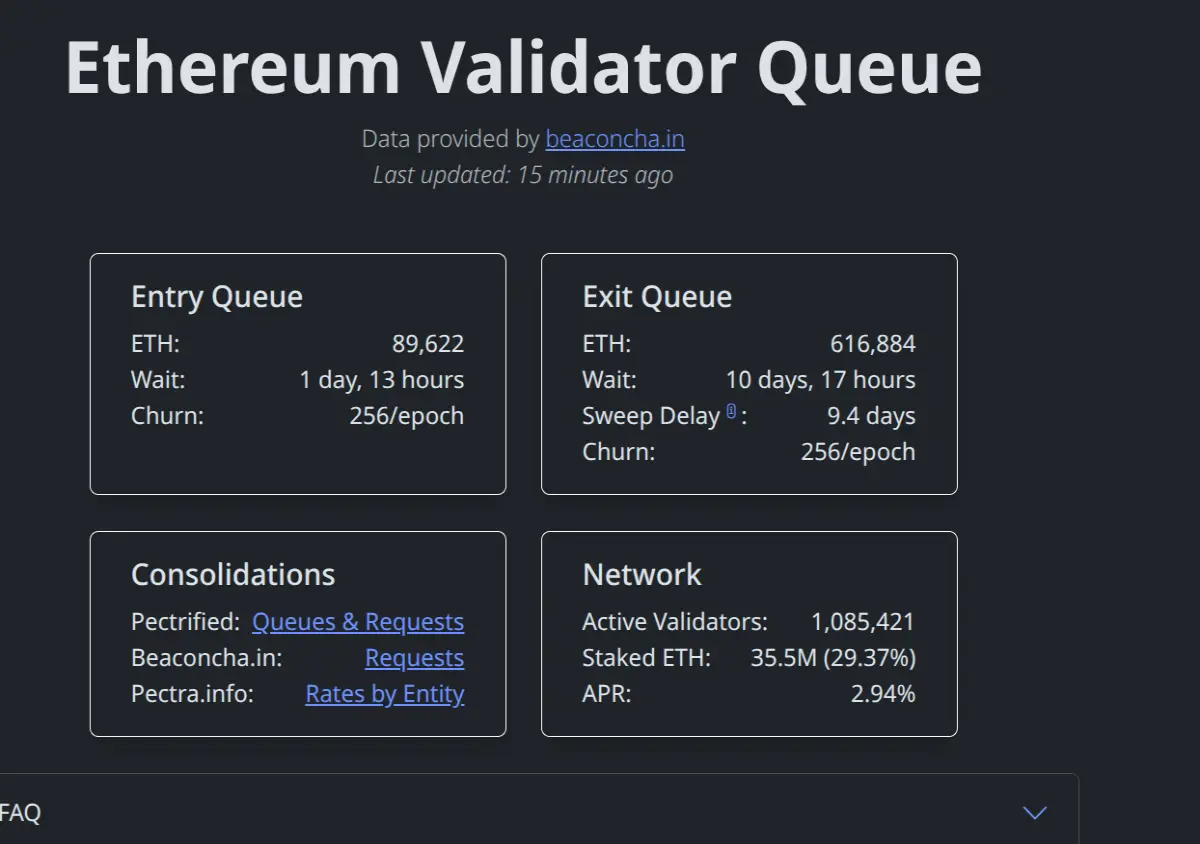
As of August 13, 587,000 Ethereum validators remain in the network's staking exit queue, a figure still close to the all-time high recorded at the end of last July. T the backlog of validators in the queue is due to withdrawal requests initiated in early July, when multiple operators began processing the release of their coins.
Meanwhile, the number of validators seeking to join is around 100,000. This figure reveals a significant asymmetry in the network's validator scaling.
A validator is a node that participates in verifying and confirming transactions through staking ether (ETH). Being "queued out" means that the operator has requested to stop participating in validation and intends to recover their staked funds.
Among the reasons for the exit queue could be profit-taking, given that the price of ETH remains above $4,500. Converting Ether to fiat currencies in this context of the currency's price would be attractive for those seeking liquidity or to close profitable positions.
The queuing mechanism designed into the protocol serves a key purpose: preventing sudden changes in the number of validators that jeopardize network stability. If inputs or outputs were immediate, the infrastructure could face security and performance issues.
Currently, the estimated wait time is 1 day to enter and up to 10 days to exit. Despite the ongoing outflows, Ethereum maintains nearly 1.1 million validators, still close to its all-time high.






