
The acquisition of bitcoin by ETF issuing firms, such as BlackRock and Fidelity, is growing at an excessive rate. The amounts purchased by these firms become more relevant when compared to the bitcoins that are mined daily on the network.
According to a balance of bitcoin inflows by BitMEX, spot bitcoin ETF firms collectively acquire an average of 4,000 BTC per day. Daily, miners only “mine” 900 bitcoins.
According to the data, in 6 of the last 35 days, the amount purchased by the firms has exceeded five digits, that is, 10,000 bitcoin. Between all the firms they would hold more than 144,000 BTC.
The largest share of the total bitcoins in the hands of the firms would be BlackRock, considered the largest investment manager in the world; and Fidelity, which follows closely, exceeding 100,000 BTC each. Other firms, such as Bitwise, Ark and Invesco, accumulate at a slower rate than the previous two, but with intense periodicity.
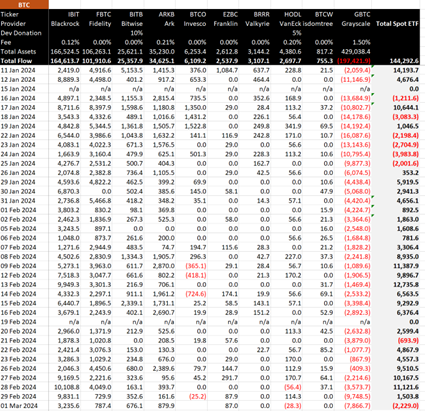
One of the firms, however, acts in complete contrast to the others when it comes to bitcoin. This is Grayscale, the American company, which is selling the asset at a dizzying pace, sometimes faster than the purchasing pace of other companies.
Grayscale's outflow of money from bitcoin would be due to a decrease in demand from its clients. This demand could be affected by the high commissions, of 1.5%, associated with the purchase of each bitcoin ETF for cash.
However, this behavior by Grayscale has not managed to stop the total positive balance for the ETFs. Institutions and the so-called “hard money” would be moving their interest to the ETFs of other firms, some of which have commissions as low as 0.12% or even 0%.
According to basic economic theory, a high demand for an asset combined with a low supply and availability of the asset increases its value. Continued demand of this kind means that, progressively, exchanges will have less bitcoin for sale, and most of them will be sitting still, frozen in private wallets, producing the so-called “ supply shock .”
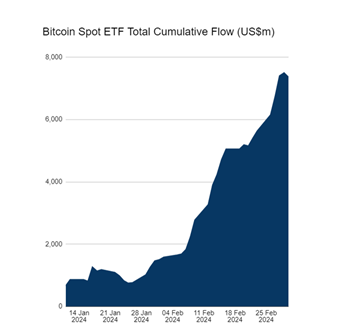
This high demand is expressed in BitMEX data, according to which bitcoin ETFs have seen $7,352.4 million in net inflows since January 11, 2024.
Although for small buyers the scarcity of bitcoin may not be a problem, since there will always be enough bitcoin on the exchanges to buy them at a trickle, for large capitals it would be different.
Some will not be able to buy bitcoin in large quantities if this trend continues, and it would worsen with the arrival of the halving . Once it happens, the issuance will go from the current 900 BTC to around 450.
This value transformation process means that each bitcoin will cost more and more, as each person will be less willing to part with it at a “low” price.
People who buy bitcoin ETFs do not own bitcoin itself, but rather a financial instrument that tracks its price and exhibits similar behavior. If someone buys a share of bitcoin and wants to liquidate it, their profits will be refunded in dollars, not the cryptocurrency. This is by order of the United States Securities and Exchange Commission (SEC).
To issue each of the bitcoin shares, an ETF firm must purchase the asset to back them. That is, it must have enough supply of it to satisfy buyers' demand.






