
Ethereum, the general-purpose decentralized network co-created by Vitalik Buterin, surpassed one million validator nodes.
These nodes are run by people or entities that have deposited 32 ethers (ETH) in the corresponding smart contract and, in addition, run the software that allows validating transactions on the network.
In total, these validators have staked more than 32 million ETH, representing 26% of the issued supply, according to data from Dune Analytics.
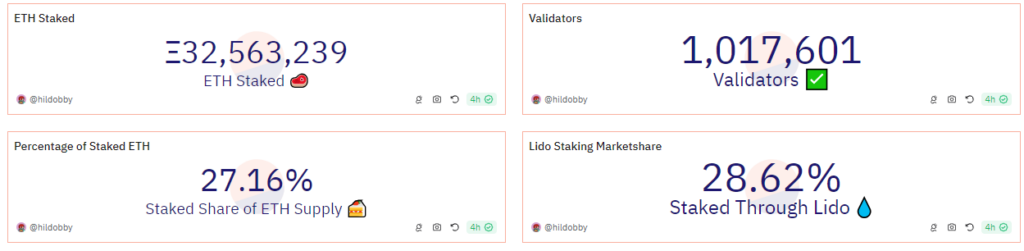
The website beaconcha.in shows a pie chart showing who the Ethereum validators are . Some interesting conclusions can be drawn from there.
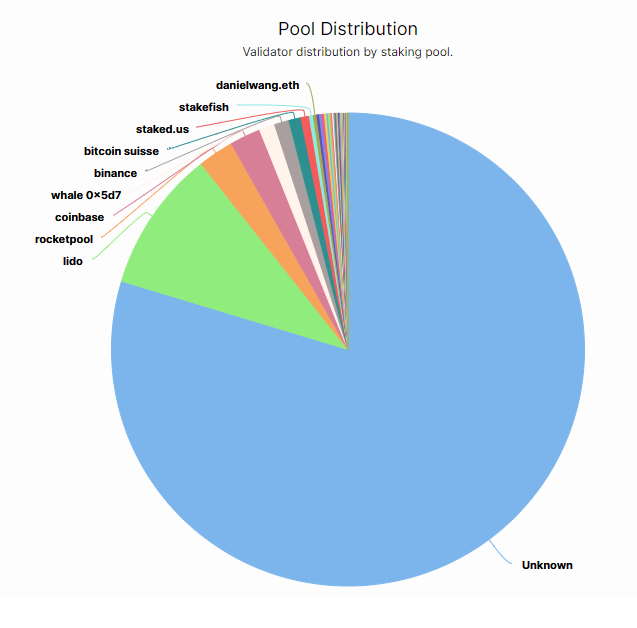
First of all, almost 800,000 nodes are from unidentified validators. These may be people or groups of people (or entities) that provide this service on an individual level. This is a positive sign for the decentralization of the network.
The same does not happen with staking pools. Almost half of this service is provided by Lido, an organization that runs 940,000 validator nodes (9.68% of the total network).
A staking pool is an entity that allows investors to be part of ETH staking, but without the need to have 32 ETH (equivalent to almost $100,000) or run the corresponding software. The pools hoard ETH from investors and run the nodes, then distribute the profits (of course, charging a fee for the service).
High centralization in staking pools is not considered desirable but rather brings some associated risks. For example, a pool that is too large can have a disproportionate influence on governance decisions or protocol changes, which could lead to decisions that favor its own interests rather than the common good of the network.
Another problem associated with the large size of Lido is its operation. Lido is a liquid staking pool, this means that investors can withdraw their investment whenever they want. To make this possible, Lido gives them a synthetic token called stETH, which is like proof of investment. This stETH, which should maintain parity with ETH, can be sold in exchange for ETH or other cryptocurrencies on centralized and decentralized exchanges.
If stETH, for whatever reason, lost parity with ETH, it would be catastrophic. Because stETH is used as collateral in countless DeFi protocols, a domino effect would occur that would result in million-dollar losses. Furthermore, trust in staking pools would be undermined, probably harming the entire Ethereum ecosystem.
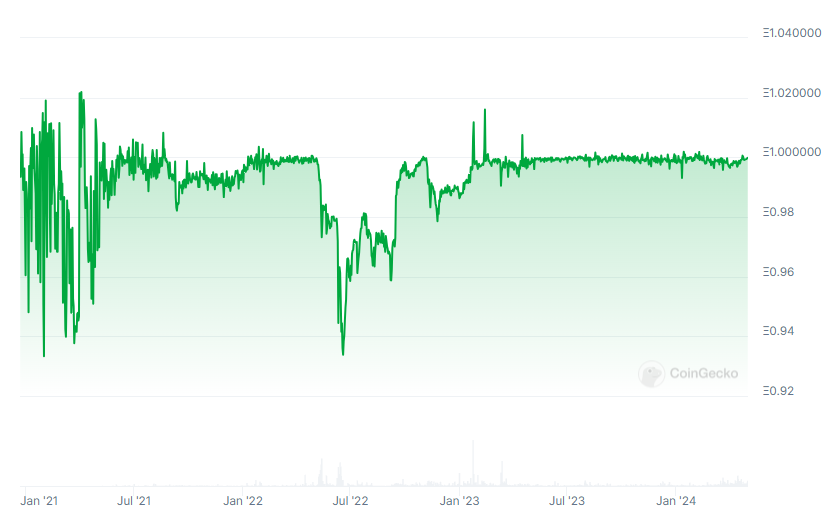
stETH price vs ETH. Source: CoinGecko.
Lido's dominant role among staking pools is not new. The truth is that the Ethereumns seem to have gotten used to living with this gigantic pool between them. At the moment, Lido (which is managed as a DAO), has not given any indication of intending to act maliciously, although the risk exists. And stETH, although it has a slight permanent oscillation (or sometimes not so slight, as seen in the graph above), tends to maintain parity with its underlying asset so far.






