
It's no exaggeration to say that the passage of the National Stablecoin Innovation Guidance and Establishment Act, better known as the GENIUS Act, is capable of igniting the Ethereum network with the same force as a spark ignites a dry forest.
Because if passed, the law could significantly transform the stablecoin landscape in the United States. And in this new scenario, the network created by Vitalik Buterin has a head start: Ethereum is currently the preferred home for these assets and has room to continue adding hosts.
But let's take it step by step, because this scenario is multifaceted. The GENIUS Act seeks to integrate these assets into the traditional US financial system, establishing clear rules for the issuance and operation of stablecoins.
This could translate into greater interoperability, new financial products, and everyday use. Stablecoins, designed to maintain a stable value against currencies like the dollar, play a key role as a link between traditional finance and the digital asset ecosystem. In addition to facilitating daily transactions, they provide liquidity to the market and act as a safe haven during times of high volatility.
This law also seeks to protect users and ensure that each stablecoin is effectively backed to ensure its 1:1 peg with the US dollar. This could increase public and institutional investor confidence, paving the way for mass adoption. The bill was approved in the Senate on June 19 and remains before debate in the House of Representatives.
According to Node Analytica Research, an on-chain data analysis firm, it is estimated that with the passage of the law, “between now and 2030 there will be exponential growth in the volume of stablecoins, multiplying the current amounts by 15, reaching $4 trillion in tokenized money.”
And this is where things get interesting for Ethereum: it could be the big price catalyst its native currency, ether (ETH), is waiting for. A large portion of stablecoin volume already moves within this ecosystem, and a significant percentage of future issuance is expected to be channeled into established networks.
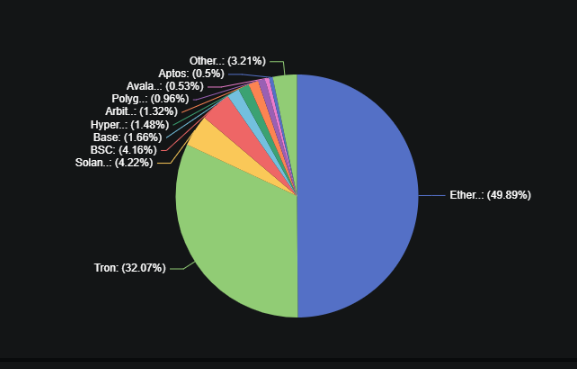
In that area, Ethereum has a stablecoin dominance of 49.89%, which represents a total of $125 billion, as seen in the following graph provided by DeFiLlama:
And if you look at the volume of stablecoins flowing through the Ethereum network, you'll see that these assets have generated fees for the protocol worth more than $1.4 billion over time.
This trend will continue to rise if the GENIUS Act is passed. According to estimates by Node Analytica, "if stablecoin volume were to grow by 1,500%, this would translate into a commensurate increase in gas fees generated by this sector and, therefore, a massive increase in the asset's price." In other words, a higher stablecoin volume translates into more activity within the Ethereum ecosystem, which would imply an increase in ETH used to pay gas fees. This increase in demand will generate upward momentum in ETH's price.
The following graph shows the price of ETH (blue line) and the gas usage of stablecoins on Ethereum:

ETH Gas usage by Ethereum stablecoins (cumulative). Source: Node Analytics.
With this favorable outlook for Ethereum, it's worth asking what happened to those projects that once promised to dethrone it.
What about the “Ethereum killers”?
Before continuing, it's important to clarify that the term Ethereum killers refers to projects like Solana and Cardano, which once promised to dethrone Ethereum in terms of scalability, speed, and cost.
However, beyond some specific advances, for example, Solana's transaction speed, none of these networks has managed to establish an ecosystem comparable to Ethereum's in terms of real-world usage, infrastructure, or institutional adoption. This narrative is not only losing traction on a technical level, but also on a market level. ETH trading volume on Binance has remained stable over the past year, while that of other altcoins has dropped considerably.
Given this scenario, if the GENIUS Act goes into effect, Ethereum stands to be one of the biggest beneficiaries. Its dominant position as the home of major stablecoins, coupled with the potential growth in usage fees, places ETH on the cusp of significant appreciation.
Without a doubt, it could be the catalyst its price needed to break out of its lethargy and head, once again, toward levels close to its all-time highs and, perhaps, set new records.






