
The supply of ETH has been increasing for three months, making the asset inflationary. In principle, this can be considered a negative thing for its market since it implies a greater supply. However, it should be noted that it does not necessarily translate into a price drop.
For context, it is important to know that since Merge (the update that Ethereum had in 2022), the emission of ETH per block was reduced. This allowed the cryptocurrency's burns to exceed the emission during times of high activity on the network, making it deflationary. However, this changed with the Dencun update in March 2024.
The proto-danksharding feature enabled with Dencun reduces transaction fees by optimizing data storage. This, coupled with lower network activity due to the proliferation of second layers and alternative networks such as Solana , led to ETH becoming inflationary again, as seen below.
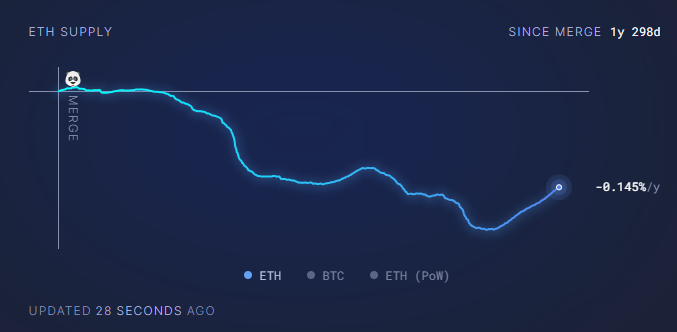 ETH supply since Merge. Source: Ultrasound.money .
According to Kennan Mell, a software engineer and technology investment specialist, there is something key to this scenario that counterbalances supply . “While inflation will dilute investors over time, it will also allow for lower transaction fees,” he noted.
“Lower transaction fees should be a net positive for Ethereum users because they reduce the overall costs of making transfers,” he explained. To clarify, he specified that it makes transferring more cost-effective overall, something that has a particular impact on frequent and low-value transactions.
For the engineer, this factor will lead to increased use of Ethereum, which could lead to higher demand and higher prices for ETH-USD.
In fact, he notes that this is already reflected in the layer 2 networks, Arbitrum and Base, which experienced an increase in transaction volume, as shown in the chart. Based on these metrics, he argues that lower transaction fees on Dencun have already been a net positive for Ethereum users.
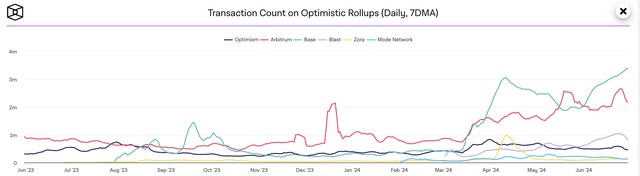 Transactions on Ethereum Layer 2 networks. Source: Seeking Alpha.
In this regard, he argues that “ Ethereum’s recent shift from a deflationary supply to an inflationary supply is a neutral development for investors.” “I remain bullish on Ethereum in the long term,” he added.
Ethereum has less inflation than gold
Mell also points out that . “While Ethereum technically used to be deflationary, it was barely noticeable,” he mentioned. The reason is that the cryptocurrency ’s overall supply has fluctuated less than 1% since the Merge.The current inflation rate of ETH is insignificant from an investment perspective
Since the Dencun upgrade, the Ethereum supply has increased by only 0.1%. The specialist indicated that this is less than 1% annual inflation, which is lower than that of traditional stores of value such as gold and silver . Therefore, he does not believe that this factor should change the long-term outlook.
“ Ethereum’s move from deflation to inflation is an interesting development worth understanding (…). However, in the grand scheme of things, this is a relatively minor development that should not change the long-term outlook for Ethereum bulls.”
Kennan Mell, investment specialist.
Additionally, unlike gold, silver, or even bitcoin(BTC), investors can keep their ETH deposited in to earn a return that offsets inflation.
Ethereum's bullish narrative is not based solely on its deflation
“After Ethereum was traded as a deflationary asset for the past two years, some investors may view the shift to inflation as a failure of their investment thesis,” Mell notes. However, he clarifies that inflationary supply should have little to no impact on the cryptocurrency ’s bullish thesis. .
“Given its relatively stable supply, Ethereum ’s bullish thesis has always revolved more around increased adoption (and perhaps USD weakness) than deflation,” the specialist sums up.
“While Ethereum could become deflationary again in the future if users transact a lot more, it is virtually impossible to predict if or when this will happen,” he added. Therefore, it is crucial to analyze the future of the cryptocurrency from other aspects.
According to his view, bulls should focus their attention on more important developments, such as the new functionality enabled by the Dencun upgrade, plans for similar upgrades in the future, and upcoming Ethereum exchange-traded funds ( ETFs ).
Meanwhile, ETH is underperforming BTC, trading 37% below its 2021 all-time high of $4,900. Bitcoin's price, on the other hand, is 20% below its new record of $73,700 reached in March 2024.






