
Ethereum transaction fees, known as gas fees, have hit record lows over the past five years, dipping to as low as $1.4, according to data from bitinfocharts.com.
While this news may seem favorable for users, who can now make transactions at a lower cost, it reveals a more complex panorama for the Ethereum network and its investors.
The following chart from CryptoQuant shows how transaction fees on Ethereum have decreased since 2021.
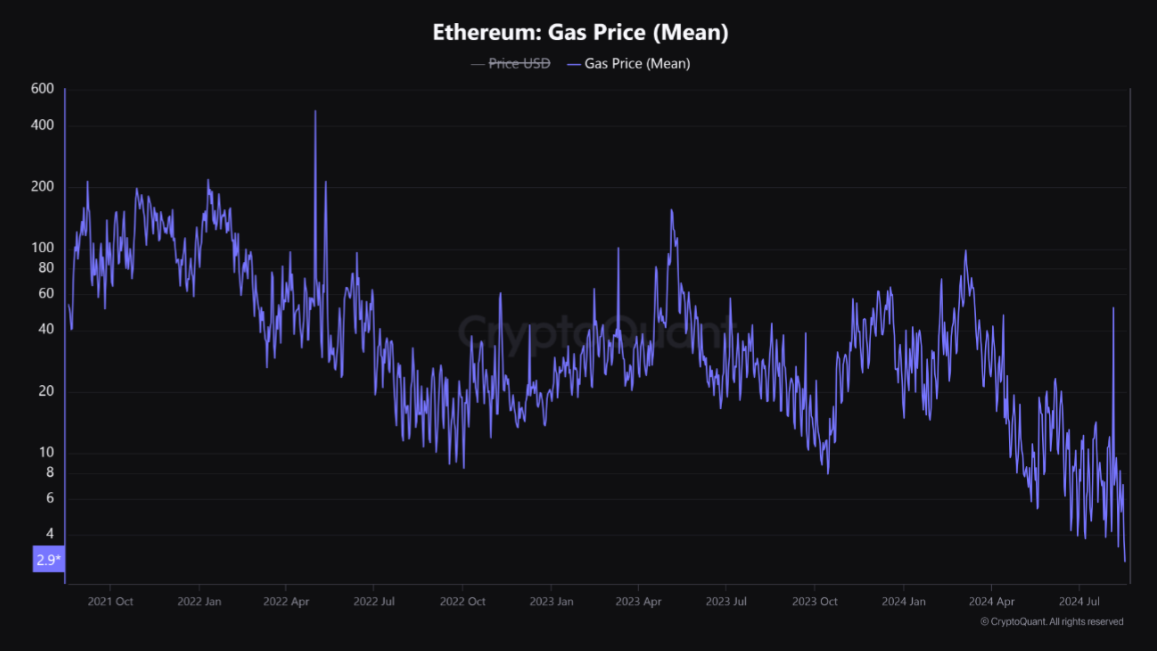 Ethereum fees. Source: CryptoQuant.
Two key factors explain this reduction in rates: low network activity and the Dencun update.
1) Low network activity
The decrease in activity on the Ethereum network is a major factor in the reduction in gas fees. This low activity is largely due to the migration of users to layer 2 networks, such as Arbitrum, Optimism, and Base, which offer transactions at a much lower cost.
At the same time, Ethereum also faces increasing competition from other networks such as Solana, which have attracted a significant share of transaction volume and users, thanks to the rise of decentralized exchanges (DEX) and memecoin trading on its platform.
This migration, both to Ethereum 's layer 2 networks and to other networks such as Solana, has reduced the demand on the Ethereum base layer, resulting in lower gas fees.
2) Dencun Update
The Dencun upgrade, implemented in March 2024, has significantly contributed to the reduction of transaction fees. This upgrade introduced improvements to network efficiency, including a new data organization mechanism called “blobs,” which optimizes the use of space in Ethereum blocks.
These improvements have not only enabled greater efficiency on the mainnet, but have also made it easier for layer 2 networks to publish their data on Ethereum with a significant reduction in fees, potentially up to 100%.
Research firm Kaiko noted that this upgrade has significantly reduced transaction fees on the Ethereum mainnet, directly impacting the cost of commissions.
Consequences of falling fees: Ethereum becomes inflationary
The reduction in fees has direct implications for the price of ETH and its inflationary nature.
By lowering fees, the amount of ETH being burned is also reduced (thanks to EIP-1559 implemented in 2021), which in turn increases the total supply of the cryptocurrency. Since the implementation of Dencun, the issuance of ETH has exceeded the amount destroyed, increasing the cryptocurrency's circulation.
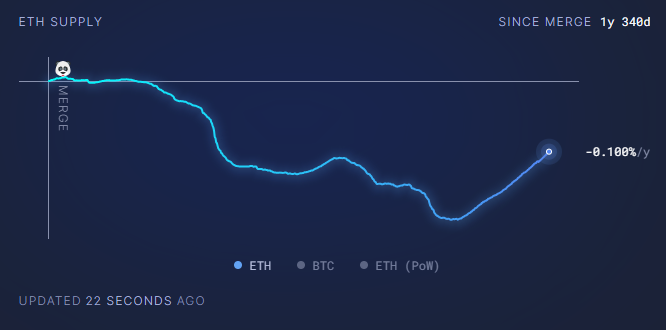 ETH circulation has been steadily increasing since April 2024. Source: ultrasound.money
This increase in supply, while relatively slight, is combined with stagnant or declining demand for ETH (due to migration to other networks and the use of rollups), which can result in downward pressure on the price of the cryptocurrency.
Despite increased demand following the approval of Ethereum spot ETFs in the United States last May, the cryptocurrency has struggled to maintain its value, falling 35% over the past five months.
On the other hand, Solana, one of Ethereum's main rivals, has seen a significant increase in trading volumes, which rose from $1.075 billion to $4.4 billion in the last week, according to data from DefiLlama.
This increase is due, in part, to the growing trading of memecoins and the rise of decentralized exchanges (DEX) on the Solana network. In addition, the native cryptocurrency solana (SOL) has shown signs of strength. At the beginning of August, it reached a new all-time high in its parity with ETH, breaking through the resistance of 0.057 ETH and reaching 0.061 ETH.






