
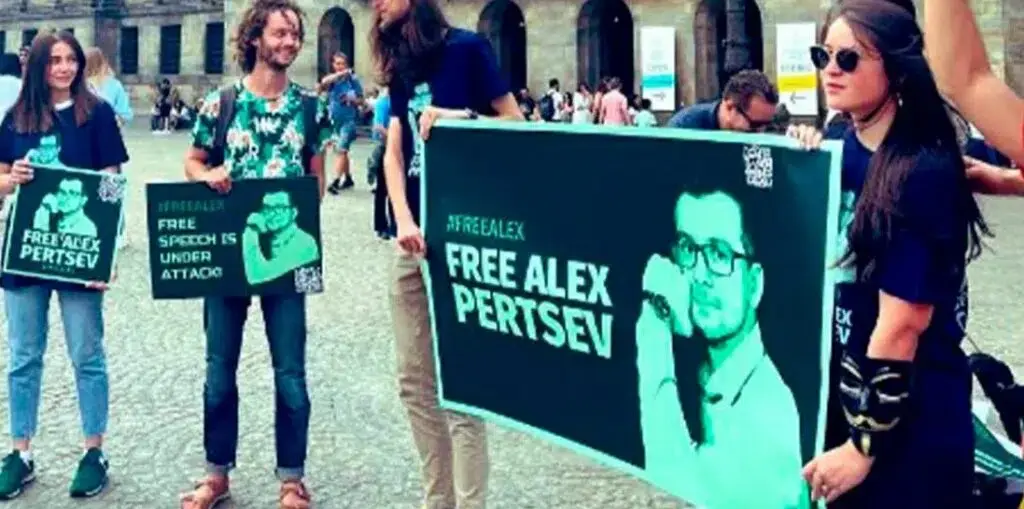
Alexey Pertsev, one of the developers of the Ethereum network transaction mixer Tornado Cash, was found guilty of the crime of money laundering and sentenced to more than 5 years in prison in the Netherlands, as ordered this Tuesday by the Oost court -Brabant.
In the hearing held today, May 14, the authorities of that country ordered that Pertsev, a 31-year-old Russian developer who fought against surveillance of the cryptocurrency ecosystem, spend 5 years and 4 months in prison. It is the same sentence suggested by the Netherlands Public Prosecutor's Office, as seen in the verdict.
The sentence, it is worth clarifying, establishes the deduction of the preventive detention that Pertsev has already undergone since August 12, 2022, when he was arrested by the Dutch Tax Information and Investigation Service (FIOD), an agency responsible for investigating financial crimes in the Netherlands.
Something that the court highlights is that the house arrest to which Pertsev had been subjected since April 2023 is cancelled. According to what is seen in the judicial documentation, the execution of the custodial sentence “will be carried out entirely within the penitentiary center ”. This, until the moment the accused is granted conditional release.
In this way, Pertsev will return to prison after more than a year of being arrested on his property, with an ankle monitor and the impossibility of leaving.
According to the court, a total of $2.2 billion was laundered through Tornado Cash and using ether. They indicate that this money comes from several dozen different hacks, committed since 2019. Although the court did not rule out that more cryptocurrencies have been laundered as a result of more crimes or thefts.
A Solution for Privacy
Pertsev indicated during the hearing that his intention in developing Tornado Cash was never to break the law or facilitate criminal activity through that channel. He assured that his goal was to offer a legitimate solution “for the growing need for privacy in the cryptocurrency community.”
In his opinion, it is up to users not to abuse Tornado Cash as it is simply a tool. He further alleges that it was impossible for him to prevent the platform from being used for illicit purposes, due to Tornado Cash's technical specifications.
It must be remembered that Tornado Cash worked through smart contracts, which were immutable, which prevented even the protocol developers themselves from adding, removing or modifying any specifications.
However, the Oost-Brabant court disagreed with Alexey Pertsev's allegations. The verdict establishes that Tornado Cash was the entity that carried out the activities of concealment and obfuscation of transactions, through its mixing service.
Likewise, the court asserted that Tornado Cash is a tool that “is adapted to criminal use.” This is because it “combines maximum anonymity and optimal concealment techniques with a serious lack of functionalities that make identification, control or investigation possible.”
The court argues that Tornado Cash carried out money laundering activities by obfuscating cryptocurrency transactions derived from the crime. Thus, the judicial entity points out that this mixer “is not just an instrument for users.”
Tornado Cash works the same way its founders intended. Therefore, the operation is entirely your responsibility,” the court says. “If the accused had wanted to be able to take measures against the abuse, then he should have incorporated them. But he didn't do it,” he added.
“The defendant and his co-authors developed the tool in such a way that it automatically performs the concealment acts necessary for money laundering,” the court insisted.
On the other hand, the court considered that Alexey Pertsev created a “shortcut” for terrorist financing. “Under the pretext of an ideology, he did not care about the laws or regulations and he felt untouchable,” the entity notes.
The Beginning of the Regulatory Crusade
Tornado Cash was created by Pertsev, Roman Storm and Roman Semenov in 2019. The first two are being prosecuted by the authorities of the Netherlands and the United States since 2022, respectively. Semenov, on the other hand, has not been arrested, although there is an arrest warrant for him for the same crime.
The arrest of the co-founders of Tornado Cash follows the action of the Office of Foreign Assets Control (OFAC) of the United States Department of the Treasury, to add that company to its list of sanctioned subjects and companies.
This was the beginning of a series of actions by the US government against the privacy of the cryptocurrency ecosystem. A pattern that was later replicated in Europe, where the authorities of that country began to accuse developers and privacy advocates.
The moves of the US government have extended for more than two years, with 2024 being one of the most memorable due to the series of recent events, in which that State took actions against the right to privacy of users , as enthusiasts of the bitcoin (BTC) ecosystem have expressed.
Last April, for example, the US government arrested other developers who, like Tornado Cash, defend people's privacy. This involved the arrest and accusation against the founders of the BTC Samourai Wallet, a platform that also allows the obfuscation of transactions.
Programmers Keonne Rodríguez and William Lonergan Hill were accused by US authorities of promoting money laundering through their platform, as well as running an unregistered money transmission company. Rodríguez was released on bail on April 30. He had to pay USD 1 million to be released.
In a similar line of events, a US court sentenced Changpeng Zhao, former CEO of the largest bitcoin and cryptocurrency exchange on the market, Binance, to four months in prison .
As with the developers, this businessman was accused of promoting money laundering. For this reason he will have to spend 120 days behind bars. A fairly low penalty compared to that suggested by the US government, in part, due to Zhao's cooperation and good disposition.






