
BlackRock has consolidated its dominance in the cryptocurrency ETF market, surpassing Grayscale in holdings of bitcoin (BTC) and ether (ETH), Ethereum's currency, for the first time.
BlackRock-managed iShares Bitcoin Trust (IBIT) and iShares Ethereum Trust ETF (ETHA) now hold more on-chain assets than any other similar fund, displacing Grayscale from its historical leadership position, according to data from analytics platform Arkham Intelligence.
At the time of writing, BlackRock ETFs collectively hold $21.217 billion, slightly outpacing Grayscale’s $21.202 billion.
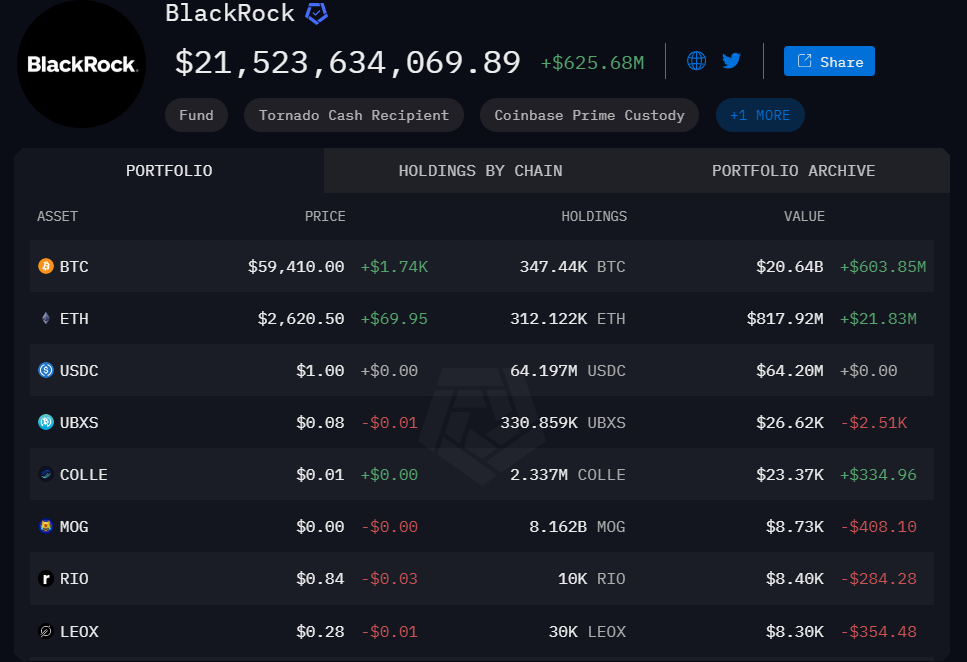
Cryptocurrency holdings in BlackRock wallets. Source: Arkham Intelligence.
The move comes amid continued capital outflows from Grayscale's funds, which have seen their market leadership erode.
Even though Grayscale continues to show a higher balance thanks to its Grayscale Digital Large Cap Fund (GDLC), with around $460 million in assets under management, the majority of its funds, including its bitcoin and Ethereum ETFs, have seen a significant reduction in their holdings.
BlackRock's dominance in the ETF market was consolidated in May, when its iShares Bitcoin Trust (IBIT) fund became the largest spot bitcoin ETF in the world.
It currently has 348,609 BTC under management since its launch on January 10, as listed on BlackRock's website.
This milestone allowed BlackRock to overtake the Grayscale Bitcoin Trust (GBTC), which previously held the top spot with 619,000 BTC.
However, since then, GBTC has seen a steady decline, reducing its holdings to 230,878 BTC , representing a 62.7% drop since January, as seen in the chart below from Coinglass.
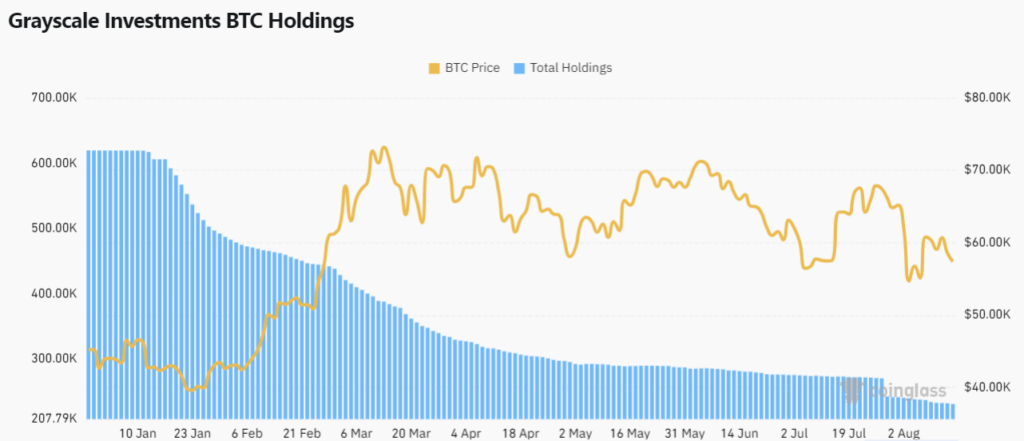 BTC outflows from Grayscale ETF. Source: Coinglass.
Regarding the flow data from yesterday, August 15, they indicate that GBTC registered capital outflows of 25 million dollars, while IBIT did not present net inflows or outflows, as reported by Soso Value.
Meanwhile, the Grayscale-managed Ethereum ETF (ETHE), which follows a similar trend to GBTC, also saw net outflows of $42 million, as reported by SosoValue.
The negative performance of Grayscale funds is attributable to the high fees it charges. These fees, which include management, brokerage and administrative services, are the highest in the market, which has contributed to the exodus of capital towards more competitive options, such as those offered by BlackRock.





