
Ki Young Ju, the CEO and founder of CryptoQuant, shared a gloomy forecast for the price of Bitcoin (BTC).
“The bullish cycle is over,” he declared in a post on his personal X account. Its projection is based on on-chain data, specifically the behavior of realized capitalization, an indicator that estimates how much capital has actually entered the market.
“When BTC enters a wallet, it's considered a purchase, and when it leaves, it's considered a sale. With this in mind, we can estimate the average cost of each wallet. Multiply this value by the amount of BTC stored, and you'll get the total Realized Capitalization. This is typically considered the total capital that has entered the Bitcoin market through actual on-chain activity,” he emphasized.
Here, it's important to differentiate between market capitalization. Ju said, "Many people misunderstand this concept. When someone buys just $10 worth of BTC, the market capitalization doesn't increase by just $10. Instead, prices are determined by the balance between buying and selling pressure on the order book."
In other words, BTC's market cap does not reflect the amount of money that has entered the market, but is instead derived by multiplying the most recent price by the total number of coins in circulation.
Using Ju's example, if someone buys BTC at a higher price than the previous one, that new price is used as a reference to calculate market capitalization. This doesn't mean that millions of dollars have flowed into Bitcoin, but rather that the price of the coins has changed based on that last transaction.
To reinforce his thesis, Ju noted that “when selling pressure is low, even a small purchase can push the price—and therefore the market cap—significantly higher.” However, he clarified: “When selling pressure is high, even large purchases fail to move the price. There are simply too many sellers. For example, when Bitcoin was trading near $100,000, the market saw massive volumes, but the price barely moved.”
For this reason, he suggested that if realized capitalization grows, but market capitalization stagnates or declines, it's a sign that "capital is coming in, but prices aren't rising—a classic bearish signal." He further explained:
“If realized capitalization remains stable while market capitalization increases, it suggests that even a small amount of new capital is driving prices higher—a bullish sign. Currently, we're seeing capital entering the market, but prices aren't responding. This is typical of a bear market.”
Ki Young Ju, the CEO and founder of CryptoQuant.
This analysis highlights the key difference between market capitalization and realized capitalization. His analysis is accompanied by a chart comparing BTC's market capitalization with the bull market and bear market phases, highlighted with green and red areas, respectively.
The chart shows that, although market capitalization remains high, there is a small red area at the bottom of the chart, which would indicate that the market is entering or continuing a bearish phase.
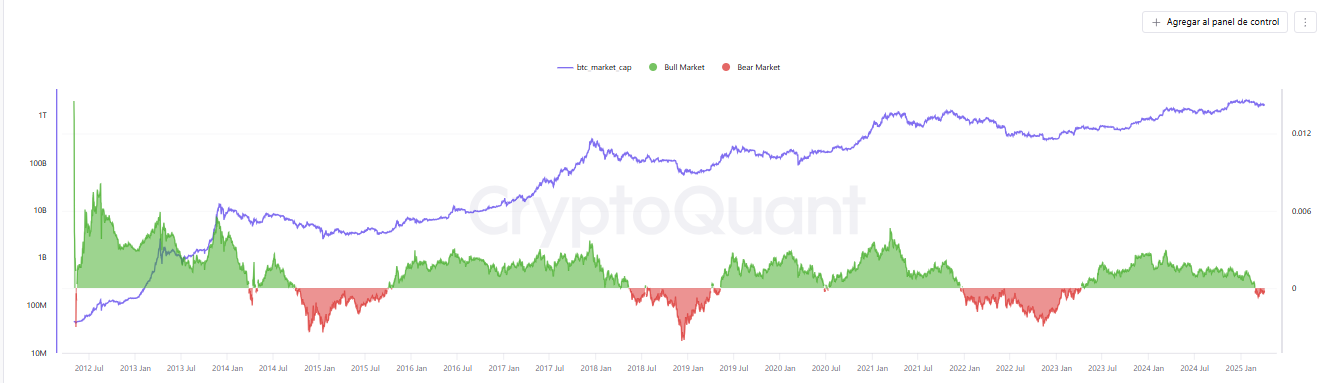 Bitcoin's market capitalization remains high, but its price isn't reflecting this. Source: CryptoQuant.
Finally, Ju stated: “Selling pressure could ease at any time, but historically, real reversals take at least six months, so a short-term rally seems unlikely.”
When the specialist mentions that "real reversals take at least six months," he means that the market needs time to emerge from a bearish phase and resume a solid bullish trend. This doesn't necessarily imply a new crypto winter, but rather a pause or consolidation within the cycle.
This analysis comes at a difficult time for the digital asset market, which is reeling from the announcements made by US President Donald Trump during the "Liberation Day" campaign.
The price of Bitcoinat the time of writing is $79535.31 27% below its all-time high (ATH) of $109,110. On April 2, the president announced reciprocal tariffs for several countries, including China and the European Union. The news had an immediate impact on the price of digital assets. Evidence of this is that 90 of the top 100 cryptocurrencies by market capitalization turned red.
This is because most investors consider BTC and cryptocurrencies to be risky assets. For this reason, in contexts of economic uncertainty and political tensions, they tend to shift their holdings toward instruments less exposed to market volatility, such as Treasury bonds.






