
Eli Ben Sasson, CEO of StarkWare, the company behind StarkNet, an Ethereum layer-2 network, has said that a major upgrade to the Bitcoin (BTC) network could be implemented within the next year. It is the instruction called OP_CAT (operation code concatenation).
The executive explained yesterday, November 14, 2024, in statements to a media outlet, that the activation of OP_CAT would open the door to new capabilities in Bitcoin, such as covenants, ZK-rollups, and layer 2 solutions.
OP_CAT is used to concatenate two items in the script data stack. In other words, it takes two items and joins them into one. This operation can be useful for creating more complex and flexible scripts.
This is not the first time that Ben Sasson has expressed his opinion on this update, as in June 2024 he had expressed his support for the proposed Bitcoin update.
The developers behind OP_CAT, who submitted a Bitcoin Improvement Proposal (BIP) for a new version of the code, are Ethan Heilman and Armin Sabouri via a soft fork . OP_CAT already has its assigned BIP, BIP-0347. A soft fork is a protocol update that does not invalidate the old code. It is best thought of as a protocol update that introduces new elements to its core programming.
Developers discuss OP_CAT
Meanwhile, OP_CAT is at a point of discussion by the community and other developers.
Several developers have added their support for this update. This is the case of Tadge Dryja, one of the authors of the Lightning Network whitepaper; Olaoluwa Osuntokun, co-founder of Lightning Labs; and Andrew Poelstra, Blockstream's Research Director and Bitcoin crypto script developer.
In contrast, other developers have expressed a more distant stance towards OP_CAT.
For example, Luke Dashjr, who claimed not to know enough to comment, but did allude to OP_CAT by comparing it to his disagreement with the imposition of Ordinals: “building on Bitcoin is fine. Attacking Bitcoin (for Ordinals) is not.”
Additionally, Dashjr expressed in February 2024 that “I doubt OP_CAT will be implemented anytime soon.”
Other developers argue that the inclusion of OP_CAT could complicate code management and increase the risk to network security. This concern is an important aspect of the debate surrounding this Bitcoin upgrade.
Meanwhile, some users in the Bitcoin community responded in OP_CAT-related posts with greater skepticism. Among those comments are comments such as “keep your shitcoins off my blockchain.”
What is OP_CAT?
In the context of Bitcoin, the OP_CAT opcode is an instruction in Bitcoin programming that allows a specific operation to be performed, in this case, joining two elements of the bitcoin stack into one, which gives flexibility to the creation of scripts .
OP_CAT was originally included in the Bitcoin instruction set, but was disabled by Satoshi Nakamoto in 2010 due to security concerns over the risk of denial of service ( DoS ) attacks.
A denial of service attack typically seeks to disrupt the normal operation of the network or specific nodes in order to slow it down and increase transaction fees due to congestion.
The reason OP_CAT is said to be an opcode is because it is part of the set of instructions that the Bitcoin scripting language (Bitcoin Script) can execute. Each opcode has a specific function and OP_CAT is simply one of these opcodes that, if reintroduced, would expand the capabilities of scripting on and the possible uses of the Bitcoin network.
Other opcodes in Bitcoin include OP_DUP, OP_CHECKSIG, and OP_EQUALVERIFY. Their functions are based on duplicating the top element of the stack to verify a cryptographic signature and corroborating that the top two elements of the stack are equal and then removing them, respectively.
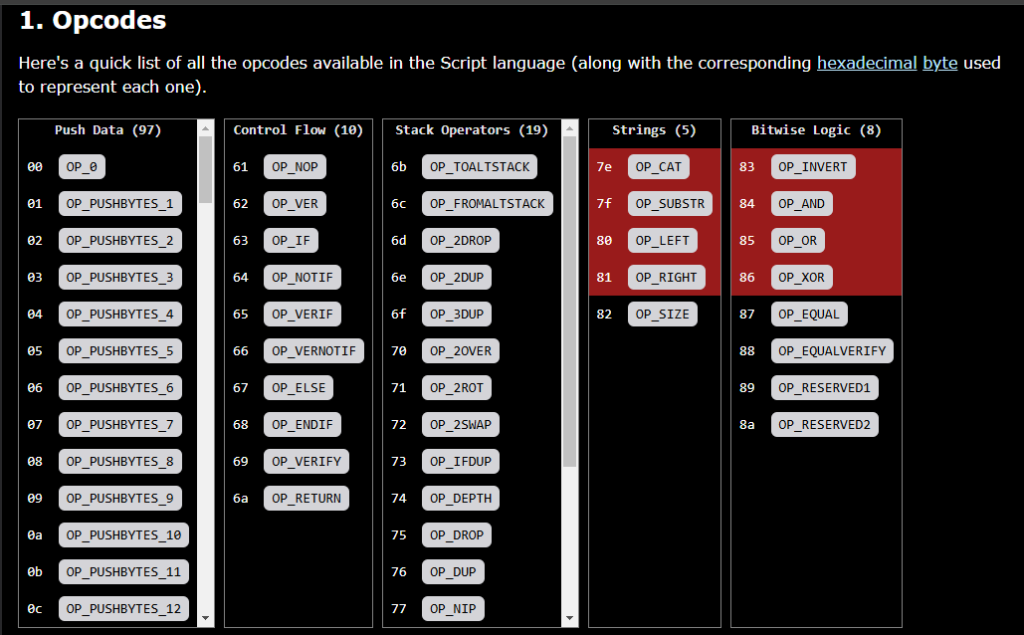 OP_CAT is just one of the bitcoin scripts that exist and will exist. Source: Learn me a bitcoin
Technical implications of OP_CAT on Bitcoin
The reactivation of the OP_CAT opcode could mark a turning point in Bitcoin's technical functionality.
OP_CAT allows concatenation of elements in the data stack. The data stack (also called bitcoin stacks) is a structure where elements are stacked on top of each other and can be added or removed.
This means that this concatenation would open the possibility of implementing more complex structures and applications within the protocol.
Potential technical implications include those mentioned by Ben Sasson, such as covenants and the introduction of ZK-rollups, among others.
What are covenants and what improvements would they bring to Bitcoin?
Covenants in Bitcoin are a proposal to introduce additional restrictions on how and where Bitcoin coins can be spent on its network.
A covenant allows a Bitcoin script to impose conditions on future transactions of a specific currency (similar to smart contracts in Ethereum, which trigger transactions if certain conditions are met, although the latter are more complex).
For example, covenants can limit the addresses to which coins can be sent.
In practice this would mean that a coin could be restricted to be sent only to a predefined list of addresses (or whitelist). This is a useful way to restrict recipients of cryptocurrency from an account, which prevents loss of funds in case of hacks.
Smart contracts on Bitcoin could expand the network's utility
On the other hand, OP_CAT would enable the creation of more complex smart contracts, which would extend the scope of possible applications on the Bitcoin network. This would include state contracts, advanced payment functionalities, and the use of oracles.
Including state contracts in Bitcoin using OP_CAT means enabling advanced functionality that would allow smart contracts to maintain and update a persistent state between multiple transactions.
This represents a significant extension of Bitcoin's current scripting model, which is designed to be more static and based on fixed conditions for spending funds.
The possibility of developing advanced smart contracts and more efficient solutions could attract companies and developers to the Bitcoin ecosystem, encouraging its adoption in the enterprise sector.
In short, Bitcoin would be more like more “modern” payment gateways and systems characterized by efficiency and speed, although not necessarily by decentralization and lack of trust.
It could also diversify the range of possible applications, expanding Bitcoin's use cases beyond being a payments network, a store of value, or a unit of exchange, allowing the development of applications with other uses.
OP_CAT and Zero-Knowledge Proofs in Bitcoin
In addition, the OP_CAT opcode could implement ZK (Zero Knowledge ) proofs in Bitcoin.
ZK proofs are a cryptographic technology that allows one party to prove to another that a statement is true without revealing any additional information. This mechanism would improve users' privacy by hiding specific details of each transaction in the aggregated data.
In the Autonomous City of Buenos Aires, the federal capital of Argentina, a project was implemented that seeks to give citizens direct ownership of their personal information through zero-knowledge proofs
In Bitcoin, this technology would also allow a large volume of transactions to be aggregated into a single verifiable cryptographic test, scaling the network's capacity to thousands of transactions per second by reducing the information that needs to be recorded directly on the main network.
In other words, the implementation of ZK proofs would aim to decrease network congestion and reduce transaction fees.
Thus, the implementation of ZK-Rollups could consolidate Bitcoin as a competitor against other networks with greater transaction capacity, such as Solana (SOL) or Ethereum, for example.
The Bitcoin network currently processes an average of 6 or 7 transactions per second (TPS), according to data from BitInfoCharts.
In short, the implementation of OP_CAT in Bitcoin would represent an opportunity to take the network to a new level of functionality and scalability. However, it is worth remembering that Satoshi Nakamoto, the most knowledgeable person on the Bitcoin protocol, removed this OP_CAT integration due to possible risks.
As such, its activation requires a careful approach to mitigate risks and ensure that the benefits outweigh the costs. This proposal, while technically promising and looking closer than ever to 2025, will depend on community consensus and a gradual implementation that prioritizes security and decentralization.






