
A recent analysis by research firm Alphractal has revealed that transaction fees on the Bitcoin network have reached unusually low levels, even as the cryptocurrency price surpasses $107,000.
According to the data shared, both total fees and the average per transaction, measured in dollars, are at historic lows, with costs not exceeding $ 1.5 per operation, regardless of the amount transferred. For Alphractal, these metrics reflect a significant change in user behavior: interest in using the Bitcoin main network has decreased notably, suggesting a transformation in the function of the currency, increasingly oriented towards being a store of value asset and less towards everyday transactions.
As a direct look at the Bitcoin mempool at the time of writing shows, low-priority transactions on the network are paying only 3 sat/vB, while high-priority transactions are paying 4 sat/vB. These figures, expressed in satoshis per byte, are equivalent to USD 0.46 and USD 0.61, and reinforce Alphractal 's argument about inactivity on the Bitcoin mainnet.
The metrics presented by Alphractal cover several key indicators of the Bitcoin network. The first, average transaction fees in dollars, shows historical spikes during periods of high activity, such as between 2017 and 2021, or even in 2024, when costs skyrocketed during times of network congestion, coinciding with significant increases in the price of Bitcoin. However, despite the recent price increase, current fees remain at extremely low levels, a phenomenon that Alphractal attributes to a decrease in mainnet usage.
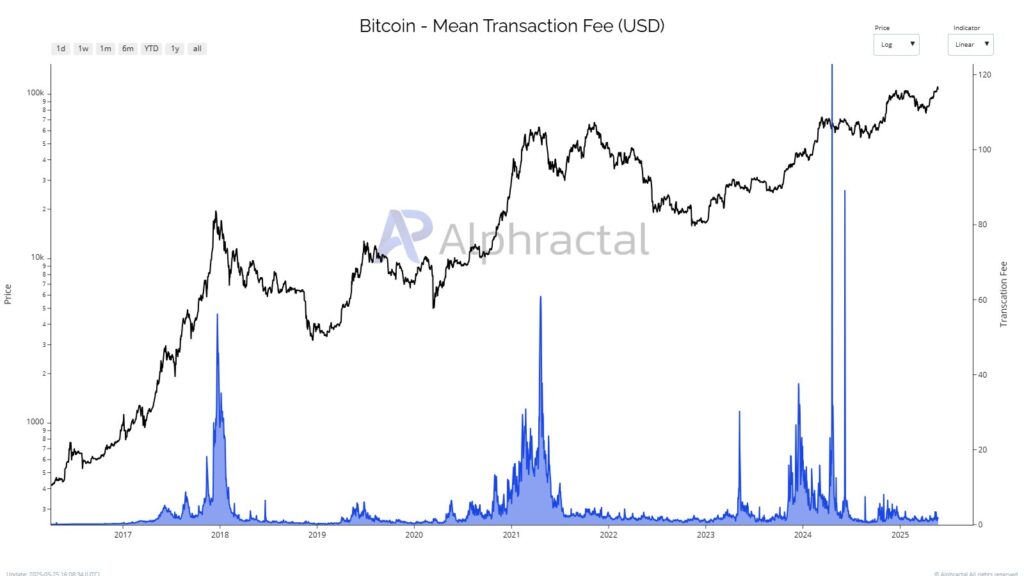 Bitcoin fees remain low. Source: Alphractal
Another relevant indicator is the transaction volume in the mempool, the space where transactions wait to be confirmed. This indicator also shows a drastic reduction, indicating that fewer users are interacting directly with the Bitcoin network for transfers or payments.
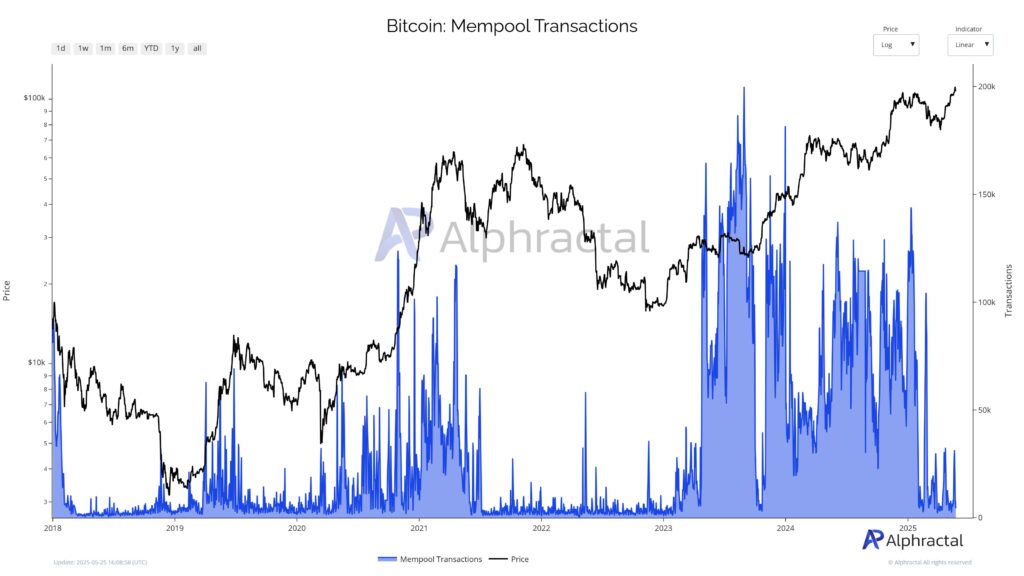 The Bitcoin mempool is decongested. Source: Alphractal
Finally, the adoption of SegWit, a technical improvement that optimizes transactions, although present, does not appear to be driving an increase in network usage, reinforcing the idea that activity on Bitcoin is in decline.
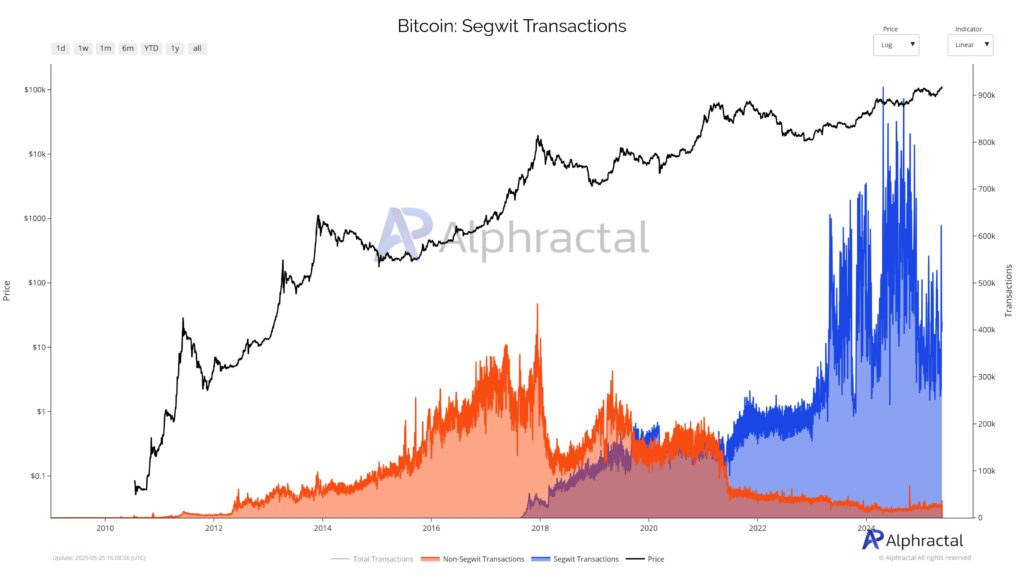 SegWit transactions show similar signs to other metrics. Source: Alphractal
This low level of activity is not limited to the Bitcoin mainnet, but is also reflected in the Lightning Network, a second-layer solution designed to facilitate fast and cheap transactions.
According to Alphractal, transactions on this network are also declining, signaling a general decline in the use of Bitcoin for peer-to-peer (P2P) payments and transfers. The analysis firm points out that this phenomenon may be related to a mass migration towards centralized exchanges and alternative networks such as TRON (TRX) , which offer transfers with minimal costs for stablecoins such as USDT.
This shift in user behavior, according to the analysis, indicates that Bitcoin is consolidating as a store of value, while transactional needs are shifting toward other technological solutions.






