
A solo Bitcoin miner found the winning nonce that allowed him to solve block 910440, mined on August 17. The discovery occurred on the Solo CKpool server and earned him a total reward of over $370,000.
The block registered a fee range between 0.00 and 301 satoshis per vByte (virtual byte). The total collected in transaction fees reached 0.012 BTC, approximately $1,454 at the market price at the time.
The block subsidy (the fixed reward that the Bitcoin protocol delivers for each block solved) was 3,125 BTC.
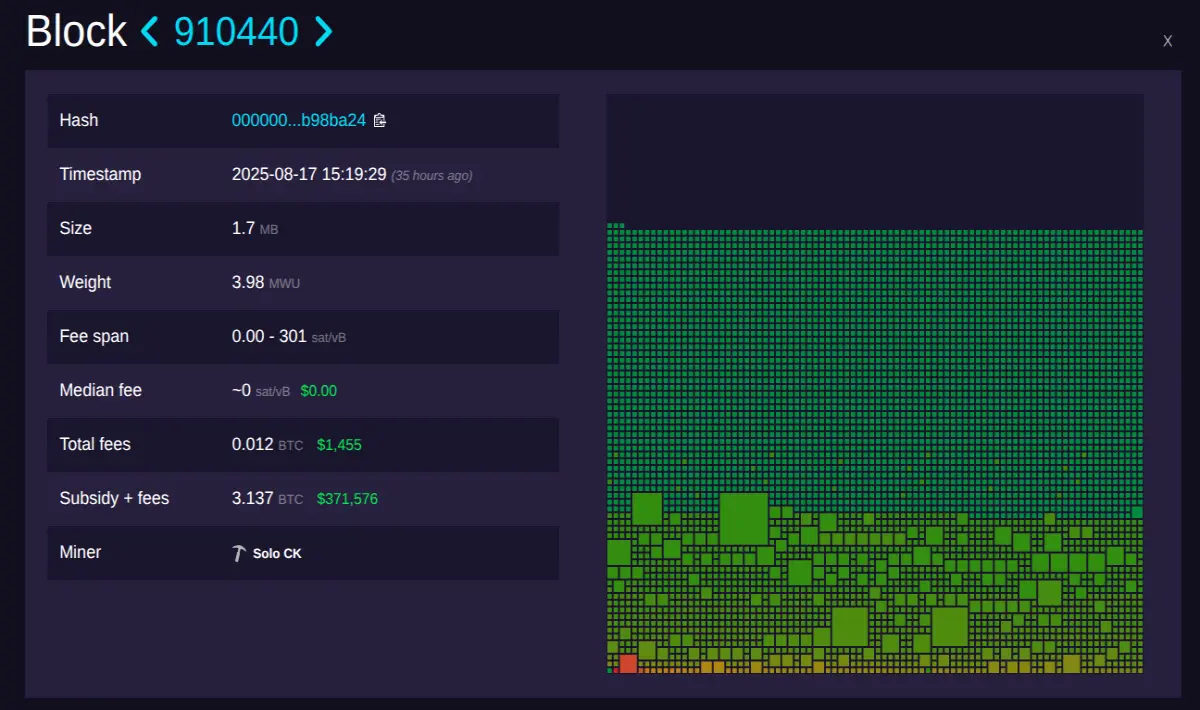
According to Kon Colivas, lead maintainer of Solo CKpool, the miner was running at a hashrate of 9 petahashes per second (PH/s). He said: “A miner of this size has a 1 in 800 chance of solving a block per day.”
A single miner operating at 9 PH/s represents just 0.00092% of Bitcoin’s total hashrate, estimated at 977 EH/s at the time of writing.
Although the proportion may seem tiny compared to the aggregate computing power of the network, achieving this capacity requires a considerable amount of infrastructure.
As an estimate, reaching 9 PH/s would be equivalent to using around 10 Bitmain S21e XP Hyd 3U units of 860 TH/s each.
Those 9 EH/s could also be translated into 39 units of the 234 TH/s S21 Pro model, or even 82 110 TH/s S19 Pro ASICs.
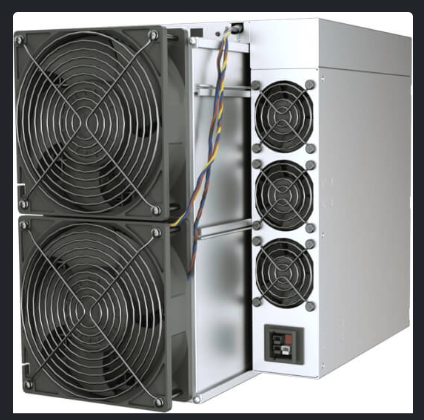
Bitmain's S21 has a hash rate of 234 TH/s and a power consumption of 3500 volts. Source: Whattomine.
These figures allow us to gauge the level of investment and resources required by a solo miner to compete, even marginally, on the Bitcoin network.
Episodes like these highlight the probabilistic nature of Bitcoin mining. Each team competes to find the valid hash that closes a block, and while the odds favor those with the most resources, chance allows individual operators to also have opportunities, albeit minimal.
However, they remain rare. The reason is the centralization of mining in large pools and industrial farms, which concentrate most of the computing power and, therefore, the chances of solving new blocks on the network. So, every now and then, a lone miner manages to “hit the jackpot.”






