
What would happen if, in January, the Securities and Exchange Commission (SEC) approves multiple applications for a spot bitcoin ETF? In addition to the favorable forecasts for the price of bitcoin, this news would mean that almost 4% of the total supply of BTC would be in the hands of ETF issuers.
This is presumed by the Coingecko, who calculate that if Grayscale's application for an ETF is approved, a total of 793,034 BTC would be linked to these financial tools. The number could be even higher, taking into account that there are 13 applications for a spot bitcoin ETF, led by well-known companies such as BlackRock.
The approval of these ETFs would represent a before and after for the market. And, currently, the amount of bitcoins managed by issuers is only 0.8%. Only Grayscale Fund Trust, which is the company with the largest amount of bitcoins held, has 3 times more BTC than all ETFs in circulation by 2023.
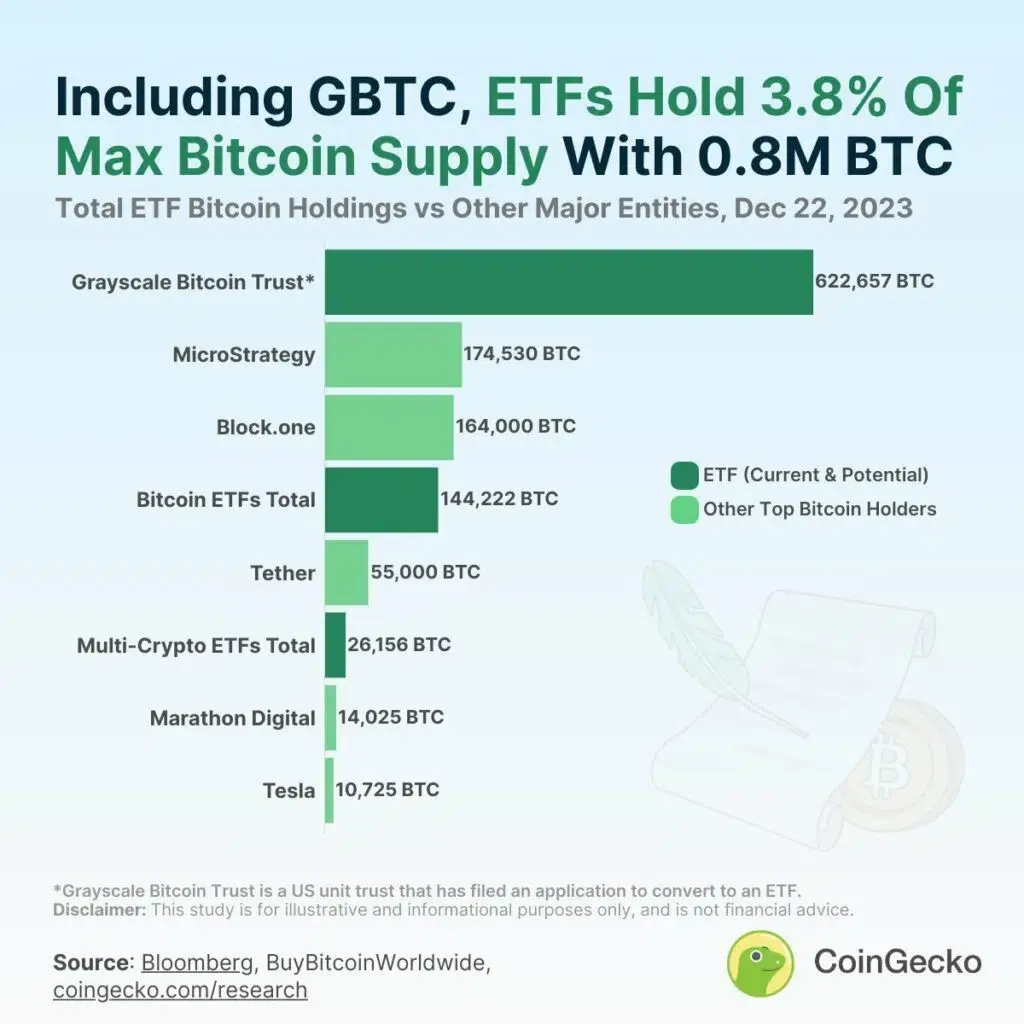
Although the difference is abysmal, it is not that ETF issuers manage few assets today. According to Coingecko's calculations, these funds must have 16 billion dollars under their administration . In this way, they are positioned as the fourth set of entities with the largest amount of bitcoins held, after Microstrategy, Block.one and Grayscale.
Although Grayscale Fund Trust has all the makings of becoming a bitcoin ETF giant, we are not yet certain that the SEC will approve its application. Therefore, at this moment, the ETF with the largest amount of assets under its protection is the XBT Provider Bitcoin Tracker One (CoinXBT).
It is a legend in the Bitcoin market, as it was the first spot ETF in history when it was issued in 2015 in Sweden. Currently, this fund has 7 billion dollars under its management. In terms of the number of assets held, it is followed by the Proshares Futures ETF (BITO), which was recently issued in the United States and already has almost 2 billion dollars. Third place is occupied by a Canadian ETF, the Purpose Bitcoin ETF (BTCC), which manages $1.5 billion.
When analyzing the different exchange-traded funds (ETFs) that are on the market, you can notice interesting characteristics. For example, the world's leading ETFs are not concentrated in the United States, but rather in Europe with a presence in Switzerland, Germany, Sweden and Jersey. Likewise, there is an overwhelming majority of spot ETFs (14 in total), although future ETFs manage a greater amount of assets, representing 61% of the total.






