
Donald Trump's return to power in 2025 has unleashed an economic storm that resonates across the globe.
His tariff policy , a flag that already waved during his first presidency, has returned with renewed force, triggering a global economic crisis.
This trade "war" is disrupting the balance of traditional markets and is also impacting Bitcoin (BTC) and other cryptocurrencies.
But what exactly is happening? Why is Trump insisting on this protectionist approach? And how is this affecting the global economy and the Bitcoin ecosystem? Here are four key points to understanding this phenomenon that is shaping the course of 2025.
1. The tariff war: a double-edged sword
The tariff war that Trump has revived is not a new concept. During his first term (2017-2021), he imposed significant tariffs on products from China, the European Union, and other trading partners, justifying it as a measure to address the United States' trade deficit.
Now, in his second term, he has raised the bar: "reciprocal" tariffs with a special emphasis on Chinese imports. His administration argues that this protects American workers and revitalizes local industries that have lost competitiveness in the face of globalization.
The following image shows the current "reciprocal" tariffs imposed by the Trump administration:
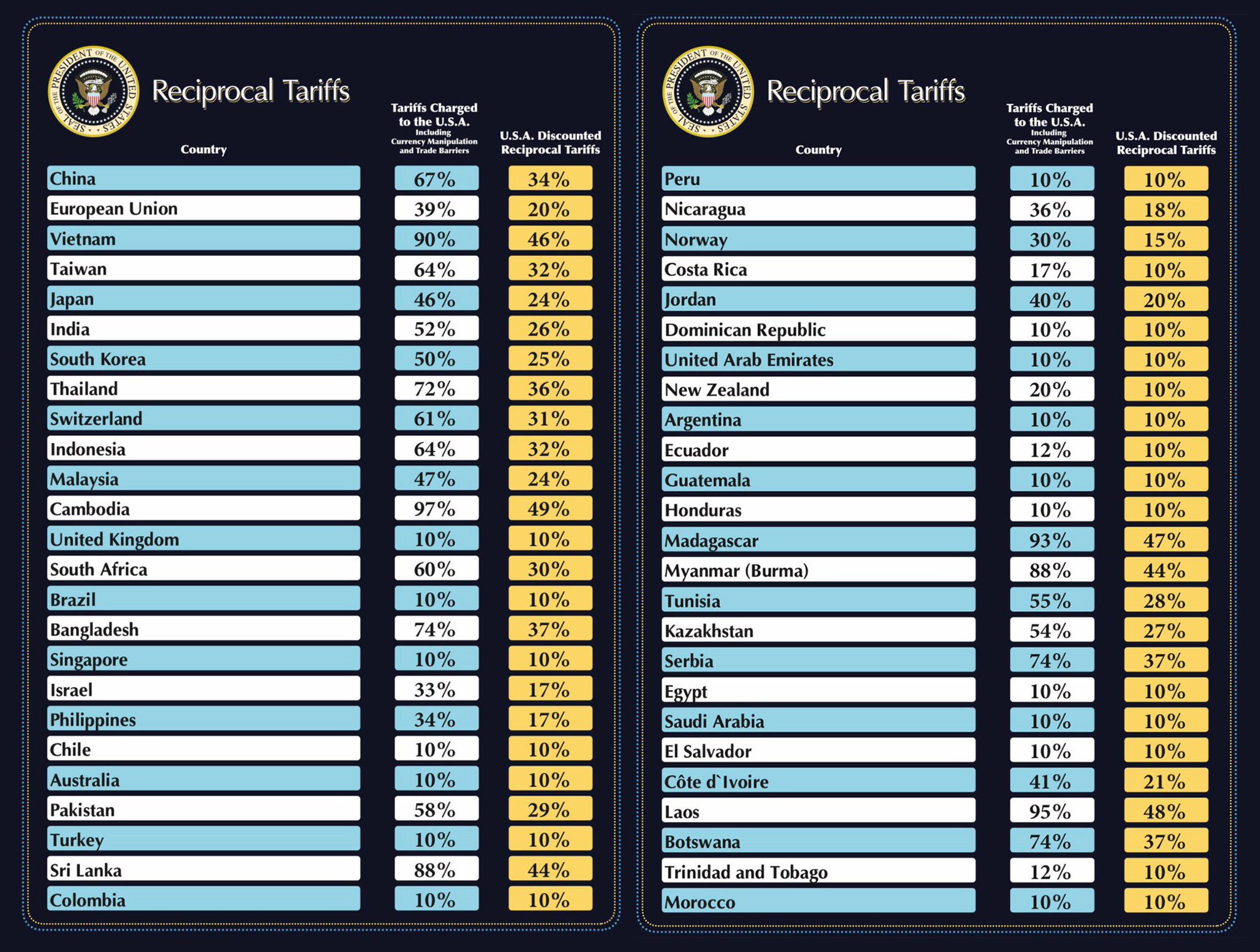
However, this strategy comes at a high cost. China has responded with 34% tariffs on certain US products.
These retaliations could trigger a potential chain reaction : disruptions to global supply chains, increased costs for businesses, and ultimately higher prices for consumers.
What Trump sees as a patriotic victory is a double-edged sword that could have long-lasting consequences for the global economy.
2. Why does Trump consider it necessary?
The core of Trump's philosophy is simple: "America First ." For him, tariffs are an essential tool to reverse what he perceives as decades of economic exploitation by countries like China, which have flooded the U.S. market with cheap goods while accumulating massive trade surpluses.
From your perspective, that may be true. But, from an unbiased perspective, it's undeniable that the global consequences will be like an earthquake from which it's almost impossible to escape.
Global supply chains are so interconnected that penalizing imports also affects American companies that rely on foreign components.
Furthermore, Trump's protectionism clashes with the free market that the Republican Party has historically championed, which could lead to internal tensions.
3. The impact on global markets
The tariff war has unleashed a wave of uncertainty in the financial markets. And investors don't like uncertainty. They prefer a calm and predictable macroeconomic environment. Bitcoin and cryptocurrencies are no exception. Today, BTC reached its lowest price so far in 2025 .
Although Bitcoiners consider BTC to be "digital gold" and the ultimate store of value, the market in general still views it as a "risky " asset. Therefore, when there is uncertainty and panic, the price of BTC tends to drop along with traditional volatile assets:
4. Long-term consequences and the role of Bitcoin
The impact of this crisis is not limited to the present. In the short term, consumers may begin to face higher prices.
In the longer term, the fragmentation of global trade could lead to more closed economic blocs, thus changing the landscape of international trade.
And what will happen to Bitcoin in such a context? Although BTC is suffering short-term declines along with risky assets, its fundamentals suggest a promising future (though perhaps not immediate).
In a world where economic policies generate inflation, uncertainty, and distrust in centralized systems, Bitcoin's unique qualities begin to shine.
Its limited supply of 21 million units makes it an anti-inflationary asset by design, unlike fiat currencies, which governments can print without limit and inorganically.
Furthermore, its decentralized nature makes it immune to central bank manipulation or political decisions. In an environment of economic fragmentation, where national currencies lose value and trade tensions erode stability, BTC has the potential to emerge as a global store of value.
Sooner or later, the market will recognize that Bitcoin is not just a speculative asset, but a solid store of value in the face of a declining traditional financial system. When that happens, its price explosion will be massive, driven by global adoption that can no longer ignore its advantages.






