
The blockchain industry has matured significantly since the early days of Proof-of-Work mining. Today, staking and validator participation have become the preferred methods for securing networks while earning rewards.
Ethereum is often recognized as the largest Proof-of-Stake ecosystem by market capitalization and developer activity. However, when evaluating staking opportunities from the perspective of rewards, enterprise adoption, validator accountability, energy efficiency, and Real-World Asset (RWA) growth, XDC Network presents several compelling advantages.
This article explores why many long-term participants view XDC Masternodes as one of the most attractive infrastructure opportunities in the blockchain industry.
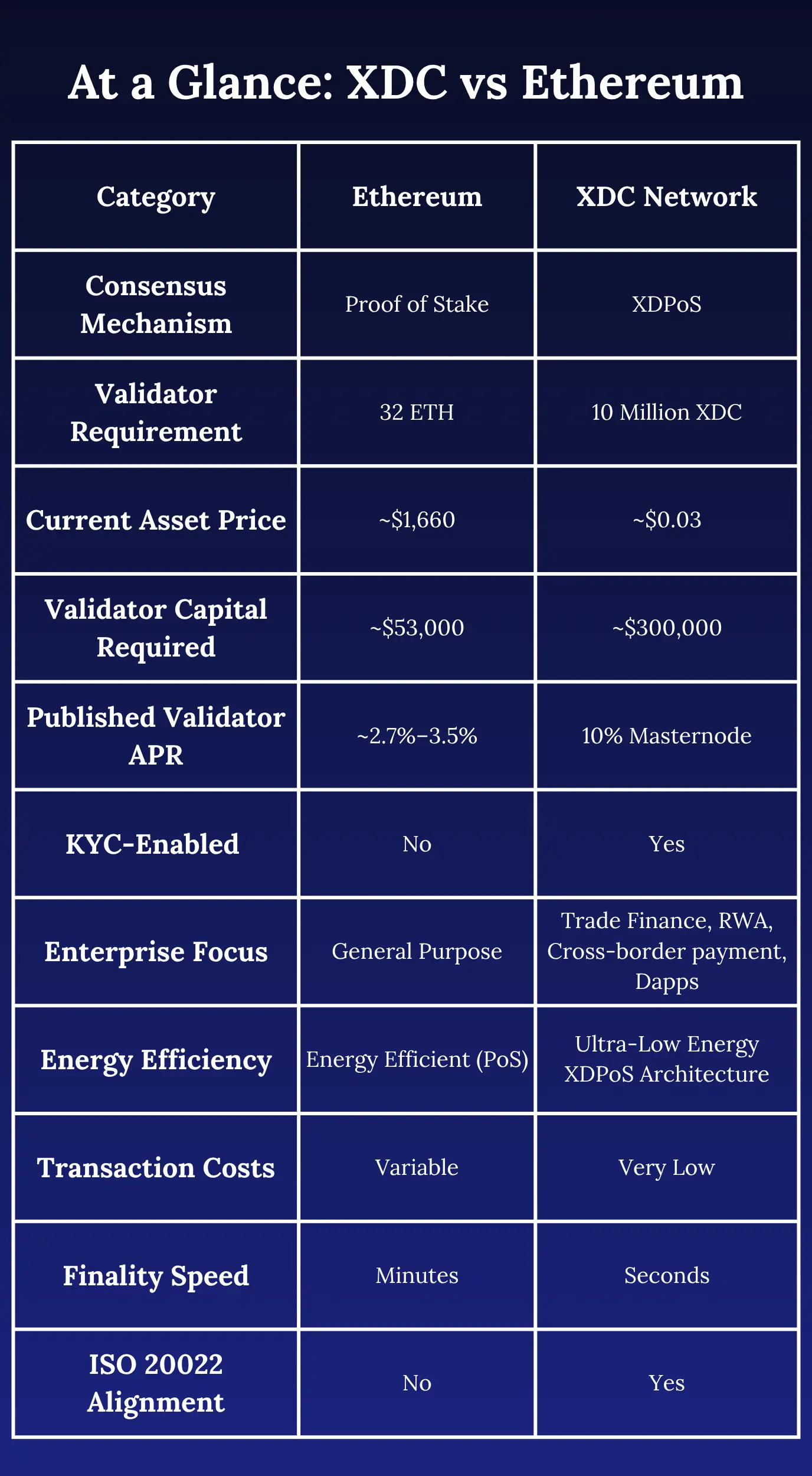
At a Glance: XDC vs Ethereum
Reference Prices (9 June 2026)
- Ethereum (ETH): $1,687.51
- XDC Network (XDC): $0.03108
Validator Capital Calculation
Ethereum
32 ETH × $1,687.51
= $54,000.32
XDC Network
10,000,000 XDC × $0.03108
= $310,800
Although XDC requires a higher validator commitment, many infrastructure providers view this as a long-term alignment mechanism that encourages committed operators and reduces short-term speculative participation.
1. Higher Reward Potential
One of the most noticeable differences between Ethereum staking and XDC Masternodes is reward generation.
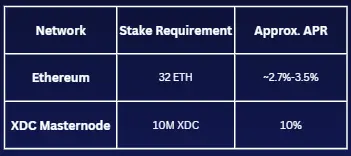
Ethereum staking rewards fluctuate depending on the total amount of ETH staked on the network. As validator participation increases, rewards tend to decrease. Current Ethereum staking yields generally range between 2.7% and 3.5%.
XDC Network currently offers:
- 10% APR for Masternodes
- 8% APR for Standby Nodes
This means XDC validators earn significantly higher percentage-based rewards compared to Ethereum validators.
Annual Reward Comparison
Estimated Annual Rewards at Current Prices
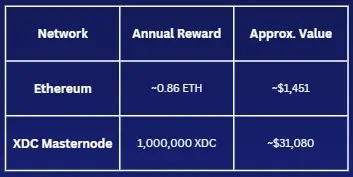
For infrastructure providers seeking predictable validator income, XDC's reward structure is substantially more attractive.
2. KYC Validators Bring Additional Trust and Accountability
One feature that often receives criticism from decentralization purists is actually viewed as a major advantage by enterprises and institutions.
To operate an XDC Masternode, validators must complete KYC verification.
Ethereum validators operate anonymously and can be created without identity verification.
While anonymity has advantages, it also creates challenges for:
- Institutional participation
- Regulatory compliance
- Enterprise trust
- Governance accountability
XDC takes a different approach.
By requiring validator KYC, the network creates an additional layer of accountability among Masternode operators.
For enterprises, financial institutions, and governments exploring blockchain infrastructure, knowing that validator operators have undergone verification can be viewed as a strength rather than a weakness.
This aligns with XDC's broader goal of becoming a blockchain network capable of supporting regulated financial markets and tokenized real-world assets.
3. Built Specifically for Real-World Assets
Ethereum was originally designed as a general-purpose smart contract platform.
XDC was designed with enterprise adoption and trade finance in mind.
Today, one of the fastest-growing sectors in blockchain is Real-World Asset (RWA) tokenization.
Examples include:
- Treasury Bills
- Trade Finance Instruments
- Bonds
- Real Estate
- Carbon Credits
- Supply Chain Assets
XDC's ecosystem has consistently focused on these sectors long before RWA became a mainstream crypto narrative.
As institutional adoption grows, many investors believe infrastructure positioned around real-world finance may benefit significantly.
4. Significantly Lower Network Costs
Network fees remain one of the most important factors for enterprise adoption.
Ethereum has made major improvements through Layer-2 scaling solutions, but mainnet transaction fees can still fluctuate significantly during periods of heavy demand.
XDC offers:
- Extremely low transaction fees
- Predictable operating costs
- Fast settlement times
For businesses processing thousands or millions of transactions, predictable fees can be a major competitive advantage.
5. One of the Most Energy-Efficient Blockchain Networks
Environmental sustainability continues to be an important consideration for governments and enterprises.
Ethereum became dramatically more energy efficient following its transition from Proof-of-Work to Proof-of-Stake.
However, XDC's XDPoS architecture was designed from inception around:
- Low energy consumption
- High throughput
- Efficient validator operations
- Sustainable network performance
The result is a blockchain infrastructure capable of processing transactions while maintaining extremely low energy requirements.
For organizations with ESG objectives and sustainability goals, this can be an important differentiator.
As governments and enterprises increasingly prioritize sustainability, energy-efficient infrastructure may become a key factor in blockchain adoption decisions.
6. Faster Settlement and Enterprise Performance
Enterprise applications require:
- Speed
- Reliability
- Low cost
- Predictable performance
XDC was optimized around these requirements.
Advantages include:
✔ Near-instant transaction settlement
✔ Fast finality
✔ Low network congestion
✔ Enterprise-grade performance
These characteristics make XDC particularly attractive for trade finance, supply chain management, payments, and asset tokenization.
7. The Opportunity Created by Current Market Prices
Perhaps one of the most interesting aspects of XDC Masternodes in 2026 is the dramatic difference in entry cost compared to previous market cycles.
During the 2021 bull market, operating a 10 Million XDC Masternode required close to $2 million worth of capital.
Today:
- XDC price is approximately $0.03
- 10 Million XDC equals roughly $300,000
The requirement has not changed.
The network rewards have not changed.
Only the market price has changed.
For long-term believers in enterprise blockchain adoption, this creates an opportunity to secure the same validator position at a fraction of the historical cost.
8. Why Institutions May Prefer XDC's Model
Institutional adoption often requires more than decentralization.
Organizations typically seek:
- Compliance
- Accountability
- Governance
- Predictable economics
- Regulatory alignment
XDC's validator model aligns with these requirements through:
- KYC-enabled Masternodes
- Enterprise-focused infrastructure
- ISO 20022 compatibility
- RWA-first ecosystem strategy
- Low-cost operations
These characteristics make XDC fundamentally different from most public blockchain networks.
For institutions exploring blockchain infrastructure, accountability and transparency are often just as important as decentralization.
Final Thoughts
Ethereum remains the largest Proof-of-Stake ecosystem and continues to dominate decentralized finance and smart contract activity.
However, size alone is not the only metric that matters.
For participants focused on:
- Higher validator rewards
- Enterprise adoption
- Real-World Asset tokenization
- Regulatory alignment
- Validator accountability
- Energy efficiency
- Long-term infrastructure opportunities
XDC Network offers several advantages that deserve serious consideration.
With a 10% Masternode APR, KYC-backed validator accountability, enterprise-focused architecture, ultra-low transaction costs, and a growing presence in the RWA sector, XDC represents a unique alternative to traditional Proof-of-Stake participation.
As blockchain adoption increasingly moves toward regulated finance and tokenized real-world assets, XDC's design choices may prove to be some of its greatest strengths.
Useful Resources
- XDC Masternode Setup Guide: https://docs.xdc.network/xdcchain/developers/node_operators/masternode/
- XDC Rewards Documentation: https://docs.xdc.network/xdcchain/rewards/
- Ethereum Staking Documentation: https://ethereum.org/en/staking/





