
What is XDC Network?
- XDC Network is a Layer-1 blockchain optimized for enterprise-grade finance / trade use cases, real-world asset tokenization, payments, etc.
- It uses a delegated Proof-of-Stake / BFT style consensus (XDPoS) and has recently upgraded to “XDC 2.0,” which reduced finality delays (three-block finality, ~2-second block time) and added forensics monitoring and node slashing mechanisms.
- Network boasts low gas fees, high throughput, and energy efficiency suited for enterprise flows.
What is CCTP V2 and why this matters for XDC
Circle’s Cross-Chain Transfer Protocol (CCTP) V2 is a burn-and-mint cross-chain mechanism for native USDC transfers that removes wrapped/bridged variants and aims to deliver capital-efficient, fast cross-chain settlement. V2 adds two notable features: Fast Transfers (near-instant settlement for supported domains) and Hooks (programmable post-transfer logic). With CCTP V2, Circle can attest and mint native USDC on supported chains quickly and with deterministic capital backing. Circle announced native USDC + CCTP V2 on XDC to enable fast, low-cost stablecoin payments and institutional flows on the XDC Network.
The 15 blockchains that USDC can move between using CCTP V2
Circle’s CCTP V2 contracts are deployed to many domains. Not all CCTP domains carry USDC; Circle’s docs list the CCTP V2 domains and note USDC is supported on all domains except BNB Smart Chain — meaning there are 15 domains where USDC is natively supported via CCTP V2. The 15 (mainnet) chains where native USDC is supported are:
- Ethereum (Mainnet)
- Avalanche (C-Chain)
- Arbitrum
- Base
- Codex
- Ethereum Layer / HyperEVM (Circle lists HyperEVM domain)
- Linea
- Optimism (OP Mainnet)
- Polygon PoS
- Sei
- Solana
- Sonic
- Unichain
- World Chain
- XDC
(These names come from Circle’s CCTP V2 supported-chains page — Circle deploys CCTP contracts to a set of domains and USDC is available on 15 of those mainnet domains; BNB Smart Chain is a CCTP domain but USDC is not issued there.)
NOTE: Circle occasionally adds new domains; the list above reflects the domains published in Circle’s official docs at time of writing. For programmatic integration always check Circle’s supported-domains docs.
Detailed comparison: USDC on XDC vs the 15 CCTP-supported chains
Speed & finality — deeper notes
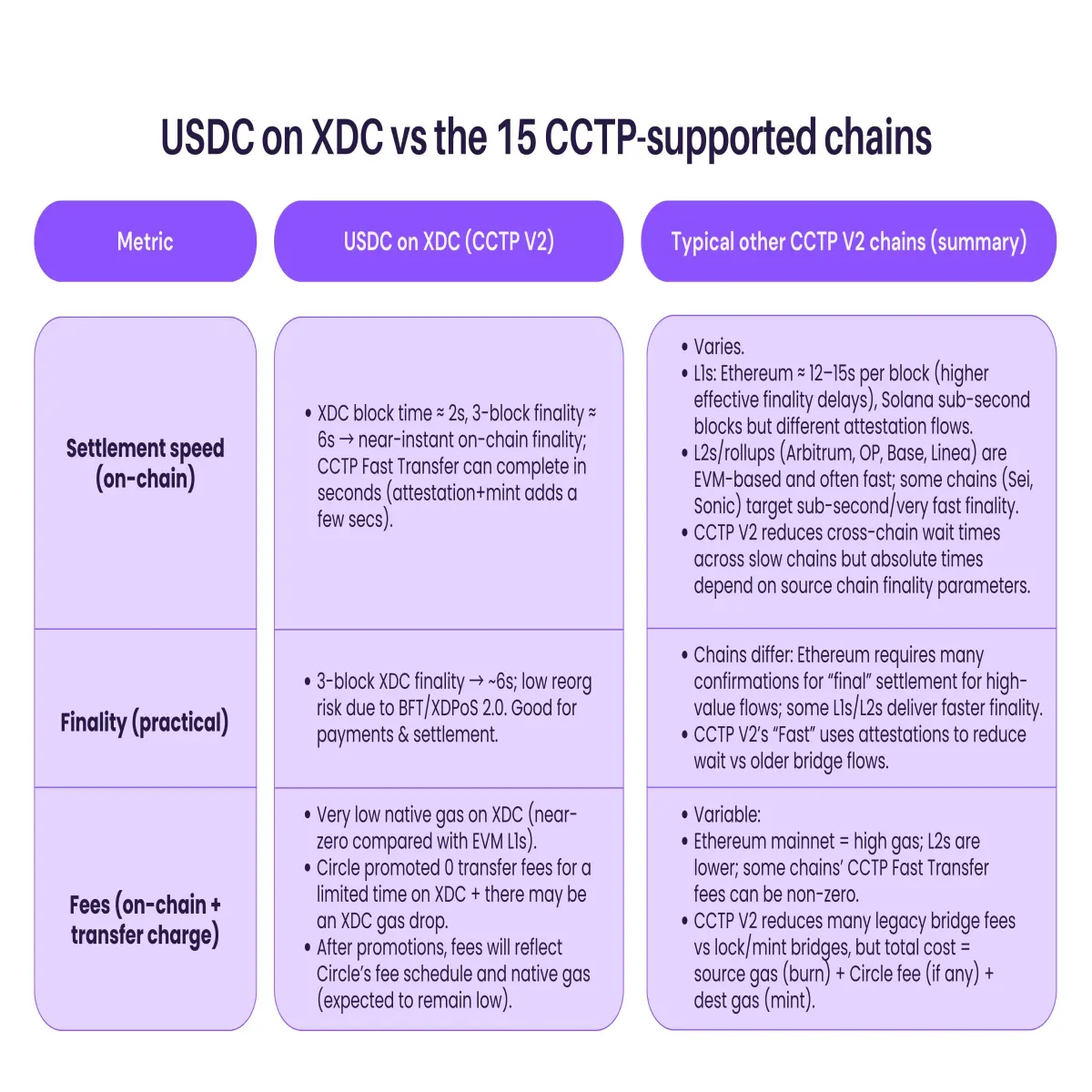
- XDC specifics: XDC 2.0 targets a 2-second block time with three-block finality → practical finality ≈ 6 seconds. That means an on-chain transfer is irreversibly final in a few seconds, which is excellent for payments and settlement workflows. This is what makes CCTP V2’s Fast Transfer useful on XDC: the source burn can be attested and destination mint completed with only a very small wall-clock delay.
- Compare to Ethereum: Ethereum (PoS) has longer block intervals and probabilistic finality; cross-chain flows from Ethereum historically waited ~10+ minutes for “final” settlement in legacy bridging models — CCTP V2 shortens these waits using fast attestations, but absolute speed still depends on the slowest link and attestation thresholds. For many rollups and new L1s the effective transfer time is much shorter than legacy bridging.
Fees — deeper notes
- On XDC: native XDC transaction gas is very low (near-zero relative to Ethereum). Circle’s announcement and ecosystem materials noted a gas drop and 0 transfer fees on XDC for a limited time — this makes cross-chain USDC transfers to XDC extremely cheap during promotion. After promotions, CCTP V2 fees will be governed by Circle’s fee schedule + native gas.
- On other chains: users pay the cost to burn on the source chain (source gas) and to mint on the destination chain (destination gas). On expensive L1s (e.g., congested Ethereum mainnet) those gas costs can dwarf the CCTP protocol fee; L2s and some L1 alternatives keep on-chain gas small. CCTP V2 fixes the wrapped-liquidity inefficiency but does not eliminate native gas costs.
Consensus, EVM and enterprise standards — what this means for integrators
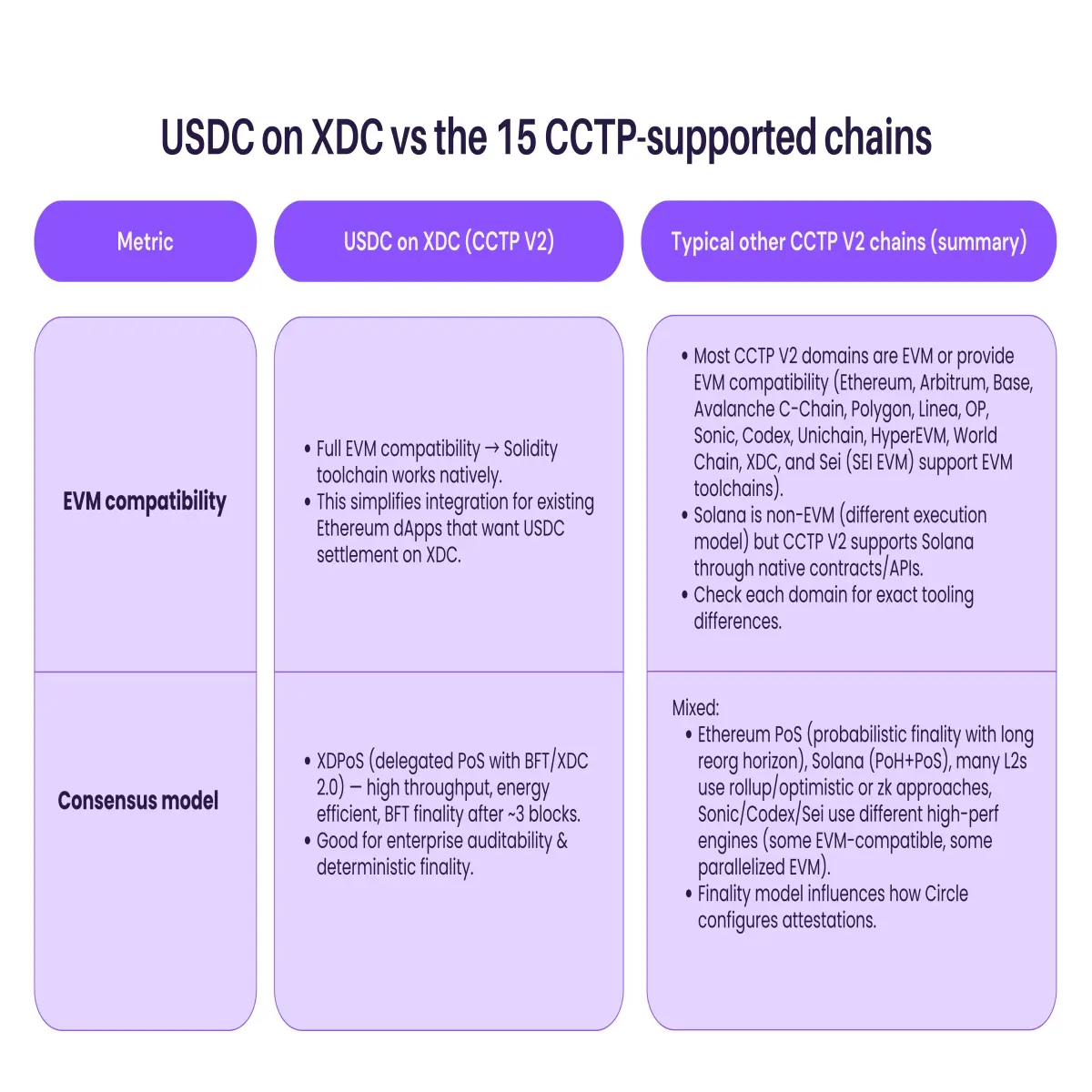
- Consensus & finality: XDC’s XDPoS + BFT finality (XDC 2.0) is optimized for deterministic finality and minimal reorg risk — an attractive property for settlement rails and auditing. Many other CCTP domains use different consensus (PoS, PoH/PoS, rollup designs, parallelized EVM) and have different tradeoffs between decentralization, throughput and finality latency.
- EVM compatibility: XDC is EVM-compatible so existing Ethereum smart contracts and tooling port easily. That is also true for most of the 15 CCTP domains (Arbitrum, Base, Avalanche C-Chain, Polygon, Linea, OP, Sonic, Codex, Sei EVM, etc.). Solana is the notable non-EVM chain in the CCTP list and requires different integration patterns. For teams building with Solidity and common toolchains (Hardhat, Foundry, MetaMask), XDC and the majority of CCTP domains are developer-friendly.
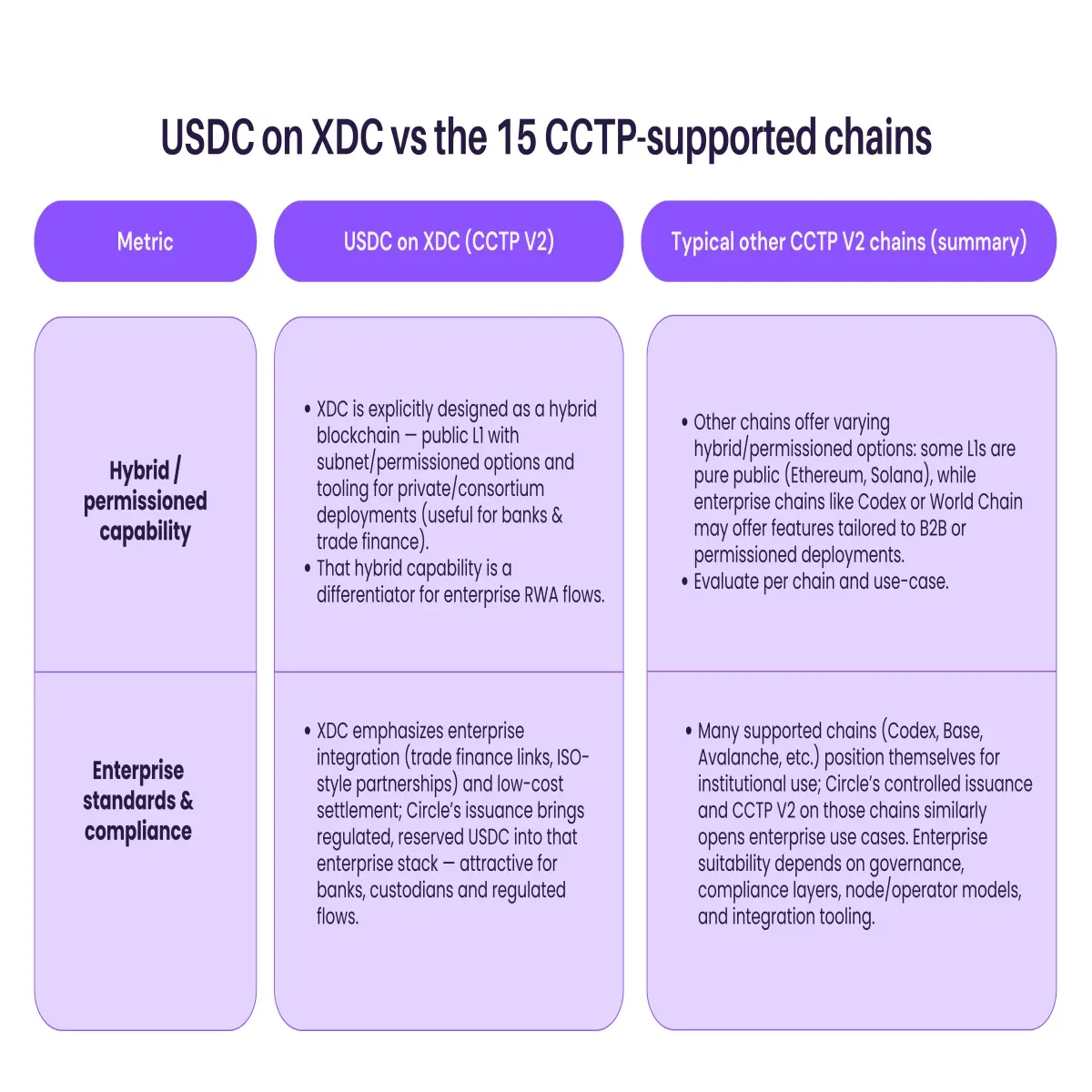
- Enterprise & compliance: Circle’s USDC issuance is regulated and can be paired with enterprise custody / on-ramp solutions (Circle Mint for institutions, custodial partners). XDC’s focus on trade finance, subnets and private/permissioned features makes the XDC+USDC stack attractive to institutions wanting a mix of public settlement and private ledgers. Other CCTP domains that explicitly target B2B (Codex, World Chain, etc.) offer similar entry points; the right choice depends on compliance requirements and settlement topology.
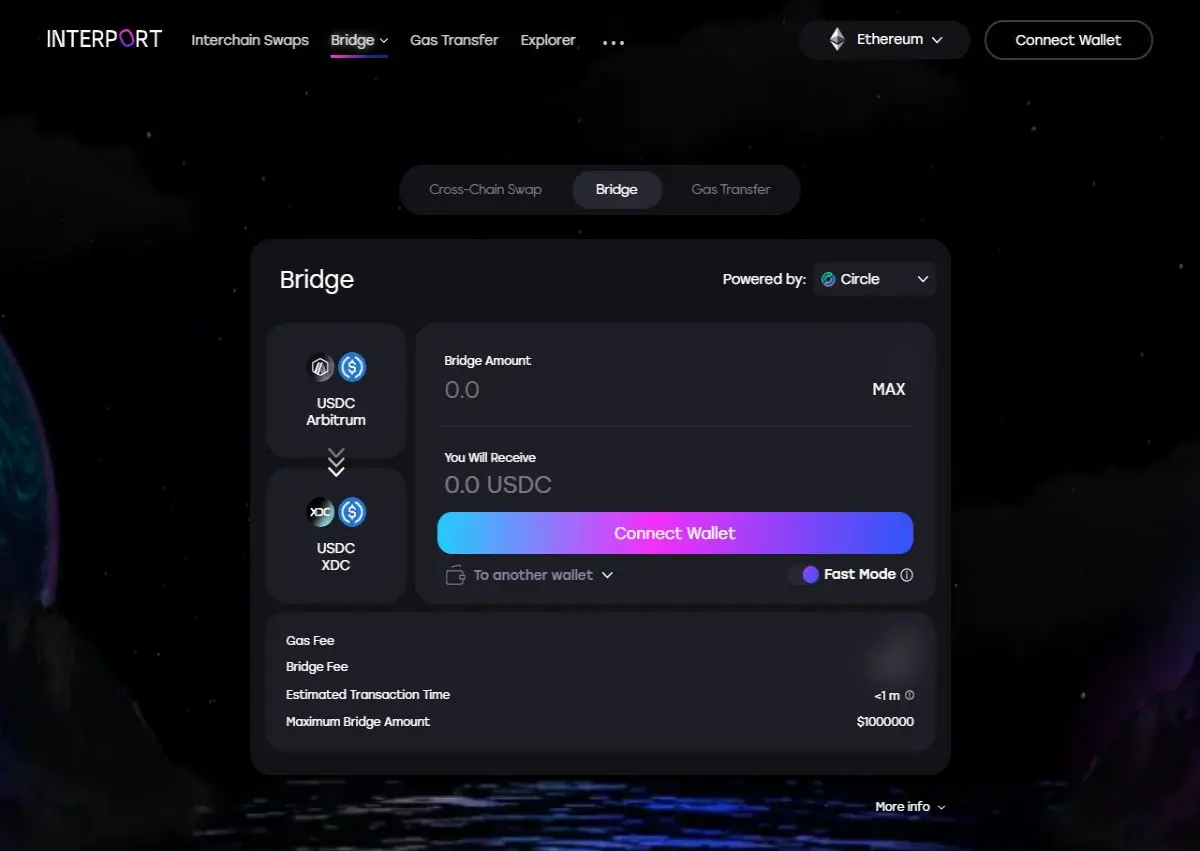
Swapping / bridging to USDC on XDC via CCTP platforms
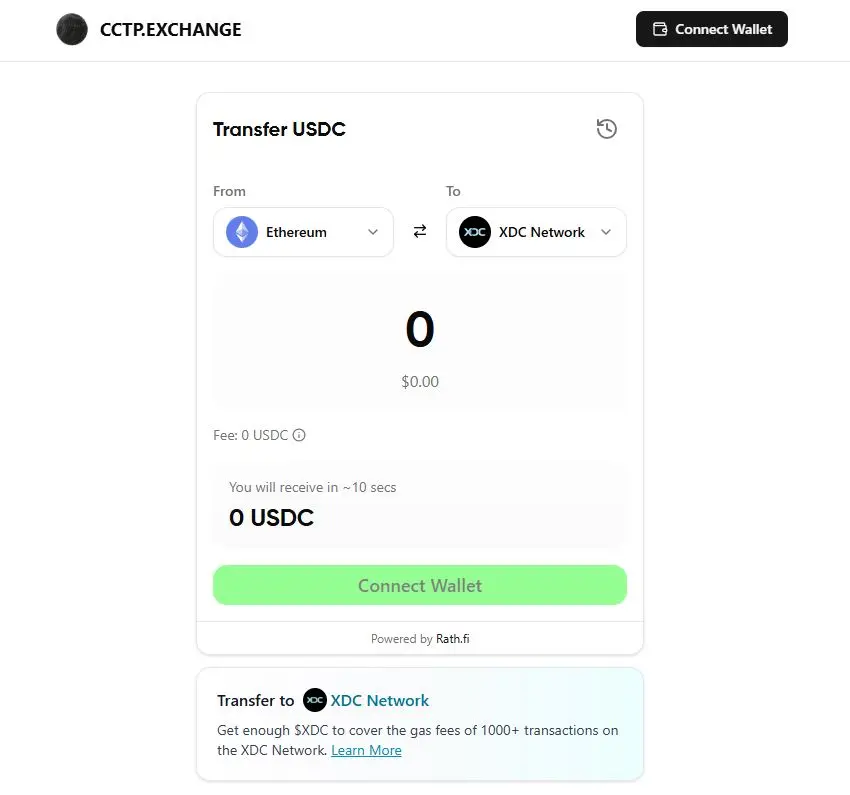
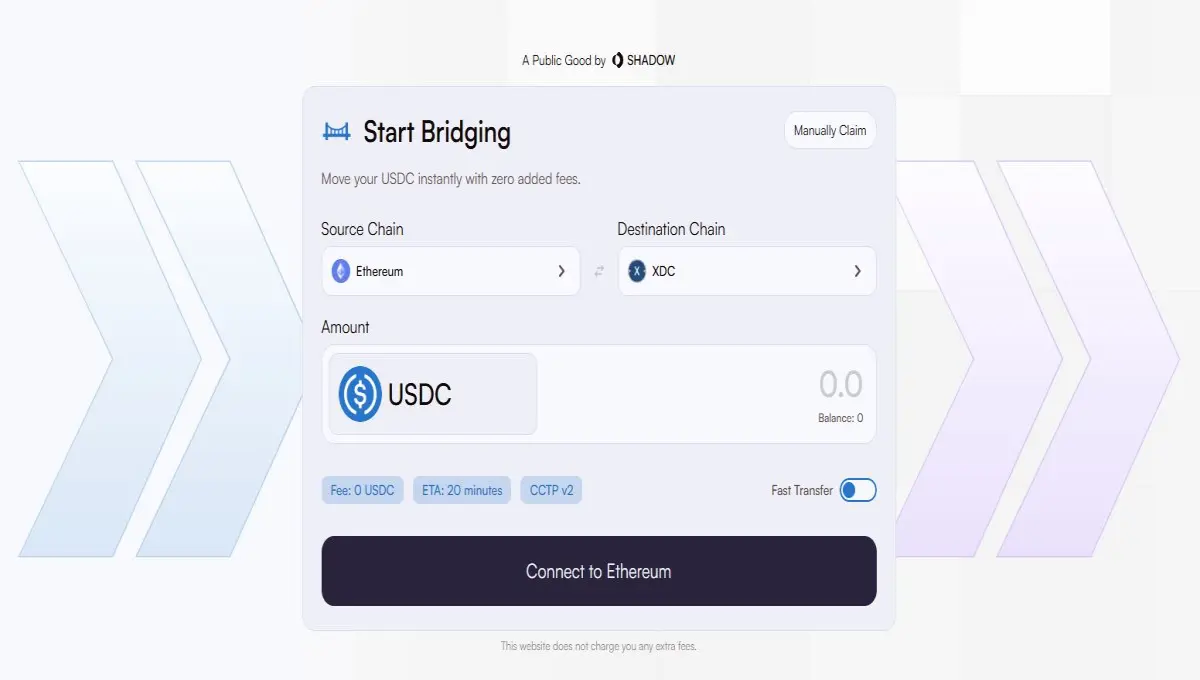
Swapping / bridging to USDC on XDC via Interport (via app.interport.fi)
Read the previous article on USDC Transfer Cost Comparison: Ethereum vs XDC – Which is Faster & Cheaper?
Disclaimer
This article is informational and based on Circle’s public documentation and XDC ecosystem materials at the time of writing. Chain features, domain lists, fees and promotional incentives change over time — check Circle’s CCTP docs and the XDC announcement pages for the most up-to-date info before building production integrations.






