
Why AI Agents Need More Than Just a Blockchain
The blockchain industry is entering a new phase where Artificial Intelligence (AI) agents are becoming autonomous participants in digital economies. These agents are no longer limited to answering questions or generating content. They are increasingly expected to negotiate contracts, manage assets, execute payments, validate data, interact with decentralized applications, and coordinate with other agents.
This evolution introduces a new challenge: traditional public blockchains were designed primarily for human users, not for millions of machine-driven transactions generated by autonomous AI systems.
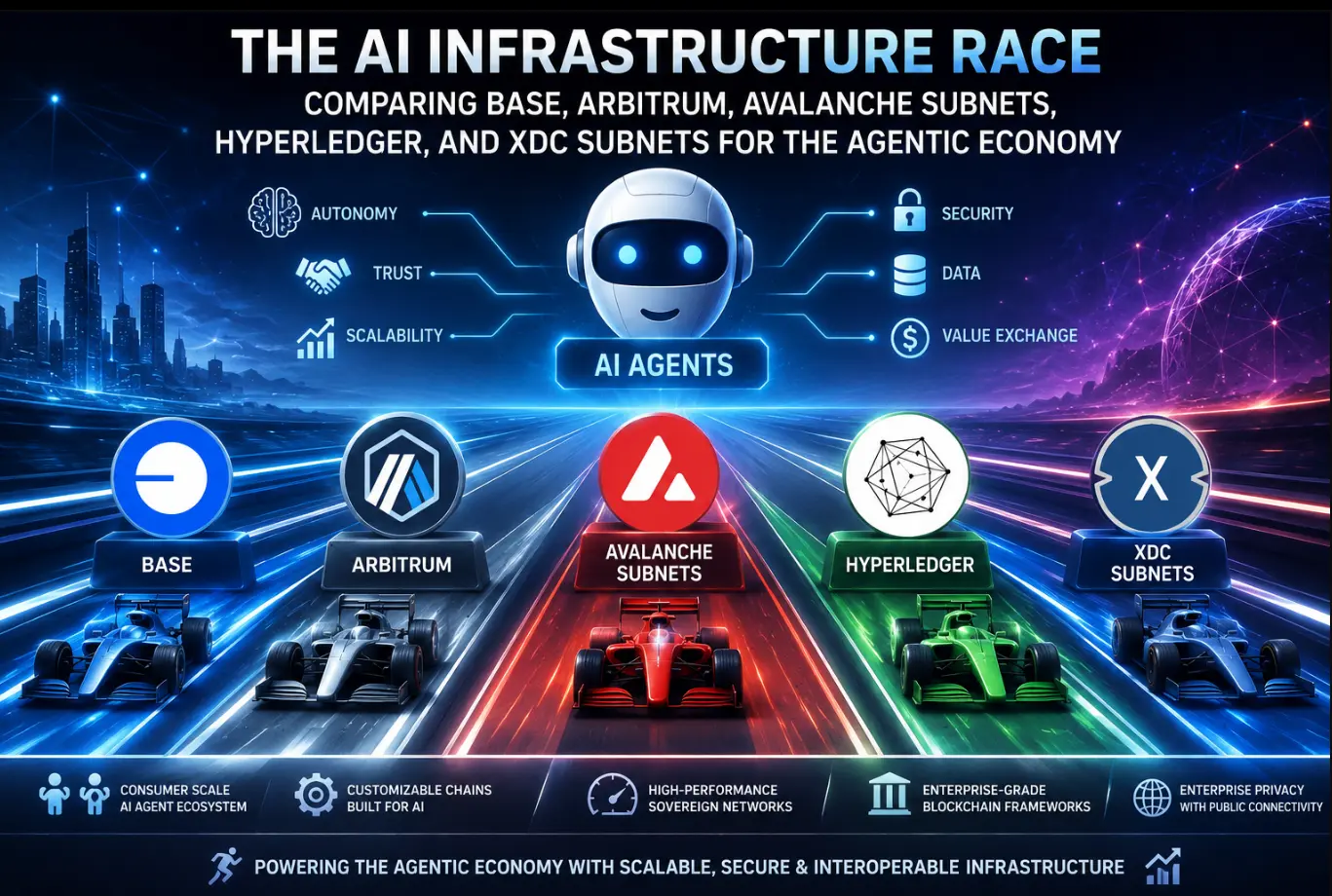
As a result, infrastructure providers are racing to build specialized environments capable of supporting the emerging Agentic Economy. Networks such as Base, Arbitrum, Avalanche, Hyperledger Fabric, and XDC Network are all approaching this challenge differently.
The critical question for enterprises and developers is:
Which infrastructure is best suited for AI agents, enterprise workflows, tokenized assets, and private execution environments?
What AI Agents Need From Blockchain Infrastructure
To operate efficiently, AI agents require:
- Fast transaction finality
- Predictable operating costs
- Secure execution environments
- Private data handling capabilities
- Autonomous payment rails
- Cross-chain interoperability
- Tokenization support
- Regulatory-friendly architecture
- Ability to run dedicated networks without congestion
Public blockchains alone often struggle to satisfy all these requirements simultaneously.
This is where sovereign chains, appchains, subnets, and private blockchain environments become increasingly important.
Base: The Consumer AI Agent Leader
Base has rapidly emerged as one of the most active ecosystems for consumer-facing AI agents.
Backed by Coinbase, Base benefits from:
- Ethereum security
- Low transaction costs
- Large retail user base
- Strong developer tooling
- Growing AI agent ecosystems
Recent industry discussions indicate Base has become one of the leading destinations for on-chain AI agents due to its low fees and developer-friendly environment.
Strengths
- Massive user adoption
- Strong AI experimentation ecosystem
- Easy onboarding
- Ethereum compatibility
Limitations
- Public-first architecture
- Limited privacy
- Not ideal for confidential enterprise workflows
- AI agents share infrastructure with all other applications
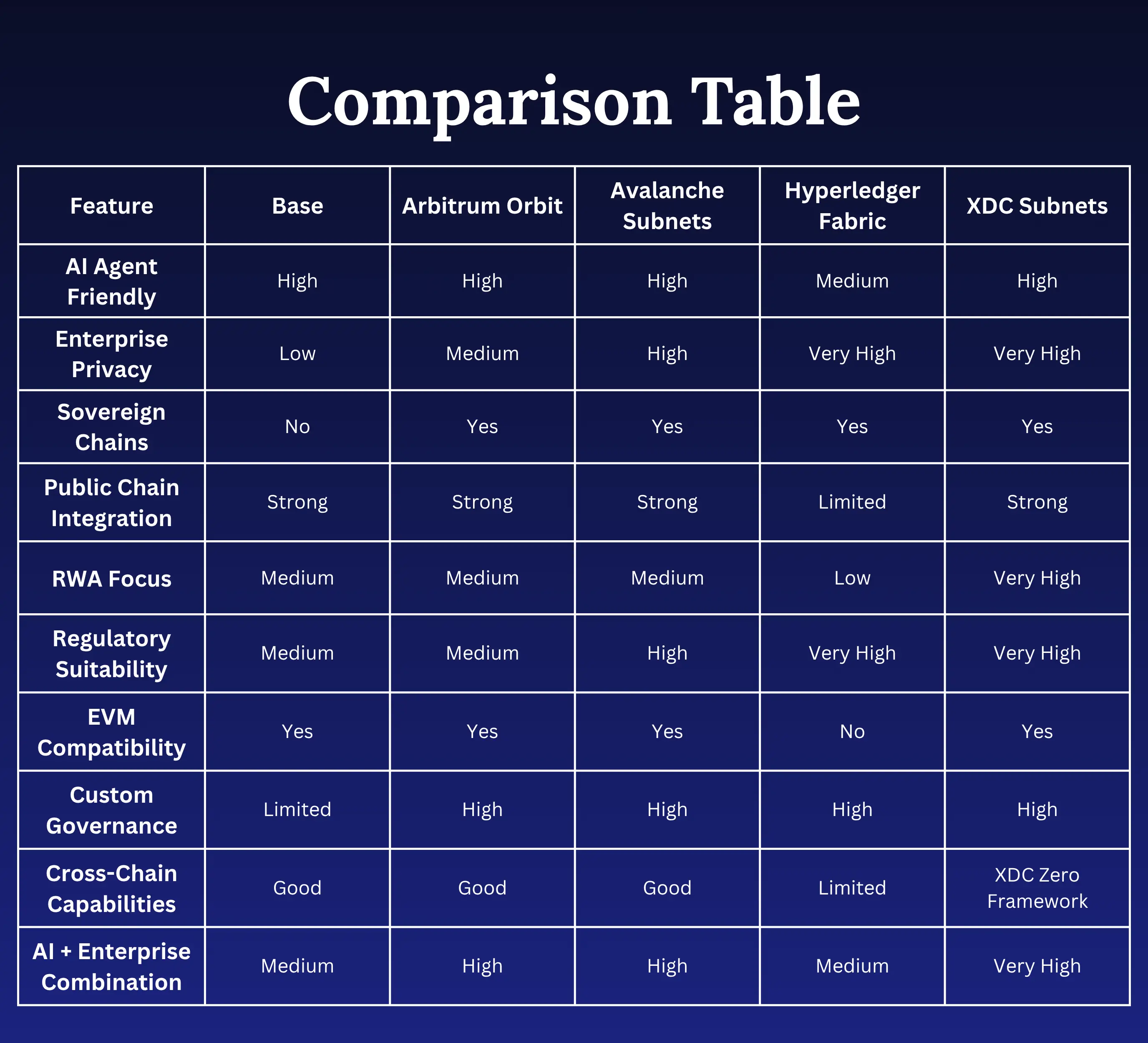
Base excels for consumer AI agents but is less suitable for enterprises requiring private execution environments.
Arbitrum Orbit: Custom AI Chains
Arbitrum Orbit enables developers to launch application-specific chains while leveraging Ethereum's ecosystem.
For AI projects, this means:
- Dedicated execution environments
- Custom gas models
- Independent governance
- High scalability
Strengths
- Ethereum ecosystem access
- Rollup security
- Flexible customization
Limitations
- More complex deployment
- Dependency on Ethereum settlement
- Additional infrastructure management
Arbitrum Orbit is attractive for AI startups that require dedicated chains but still want Ethereum liquidity.
Avalanche Subnets: High-Performance Sovereign Networks
Avalanche pioneered the subnet model and remains one of the strongest competitors in this category.
Subnets allow organizations to launch sovereign blockchain environments with their own validator requirements, tokenomics, and execution logic.
Strengths
- Independent validator sets
- Custom virtual machines
- Performance isolation
- Sovereign governance
AI Agent Advantages
- Dedicated throughput
- Low latency
- Specialized execution environments
Limitations
- Operational complexity
- Validator management requirements
- More infrastructure overhead
Avalanche Subnets remain one of the most mature sovereign-chain solutions available today.
Hyperledger Fabric: Enterprise Permissioned Blockchain Infrastructure
What is Hyperledger Fabric?
Hyperledger Fabric is a permissioned blockchain framework designed for enterprise use cases where participants are known, authenticated, and governed through organizational policies.
Unlike public blockchains, Fabric does not rely on a native cryptocurrency or gas fees. Instead, it focuses on secure business transactions between trusted organizations.
Fabric offers:
- Permissioned membership
- Identity management
- Modular architecture
- Private transactions
- High throughput environments
Research shows Fabric supports modular consensus systems and enterprise-grade permission controls without relying on a native cryptocurrency.
Strengths
- Regulatory compliance
- Enterprise privacy
- Fine-grained permissions
Limitations
- Limited token economy support
- Weak interoperability with public blockchain ecosystems
- Less attractive for open AI economies
Hyperledger excels inside enterprises but is less suitable for open AI-agent marketplaces and tokenized asset ecosystems.
XDC Subnets: Purpose-Built for Enterprise AI and RWA Infrastructure
XDC Subnets introduce a different approach.
Rather than choosing between public blockchain openness and private blockchain confidentiality, XDC combines both worlds through sovereign subnets anchored to the XDC ecosystem.
XDC Subnets operate as independent blockchains while maintaining optional connections to the XDC mainnet through checkpointing and interoperability frameworks.
This architecture is particularly relevant for AI-driven enterprises handling:
- Tokenized real-world assets (RWAs)
- Trade finance workflows
- Supply-chain automation
- Autonomous AI settlements
- Confidential enterprise data
Why XDC Subnets Are Well Positioned for AI Agents
1. Private Execution for Autonomous Agents
Many enterprise AI agents process:
- Customer records
- Financial transactions
- Supply-chain data
- Regulatory documentation
These datasets cannot always be executed on public chains.
XDC Subnets allow organizations to run private blockchain environments while exposing only checkpoint information to the mainnet.
2. Sovereign Governance
Organizations can customize:
- Validator counts
- Governance structures
- Token economics
- Epoch parameters
- Network rules
without impacting other applications.
3. Fast Settlement for Agent-to-Agent Transactions
XDC's infrastructure delivers approximately:
- 2-second block generation
- Near-instant settlement
- High throughput
which is critical for machine-to-machine transactions.
4. Native Enterprise Focus
Unlike most blockchain ecosystems that later expanded toward enterprises, XDC was built around:
- Trade finance
- Asset tokenization
- Enterprise adoption
- Institutional workflows
from the beginning.
5. RWA and AI Convergence
The next generation of AI agents will increasingly manage:
- Invoices
- Bonds
- Treasury assets
- Carbon credits
- Supply-chain documents
- Trade finance instruments
XDC's existing focus on tokenized real-world assets positions it naturally for this convergence.
How to Launch an XDC Subnet or Private AI Network in Minutes
One of the strongest advantages of XDC Subnets is the ability to deploy a dedicated blockchain environment without managing complex infrastructure manually. Using the official Subnet Deployment Wizard, organizations can launch sovereign AI-ready networks, private enterprise chains, or RWA-focused environments within minutes.
Whether you're building an AI agent marketplace, a tokenized asset platform, or a private enterprise network, XDC Subnets provide a streamlined deployment experience.
Prerequisites
Before launching a subnet, ensure your environment meets the following requirements.
Supported Operating Systems
- Linux (recommended for production)
- macOS
Required Software
- Docker
- Docker Compose
These tools are used to orchestrate subnet nodes and supporting services.
Recommended Hardware
Subnet Management Services
- 4 CPU Cores
- 8 GB RAM
- 32 GB Storage
Individual Subnet Blockchain Node
- 2 CPU Cores
- 4 GB RAM
- Approximately 50 GB storage annually (depending on blockchain activity)
Wallet Requirements
You will need a Web3 wallet funded with XDC or testnet tokens to deploy and interact with subnet infrastructure.
For development and testing, developers can obtain tokens from the XDC Apothem testnet faucets before deployment.
Step 1: Launch the Deployment Wizard
XDC provides a deployment wizard that automates much of the subnet creation process.
Download and execute the deployment launcher:
curl -O https://raw.githubusercontent.com/XinFinOrg/Subnet-Deployment/v2.0.0/container-manager/start.sh


chmod +x start.sh


./start.sh
After execution, a local deployment server will start automatically.
Step 2: Open the Subnet Deployment Dashboard
Open your browser and navigate to:
http://localhost:5210
If you are deploying on a remote server, access the dashboard through the server's public IP address and configured port.
The dashboard serves as the control center for creating and managing your subnet infrastructure.
Step 3: Choose a Network Configuration
The deployment wizard provides multiple predefined configurations designed for different use cases.
Examples include:
- Development environments
- Enterprise private networks
- AI agent ecosystems
- Tokenization platforms
- Custom blockchain deployments
Organizations can either:
- Use a predefined template for rapid deployment
- Fully customize network parameters
Key configuration options include:
- Network name
- Validator settings
- Governance rules
- Consensus parameters
- Token economics
- Permission controls
- Cross-chain connectivity options
This flexibility allows enterprises to build sovereign blockchain environments tailored to their specific operational requirements.
Step 4: Deploy Subnet Infrastructure
Once configuration is complete, the wizard automatically provisions the required blockchain components.
The deployment process typically includes:
Starting Subnet Nodes
Validator and blockchain nodes are initialized and connected to form the subnet network.
Deploying Cross-Chain Contracts
Cross-chain infrastructure contracts are deployed to enable interoperability between the subnet and external ecosystems.
Launching Subnet Services
Additional services required for network operations, monitoring, and management are automatically started.
Throughout deployment, administrators can monitor container health and service status directly from the dashboard.
Step 5: Verify Network Status
After deployment completes successfully, verify that:
- Blockchain nodes are producing blocks
- Validators are operating correctly
- Cross-chain services are active
- Management services are healthy
The built-in status monitoring interface provides real-time visibility into subnet operations.
Step 6: Configure AI, RWA, or Enterprise Applications
Once the subnet is live, organizations can begin deploying:
- AI agent frameworks
- Tokenized asset platforms
- Enterprise workflows
- Trade finance applications
- Supply-chain solutions
- Private smart contract environments
Because the subnet operates independently, performance remains isolated from public network congestion.
Step 7: Manage and Scale the Network
After launch, subnet operators can continue expanding the network by:
- Adding validators
- Updating governance parameters
- Integrating AI agent services
- Enabling additional interoperability features
- Scaling infrastructure as usage grows
The management dashboard provides a centralized interface for ongoing operations and maintenance.
Why This Matters for AI Infrastructure
As AI agents increasingly execute transactions, manage assets, and interact autonomously across digital ecosystems, organizations need dedicated blockchain environments that provide predictable performance, privacy, and governance control.
XDC Subnets make it possible to launch sovereign AI-ready networks in minutes while maintaining interoperability with the broader XDC ecosystem, making them an attractive option for enterprises building the next generation of agentic applications.
Conclusion
The AI infrastructure race is no longer about transaction speed alone. It is about creating environments where autonomous agents can securely transact, coordinate, and manage real-world value.
Base is optimizing for consumer-scale AI adoption. Arbitrum Orbit focuses on customizable rollups. Avalanche delivers mature sovereign networks. Hyperledger remains the enterprise permissioned standard.
However, XDC Subnets stand out by bringing together sovereign blockchain deployment, enterprise-grade privacy, interoperability, EVM compatibility, and a strong foundation in real-world asset tokenization—making them particularly well positioned for the emerging AI-powered economy.
Important Ref links
- Official Website: https://xinfin.org/
- Official Subnet page: http://xinfin.org/xdc-subnet
- Subnet Doc: https://docs.xdc.network/subnet/overview/






