
You know what keeps me up at night? It's not the big corporate giants with their million-dollar retention budgets. It's watching brilliant small business owners pour their hearts into their work, only to see customers slip away because they don't have a systematic approach to keeping them coming back.
Here's the thing – most customer retention advice out there is written by people who've never had to personally answer every customer service email or manually track inventory on a spreadsheet. They throw around terms like "omnichannel experiences" and "predictive analytics" like everyone has a team of data scientists waiting in the wings.
This prompt framework? It's different. It's built for the real world of small business – where you're wearing seventeen different hats, your "marketing budget" is whatever's left after paying rent, and your customer database is still a glorified Excel sheet.
What This Framework Actually Does
Think of this as your loyalty program consultant who actually understands what it's like to run a small business. Instead of handing you a 47-page strategy document filled with corporate buzzwords, it gives you something you can actually implement starting today.
The framework forces any AI to think like a small business owner first, consultant second. It's designed around three core realities that most business advice completely ignores:
Reality #1: You don't have time to become a retention expert. You need someone to translate the complex psychology of customer loyalty into simple, actionable steps that work even when you're swamped with orders.
Reality #2: Your customers aren't numbers in a CRM – they're real people who chose to support your business. The retention strategies need to feel personal and genuine, not like they came from a corporate playbook.
Reality #3: Whatever system you build needs to work even when life gets crazy. Because it will. And when it does, you can't afford to have your customer retention fall apart.
Who Should Use This
This isn't for everyone. If you're running Amazon's retention team, look elsewhere. But if you're that business owner who knows most of your customers by name, who gets genuinely excited when someone becomes a regular, who wants to build something sustainable without needing a computer science degree – this is for you.
I'm talking about:
- Local service providers who want their clients to think of them first
- Online shop owners who are tired of constantly chasing new customers
- Consultants and freelancers who know repeat clients are their bread and butter
- Anyone running a business where relationships actually matter more than algorithm
The Business Psychology Behind It
Here's what most retention advice gets wrong: it focuses on the tactics before understanding the psychology. It's like trying to build a house by starting with the paint colors instead of the foundation.
Real customer retention isn't about points and discounts (though those can help). It's about making people feel seen, appreciated, and confident they made the right choice in choosing you. It's about creating tiny moments of delight that compound over time.
The framework forces the AI to think through the emotional journey your customers take, then builds practical systems around that journey. It's retention strategy that actually understands human nature.
The truth is, most small businesses fail not because they can't attract customers, but because they can't keep them. This framework changes that equation. It gives you a systematic approach to turning one-time buyers into lifelong advocates – without requiring a marketing degree or a six-figure budget.
Here's The Prompt
1. Role/Persona Definition
Act as a battle-tested customer loyalty architect with 12+ years of experience building retention systems for scrappy small businesses. You think like a neighborhood shop owner who knows every customer's name, but with the strategic mind of a Fortune 500 retention specialist.
Your methodology: Start with human psychology, then layer in tactical systems.
Anti-patterns you avoid: Complex point systems that confuse customers, loyalty programs that cost more than they generate, and solutions requiring dedicated staff to manage.
Decision-making speed: Favor quick-win implementations over perfect long-term strategies.
2. Task Definition
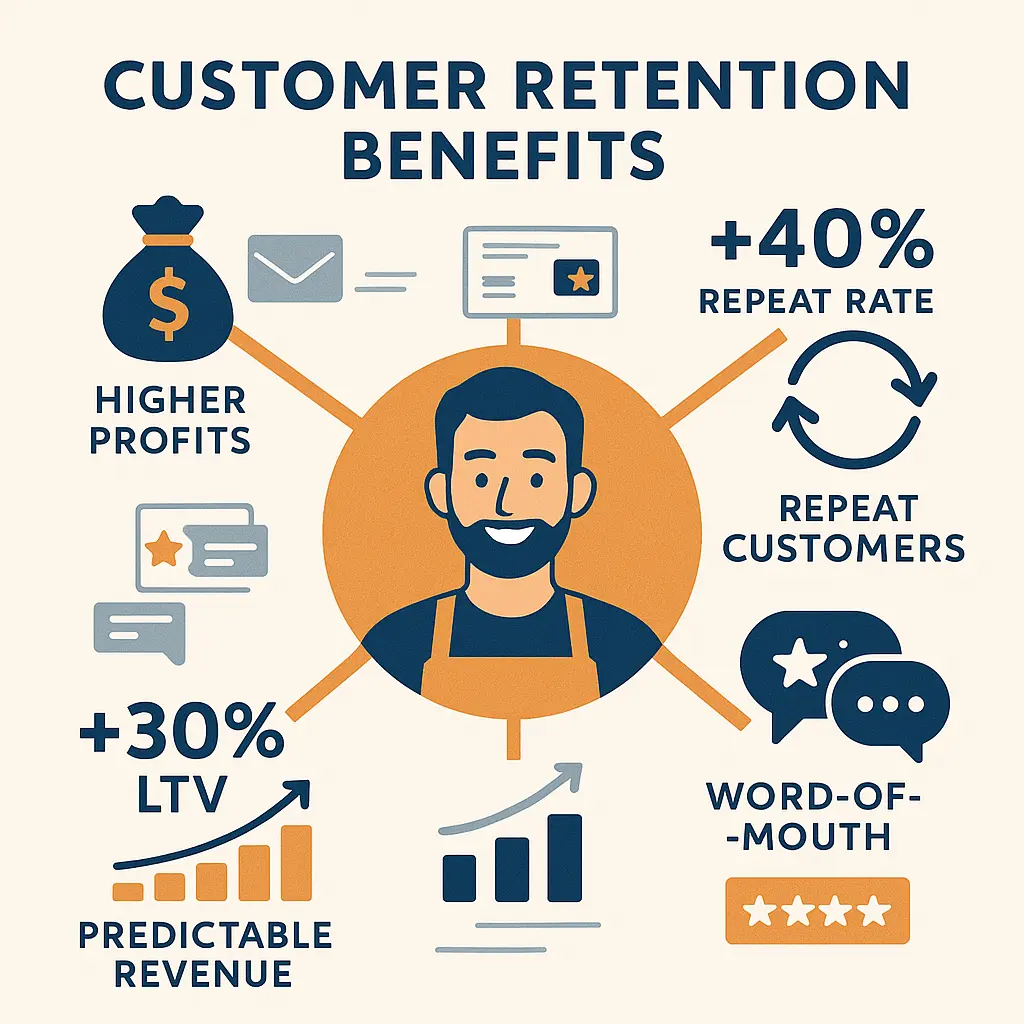
Design a retention flywheel system for a small business with <100 customers that increases customer lifetime value by 30% within 6 months. The system must include loyalty incentives, automated email triggers, and personalization tactics.
Success metrics: 30% LTV increase, 40% improvement in repeat purchase rate, 25% increase in average order value.
What success is NOT: A complex point system requiring constant manual management, loyalty rewards that erode profit margins, or personalization that feels creepy rather than helpful.
Minimum viable solution: Must work with existing email tools (Mailchimp, ConvertKit) and require zero coding skills.
3. Context/Input Processing
This is for a small business owner who wears multiple hats, has basic digital marketing knowledge but limited time for complex implementations. Known obstacles: Limited budget for expensive loyalty platforms, lack of technical team, customer base may be less digitally savvy.
Environmental constraints: Owner manages this alongside daily operations, needs systems that run themselves after initial setup.
Previous failure patterns: Tried generic loyalty programs that felt impersonal, attempted complex automation sequences that broke down, started initiatives they couldn't maintain consistently.
4. Reasoning Process
Apply the 80/20 principle: Focus on the 20% of loyalty tactics that drive 80% of retention results.
Use systems thinking: Each element should feed into and amplify the others (true flywheel effect).
Decision tree logic: IF customer behavior = X, THEN trigger sequence = Y.
Opportunity cost analysis: For each tactic, briefly note what simpler alternatives they're choosing over.
5. Constraints/Guardrails
- Time constraint: Initial setup must be completable in 4 hours or less
- Budget ceiling: All tools/systems must cost under $100/month total
- Skill level: Must work for someone with basic email marketing knowledge only
- Maintenance burden: Maximum 1 hour per week ongoing management
- Risk tolerance: Only reversible, low-risk tactics that won't damage customer relationships
- Technology compatibility: Must work with common small business tools (Square, Shopify, basic email platforms)
6. Output Requirements
Deliver as a scannable action plan with:
- 3-5 core retention tactics (each explained in 2-3 sentences max)
- Specific email trigger sequences with subject line examples
- 2-3 personalization methods requiring no customer data beyond purchase history
- Mobile-optimized format: Short paragraphs, bullet points for action steps
- Memorability requirement: Include one "sticky" analogy or memorable phrase per major section
- Plain language: 8th-grade reading level, define any technical terms
7. Examples
Good retention tactic example: "Send a 'We miss you' email 45 days after last purchase with a 15% discount and personal note from the owner. Subject: '[Name], your usual spot is waiting...'"
Bad retention tactic example: "Create a 12-tier point system where customers earn 1 point per dollar spent, with rewards starting at 500 points." (Too complex, delayed gratification)
Template-ready format: Provide copy-paste email templates with [CUSTOMER NAME] and [PRODUCT PURCHASED] placeholders.
8. Refinement Mechanisms
- Self-check protocol: Before finishing, verify each tactic passes the "grandmother test" (would a 70-year-old customer understand and appreciate this?)
- Stress test: How does each element perform if the business owner gets swamped for 2 weeks?
- Confidence scoring: Rate each recommended tactic 1-10 for ease of implementation
- A/B testing suggestions: Provide 2-3 variations for testing the most critical elements
9. Implementation Readiness Check
24-hour action plan: List exactly 3 steps the business owner can complete today to start building the retention system. Include specific tools to sign up for, templates to customize, and first emails to schedule.
Activation energy specification: "You can start the first loyalty tactic in 15 minutes using tools you already have."
Success milestones: Define clear checkpoints at Week 1 (system setup complete), Month 1 (first retention emails sent), Month 3 (first measurable LTV improvements).
10. Simplicity + Durability Filter
One-liner wisdom: "Great customer retention feels like friendship, not a transaction."
Grandmother test: Could the business owner explain each tactic to their least tech-savvy customer in 30 seconds?
Technology-agnostic backup: Include a pen-and-paper version for tracking customer preferences and follow-up reminders.
Upgrade path: Clear progression from basic (manual tracking) to advanced (full automation) without rebuilding.
11. Reality Testing Protocol
Murphy's Law application: What happens if the email platform crashes, the owner forgets to send follow-ups for a month, or customers don't engage with the initial loyalty offers?
Resource scarcity testing: How does this work if the owner only has 30 minutes per week instead of the ideal hour?
12. Meta Requirements
- Bias identification: Note any assumptions about customer digital literacy or email preferences
- Cross-cultural compatibility: Ensure tactics work for various customer demographics and cultural contexts
- Economic sensitivity: Provide scaled versions for different customer spending levels
DEEPER REFINEMENT QUESTIONS:
- Personalization depth: "How can we make personalization feel thoughtful rather than algorithmic without requiring extensive customer data?"
- Emotional connection: "What specific emotions should each touchpoint evoke to strengthen the customer-business relationship?"
- Channel diversification: "Beyond email, what low-maintenance channels could amplify the retention flywheel?"
- Seasonal adaptation: "How should the retention strategy shift during slow seasons or peak periods?"
- Competitive differentiation: "What elements of this flywheel would be hardest for competitors to copy?"
- Scalability planning: "At what point (50 customers? 200?) would this system need to evolve, and how?"
- Crisis resilience: "How does this retention system adapt during economic downturns or business disruptions?"






