
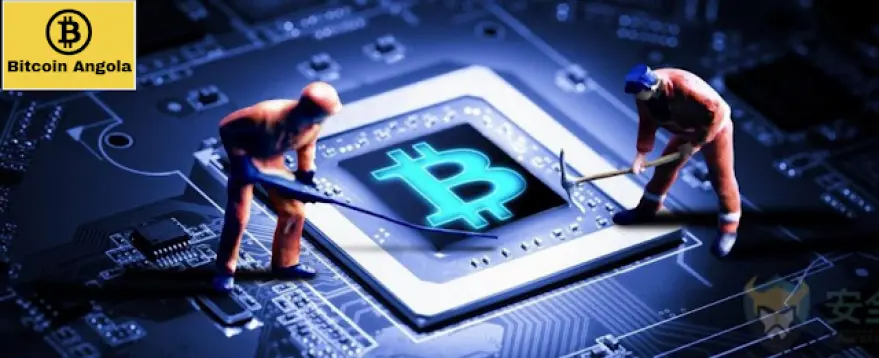
In recent times there have been many questions about bitcoin mining in our Community, to address all these doubts we will address in this post and in the coming how the bitcoin mining process works and what differentiates bitcoin from other cryptocurrencies
Bitcoin basics: how Bitcoin differs from traditional currencies
In Angola the kwanza (AOA) is made and regulated by a central bank - National Bank of Angola. In addition to a number of other responsibilities, the BNA regulates the production of new money and combats the use of counterfeit currency.
Even digital payments (internet banking) using kwanza are supported by a central authority. When you make an online purchase using internet baking, like multicaixa express (a digital online banking of Angola) for example, this transaction is processed by a payment processing company, such as Mastercard or Visa. In addition to recording your transaction history, these companies verify that the transactions are not fraudulent, which is why your debit or credit card may be suspended while traveling.
Bitcoin, on the other hand, is not regulated by a central authority. Instead, Bitcoin is supported by millions of computers around the world called "nodes". This computer network performs the same function as the National Bank of Angola, Visa and Mastercard, but with some important differences. Nodes store information about previous transactions and help to verify their authenticity. Unlike these central authorities, Bitcoin nodes are spread across the world and record transaction data in a public list that can be accessed by anyone, including you. To learn more about the nodes read our guide on Blockchain For Beginners and Advanced.
Bitcoin Basics: What is cryptocurrency mining?
When someone makes a purchase or sale using bitcoin, we call it a "transaction". Transactions made using internet baking are documented by banks. Bitcoin miners achieve the same effect without these institutions by grouping transactions into "blocks" and adding them to a public record called a "blockchain". The nodes keep records of these blocks so that they can be verified in the future.
When bitcoin miners add a new transaction block to the blockchain, part of their job is to ensure that those transactions are accurate. (We will delve deeper.) In particular, bitcoin miners ensure that bitcoin is not being duplicated, a unique peculiarity of digital currencies called "double spending". With printed coins, doubling money is not a problem.
Digital information can be reproduced with relative ease; therefore, with Bitcoin and other digital currencies, there is a risk that a buyer will make a copy of the bitcoin and send it to another party while still holding the original. Let's go back to the printed currency for a moment and say that someone tries to duplicate their 100 kwanza (Angolan currency) bill to spend both the original and the counterfeit in a supermarket. If an employee knew that customers were doubling money, all they would need to do would be to examine the account serial numbers. If the numbers were identical, the employee would know that the money had been doubled. This analogy is similar to what a bitcoin miner does when it checks for new transactions.
Miners' reward
However, with 500,000 purchases and sales taking place in a single day, checking each of these transactions can be very laborious for miners, which represents another important difference between bitcoin miners and the National Bank of Angola, Federal Reserve, Mastercard or Visa. As compensation for their efforts, miners receive bitcoin whenever they add a new transaction block to the blockchain. The amount of new bitcoin released with each extracted block is called "block reward". The block reward is halved every 210,000 blocks or approximately every 4 years. In 2009, there were 50. In 2013, there were 25, in 2018 it was 12.5, and in May of 2020, it will drop to 6.25.
At this rate of halving, the total number of bitcoin in circulation, despite increasing, will reach a limit of 21 million, making the currency more scarce and valuable over time, but also more expensive for miners to produce. We will go deeper into halving in the next posts.
In the next few we will continue our series on bitcoin mining. If you have any questions or suggestions, leave them in the comments below.
Origianl article: https://www.bitcoinangola.net/2020/01/introducao-mineracao-de-bitcoin-o-que-e.html
Follow us on the Social Media
Facebook: https://www.facebook.com/bitcoinangolablog/?ref=bookmarks
Twitter: https://twitter.com/BitcoinAngola
Instagram: https://www.instagram.com/bitcoinangola1/
Our Medium publication: https://medium.com/bitcoin-angola





