I wrote a previous article titled: The Psychology of a Bitcoin Standard, where I discussed the change in perspective of prices when viewing it in terms of Bitcoin. If you'd like to help in starting to think more in terms of Bitcoin, you can download the plug in that I mention in the article here. But now, it's time to discuss the common perspective of what it is like to live on a Fiat Standard.
The Nature of Fiat Money
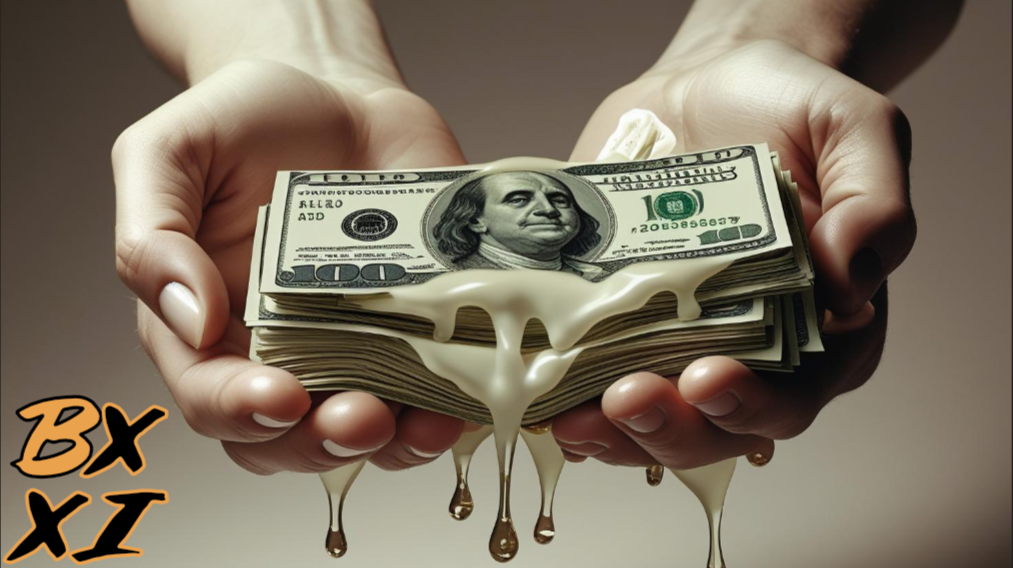
Fiat money, unlike Bitcoin, does not have a predictable and limited supply. Ever since the US dollar was severed from the gold standard in 1971, the M2 money supply increased by over 2,800% from 1971 to 2024; nearly $20 trillion has been added to the system in that time. When looking at products like gas, food, and housing in the US, prices since 1971 have increased ~870% ($0.36/gallon), ~675% (per food price index), and ~1,580% (median) respectively. Since humans are flawed and those at the top are greedy, those that have access to a money printer to lend an infinite amount of money indefinitely, those closest to the money printer benefit when money is created, while those furthest hurt the most (Cantillon Effect). As such, the money supply is inflated, people's savings and purchasing power decreases, and they require more money to afford the same goods and services than they did in the past. A common misconception with inflation is that "greedy capitalists" raise their prices. Although greedy business owners do exist, the reason prices go up is because purchasing power goes down. It may not seem like our purchasing power is decreasing and it is just that prices are increasing is because the $20 bill in your pocket still says $20. If you were to save a $20 bill from the year 2000, it would now be worth $11.11 when adjusted for inflation. However, it wouldn't make sense for us to print $11 bills and keep prices of goods static since the year 2000, so instead the devaluation of money is reflected by increase in prices.
Fiat is a Helluva Drug
Since fiat is constantly losing value year over year, one needs to acquire more money in order to afford what they could have bought for less in years past. A common retort to this is "We get paid more than we did in the past." This is a misnomer because although it is nominally true that salaries and minimum wage are higher than it was years ago, real wages have been flat or declining over the years when adjusted for inflation. For example: if your wage has increased by 3% but inflation is at 5%, your real wage has declined by 2%. Yes, there has been a slight rebound the last couple of years, but the U.S. dollar has lost approximately 90.5% of its purchasing power since 1970 due to cumulative inflation and real wages (adjusted for inflation) have only increased by about 3.8% over the same period. This means that if your dollar bought 1 unit of goods in 1970, it now only buys about 9.5 cents worth.
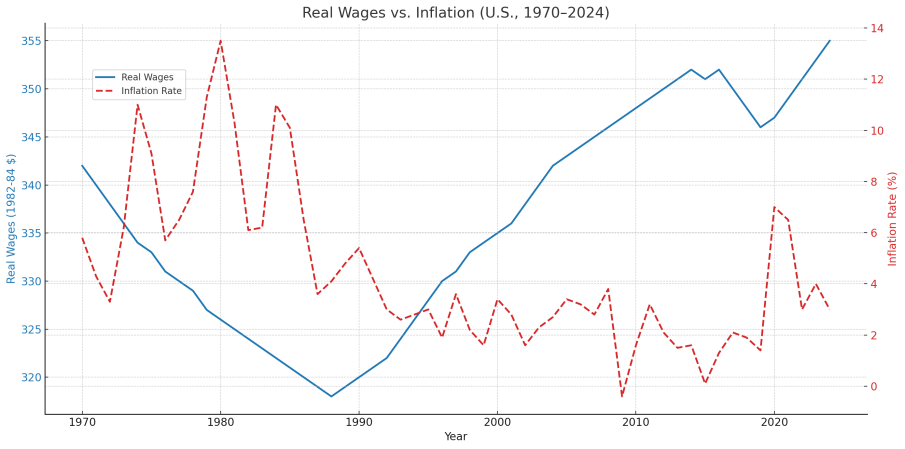
Graph by ChatGPT
So why is fiat a helluva drug? Because you need more than what you previously did in order to get the same effect. Like an addict who builds a tolerance over time and needs to consume more in order to get the same feeling that they did in the past, you need more dollars to achieve the same "high" (affordability of goods/services). Likewise, when it is time for the Federal Reserve to lower interests rates and print more money to stimulate the economy a dose of fiat is injected into the economy creating a euphoria of spending and borrowing. Over time however, a tolerance develops where more money creation (doses) is needed to achieve the same effect. Governments, markets and consumers become reliant on cheap credit an liquidity and the system becomes dependent on the stimulus. This leads to a withdrawal where interests rates are raised or stimulus cuts lead to crashes, recessions or unrest. Then the cycle starts over again.
On a micro level, the paper chase has been exacerbated. About 61% of US adults live paycheck to paycheck, 28% say they expect their financial situation to get worse a year from now, and 59% say they couldn't cover a $1,000 emergency expense with savings. Unsurprisingly, 90% of Americans say money impacts their stress level. It has become the norm that more and more people are working at least two jobs and/or have a side hustle. In pre-2013, only about 7% of U.S. job holders had a side hustle; by 2019 it climbed to 19%, and by 2024, it reached between 36–39%,and approximately 40% of U.S. households now include someone engaged in side hustling. Now I'm all for a gig economy and people carving out time to create multiple streams of income or to monetize a hobby/passion of theirs, but a great deal of this comes out of necessity rather than by choice.
I also believe it is no coincidence that the increase in trying to get "easy money" through means like gambling and OnlyFans is a response to money printing and the increase in cost of living. Since the 2018 Supreme Court ruling, the number of states with legal sports betting has grown from 1 to 38, leading to a surge in online sports wagers from $4.9 billion in 2017 to $121.1 billion in 2023, generating nearly $500 billion in wagers and contributed $1.8 billion in state tax revenues. Online searches for gambling addiction have increased by 23%, indicating a rise in help-seeking behaviors linked to the proliferation of online sportsbooks. And as for OnlyFans, the site has approximately 4.5 million active creators with a 29% increase from 2022 to 2023. It's revenue surged from $5.5 billion in 2022 to $6.63 billion in 2023. 2024 revenue projections are estimated to be $7.9 billion. I won't go into detail about the short and long term effects these behaviors have socially and culturally, but you get the idea: when the cost of living rises via money printing and people are having difficulty making ends meet, desperate times call for desperate measures.
Instead of getting discouraged with the rise in prices and dollar debasement, switching your mindset of to a Bitcoin standard and measuring goods and your wealth in terms of sats offers a more optimistic outlook. You can start to see prices deflating when priced in satoshis. This is due to Bitcoins immutable and set 21 million supply that no one entity can rewrite. No politician, no CEO, no central bank can issue more Bitcoin nor change the issuance schedule; everyone plays by the same rules. The liability that is the addiction of money printing becomes an asset: Bitcoin appreciates relative to the dollar's devaluation. The more time you spend studying and acquiring Bitcoin, you can see the fruits of you labor being saved and appreciating, not getting arbitrarily devalued because a group of central bankers deemed it necessary to turn on the money printer for the next high.
Thank you for your time and attention.
Please consider checking out my Bitcoin merch (hoodies, t-shirts, stickers, cases, mugs etc.) designed by me using this link.
Happy Stacking,
B