
For years, the quantum threat to Bitcoin sounded like science fiction.
It belonged to the same category as flying cars, artificial general intelligence and fusion energy: serious enough for researchers, but too distant for most investors to worry about. Bitcoin holders had more immediate problems to think about — volatility, regulation, exchange risk, custody, ETF flows and market cycles.
But that conversation is changing.
21Shares, one of the largest issuers of crypto exchange-traded products, has now warned asset managers that quantum computing is no longer a theoretical curiosity. The danger is not immediate. No quantum computer today can break Bitcoin’s cryptography at scale. But the preparation window may be shorter than many investors assume.
That is what makes the subject uncomfortable.
The real risk is not that Bitcoin suddenly stops working tomorrow. The blockchain will not be rewritten. Old blocks will not disappear. Mining will not be instantly taken over by a mysterious quantum machine.
The weak point is more precise — and potentially more dangerous.
It is ownership.
The Threat Is Not Bitcoin’s Blockchain — It Is the Signature That Protects Your Coins
Most people misunderstand what a quantum computer would actually threaten.
Bitcoin is often described as “secured by cryptography,” which is true, but too vague. Different parts of the system rely on different forms of security. The blockchain’s history is protected by proof-of-work and network consensus. The ownership of individual coins is protected by digital signatures.
That distinction matters.
A sufficiently powerful quantum computer would not magically erase Bitcoin’s ledger. It would not change the fact that transactions happened. Instead, it could attack the mathematical link between a public key and a private key.
In normal terms, a public key is information that can be visible on-chain, while a private key is the secret that allows someone to spend coins. Today, classical computers cannot realistically reverse-engineer the private key from the public key. That is the foundation of Bitcoin ownership.
Quantum computing could change that.
If an attacker could derive a private key from an exposed public key, then they could spend coins that do not belong to them. The ledger would remain accurate, but the guarantee of ownership would break.
That is why the threat is so subtle. Bitcoin itself would still be running. Nodes would still validate blocks. Miners would still mine. Wallets would still display balances.
But some balances might no longer be safe.
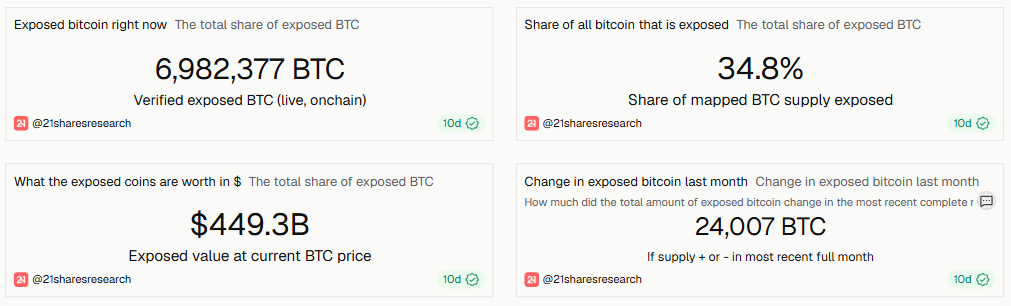
The most exposed coins are those connected to public keys already visible on-chain. This includes old pay-to-public-key outputs from Bitcoin’s earliest years, reused addresses and certain transaction types where public keys are revealed before or during spending.
For ordinary users, this means the problem is not “Bitcoin versus quantum computers” in some abstract sense. The real question is: which coins are protected by quantum-safe structures, and which ones are sitting behind cryptography that future machines may eventually break?
That is exactly why institutional investors are starting to care.
For a fund manager, custody is not just a technical detail. It is fiduciary responsibility. If billions of dollars sit in assets secured by cryptography that may need to migrate within the next decade, that becomes a due diligence issue.
Why the Timeline Suddenly Feels Less Comfortable
The usual response to quantum risk has always been: “It is decades away.”
That may still be true in the strictest sense. No machine currently exists with the scale, error correction and stability required to break Bitcoin’s signatures across the network. But the problem is that timelines in deep technology rarely move in straight lines.
Quantum progress does not have to be smooth to be disruptive. One major algorithmic improvement can change the estimated cost of an attack. One hardware breakthrough can shift expectations. One research paper can compress the assumed deadline.
That is why 21Shares is pushing the subject into institutional conversations now.
A recent wave of research has suggested that the resources required to attack some blockchain signature systems may be much lower than earlier estimates. The threat has not arrived, but the margin of comfort has narrowed.
This is especially important because Bitcoin cannot migrate overnight.
A centralized company can issue a security update. A bank can enforce a new cryptographic standard. A cloud provider can push infrastructure upgrades across its systems. Bitcoin cannot do that.
Bitcoin is decentralized. That is its greatest strength, but also a coordination challenge.
To become quantum-resistant, Bitcoin would need broad agreement across developers, node operators, miners, wallet providers, custodians, exchanges and users. New address formats would need to be adopted. Wallet software would need to support them. Hardware wallets would need firmware updates. Exchanges and custodians would need operational migration plans. Users would need to move funds voluntarily.
And some users will not move.
Some lost coins cannot move. Some dormant wallets may never wake up. Some holders may ignore the warnings until it is too late. Some institutions may delay because migration creates operational risk. Some users may not even understand that their address type matters.
That is what makes the quantum issue different from normal market risk.
A Bitcoin crash can be waited out by patient investors. A broken custody assumption cannot.
If the network waits until a cryptographically relevant quantum computer is already visible, it may be too late to coordinate a calm migration.
The Real Institutional Question: Which Networks Are Preparing Fast Enough?
The 21Shares warning is not only about Bitcoin. It also concerns Ethereum, Solana and the broader crypto market.
Different networks face different forms of quantum risk because their account models, signature schemes and governance structures are not identical. Some ecosystems may be easier to upgrade. Others may have larger exposure because of public key visibility, address reuse, validator infrastructure or smart contract dependencies.
Bitcoin has taken early steps through discussions around quantum-resistant address proposals. But because Bitcoin governance is conservative by design, deployment could take years. That caution protects Bitcoin from reckless changes, but it also makes emergency coordination difficult.
Ethereum may have more flexibility because its roadmap already includes account abstraction, cryptographic upgrades and deeper research coordination. But Ethereum’s complexity is also a weakness. The ecosystem includes smart contracts, rollups, bridges, validators, wallets, staking infrastructure and layer-2 networks. Coordinating quantum-safe migration across that entire system would be extremely difficult.
Solana appears to be moving quickly in practical testing, including post-quantum signature experiments. But there is a trade-off: post-quantum signatures can be much larger and heavier than current signatures. For a high-throughput chain, that matters. A quantum-safe design that severely reduces performance could challenge the very thing that makes Solana attractive.
This is the core investment question.
The winner may not be the network that admits the quantum problem first. It may be the network that can actually migrate without breaking user experience, liquidity, performance or trust.
For asset managers, this introduces a new type of analysis. They can no longer look only at market capitalization, liquidity, developer activity and regulatory positioning. They may also need to evaluate cryptographic agility.
Can the network upgrade?
Can users migrate?
Can custodians support the transition?
Can old assets be protected?
Can the chain remain usable after adopting larger, slower or more complex post-quantum signatures?
These questions are not priced clearly into crypto markets today. Most investors still treat quantum risk as distant background noise. But if major allocators begin including it in risk models, that could change.
The Strange Problem of Dormant Coins
One of the most sensitive parts of the quantum debate concerns dormant crypto assets.
Bitcoin has millions of coins that have not moved in years. Some belong to long-term holders. Some are probably lost forever. Some may belong to early miners. Some are linked to the mysterious early history of Satoshi Nakamoto.
If the network eventually creates quantum-resistant addresses, active holders can migrate.
But what happens to coins that never move?
This is where the debate becomes philosophical.
One side argues that vulnerable coins should eventually be frozen after a long warning period. The logic is defensive: if no legitimate owner migrates, and the public key is exposed, then leaving those coins spendable may simply allow the first quantum attacker to steal them.
The other side sees this as a dangerous violation of Bitcoin’s principles. Bitcoin is supposed to protect property rights through rules, not judgment calls. If the network decides some coins are too risky to remain spendable, even for security reasons, it opens a door many Bitcoiners do not want opened.
Today, this debate is theoretical.
But it may not remain theoretical forever.
Dormant coins are not just a technical problem. They are a cultural one. Bitcoin’s credibility rests partly on the idea that no one can arbitrarily seize or invalidate coins. Any quantum-response plan that touches old coins will face enormous resistance.
That is why the best solution is preparation before the crisis.
The more time the ecosystem has, the more likely it is that migration can happen voluntarily, cleanly and without panic. The less time it has, the more likely it is that hard choices become unavoidable.
The Countdown Is Quiet — But It Has Started
Quantum computing is not about to destroy Bitcoin tomorrow.
That should be said clearly.
The current risk is not immediate. The machines needed to break major crypto networks do not yet exist. Bitcoin remains functional, secure against today’s attackers and deeply resilient as a monetary network.
But the institutional conversation has changed.
When a firm like 21Shares tells fund managers to take quantum risk seriously, it signals that the issue has moved beyond academic papers and niche developer forums. It is becoming part of professional crypto due diligence.
That does not mean investors should panic.
It means they should ask better questions.
Which assets have exposed public keys? Which custodians have migration plans? Which networks are testing post-quantum signatures? Which protocols can upgrade quickly? Which bridges, multisigs and shared treasuries depend on vulnerable key structures? Which risks are already measurable on-chain?
Bitcoin’s greatest strength has always been time.
It has survived because it moves carefully, resists unnecessary change and prioritizes security above convenience. But quantum computing introduces a new kind of pressure. Moving too fast would be dangerous. Waiting too long could be worse.
The clock is not loud yet.
But it is ticking.






