
The crypto market has always loved new launches. Every cycle brings a new wave of tokens, new narratives, new launchpads and new promises of early access to the next big thing.
But in 2026, that enthusiasm has almost disappeared.
Public token sales — whether ICOs, IDOs or IEOs — are going through one of their worst periods in years. After a strong peak in early 2025, the market has collapsed into a much colder and more selective environment. The numbers are brutal: only $58 million was raised through public token sales in the second quarter of 2026, across just 37 operations.
For an industry once built on the dream of “getting in early,” this is a major warning sign.
The question is no longer whether investors are interested in new tokens. The real question is whether they still trust them.
Public Token Sales Are No Longer the Market’s Main Attraction
A few years ago, ICOs were one of the most exciting parts of the crypto ecosystem. They gave retail investors direct access to early-stage projects, often before exchange listings and before institutional money could dominate the opportunity.
That model helped create some of crypto’s biggest success stories. It also created some of its worst disasters.
Today, the market looks very different.
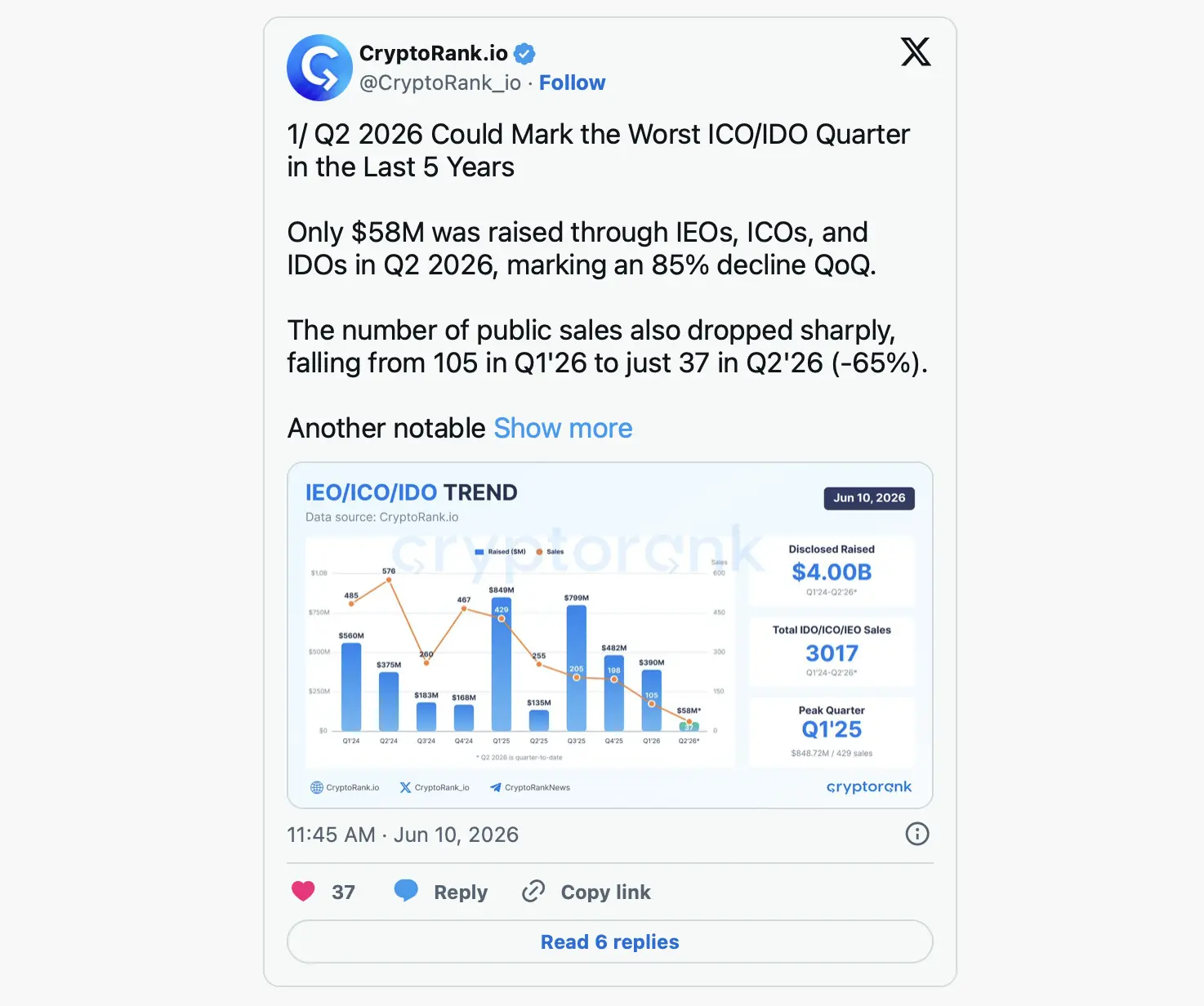
In the second quarter of 2026, public token sales raised just $58 million. That is not simply a slowdown. It is a collapse compared with the previous cycle of enthusiasm. In the first quarter of 2025, the market had reached a recent high with $849 million raised across 429 sales. In just five quarters, the amount of capital flowing into these offerings has been divided by almost fifteen.
The number of sales has also fallen sharply. From 105 token offerings in the first quarter of 2026, the market dropped to only 37 in the second quarter. May was especially weak, with just 13 recorded sales — the lowest monthly figure since the deep crypto winter of 2020.
This tells us something important: the issue is not only that projects are raising less money. Fewer projects are even managing to launch public sales at all.
That change reflects a deeper shift in the industry. Retail investors are no longer blindly rushing into every new token. Launchpads no longer generate automatic hype. And projects can no longer assume that a whitepaper, a token ticker and a few influencers will be enough to attract capital.
The market has become much harsher.
Retail Investors Have Been Burned Too Many Times
The collapse of the ICO market is not difficult to understand. Many investors have simply lost confidence.
For years, public token sales promised early access to high-growth opportunities. But in practice, many retail participants ended up buying tokens close to the top of the hype cycle. By the time a token became tradable, early insiders, private investors or market makers often had better positioning than the public.
That created a painful pattern.
A project would launch with excitement. The token would list. Liquidity would appear briefly. Then selling pressure would build, attention would fade and the token would slowly bleed lower. In many cases, retail buyers were left holding assets that never recovered.
In 2026, that frustration is visible in the data. Among dozens of IDOs recorded this year, only one has reportedly delivered a positive return. The rest have performed extremely poorly, with many losing nearly all of their value after launch.
This kind of track record does lasting damage.
Retail investors may be speculative, but they are not infinitely forgiving. When too many launches end the same way, people stop believing the story. They stop joining presales. They stop trusting launchpads. They stop treating “early access” as an advantage and start seeing it as a warning sign.
That is one of the biggest problems facing the token launch market today.
A public sale only works if buyers believe they are being offered a fair opportunity. If they feel they are simply exit liquidity for earlier investors, the model breaks.
And right now, for many people, that model already feels broken.
Venture Capital Is Pulling Back Too
The weakness is not limited to retail token sales. Venture capital is also becoming more cautious.
In April 2026, crypto startups raised around $698 million across 72 funding rounds, the weakest monthly figure in a year. One year earlier, in April 2025, the sector had raised more than $2 billion. That is a huge drop, and it shows that private investors are also becoming more selective.
This matters because public token sales and venture funding are connected.
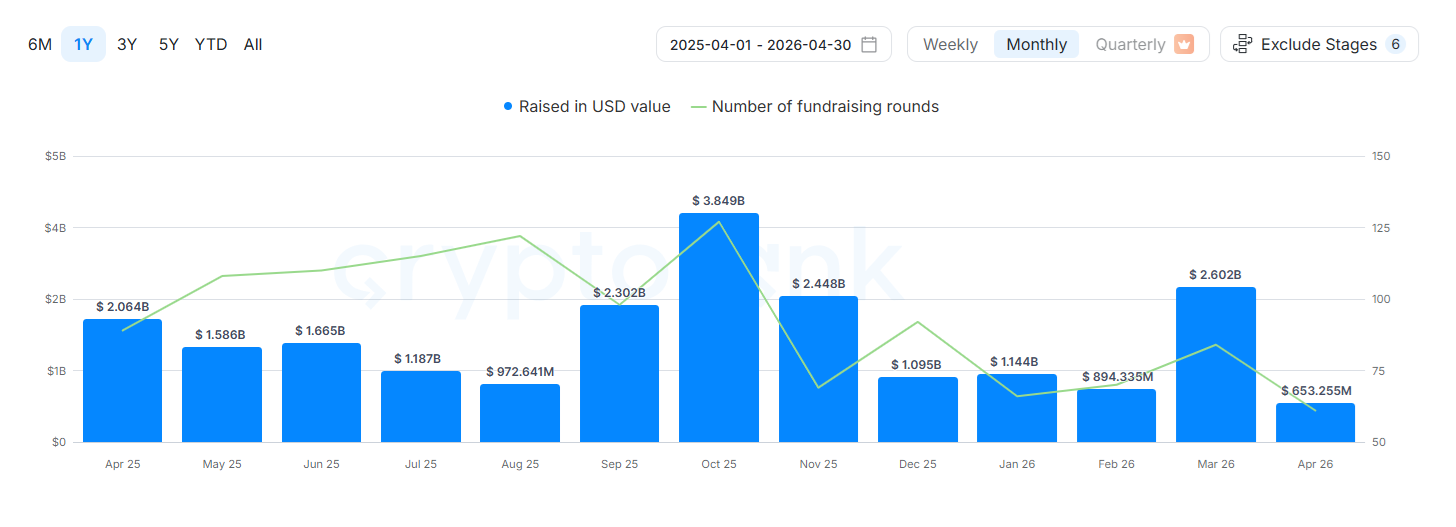
When VC capital is abundant, projects can build longer before going public. They can delay token launches, invest in product development, and use public sales mainly as a community distribution tool. But when private funding becomes harder to secure, some projects are forced to look for alternative financing.
In theory, that should benefit ICOs and IDOs.
In practice, the opposite is happening.
Retail investors are no longer willing to fill the gap left by venture capital unless the project has strong credibility, real users and clear token utility. The days when a team could raise millions simply by promising a future ecosystem are fading fast.
This is a major cultural change for crypto.
The market is moving away from narrative-first fundraising and toward proof-first fundraising. Investors want to see traction before the token launch. They want working products, active users, transparent tokenomics, realistic valuations and credible revenue models.
A token is no longer enough.
The project behind it must justify why the token needs to exist at all.
IEOs Are Holding Up Better, but They Are Not Saving the Market
Initial Exchange Offerings, or IEOs, appear to be performing better than ICOs and IDOs in 2026. Because they are hosted through centralized exchange launchpads, they often benefit from stronger distribution, better liquidity and more structured listing support.
According to available market data, IEOs have produced a positive average return this year, while many IDOs have performed terribly.
But this does not mean IEOs are reviving the token sale market.
Their volume remains small, and access is often limited. Many exchange launchpads now operate under tighter selection standards, and users are more careful about which launches they join. A positive average return in a small segment does not offset the collapse of the broader public sale market.
Still, IEOs show what investors are now demanding: curation, liquidity, reputation and some level of accountability.
This is why decentralized launchpads are under pressure. They need to prove they can protect users from low-quality deals, unfair tokenomics and unsustainable hype cycles. Otherwise, investors will continue to prefer either established exchanges or secondary-market entries after the dust settles.
The launch model is not dead.
But the old version of it is.
The ICO Market Is Not Dead — It Is Being Forced to Grow Up
It would be easy to say that ICOs are finished. That would probably be too simplistic.
Crypto has gone through this kind of reset before. The 2017 ICO boom ended badly, but token launches did not disappear. They evolved into IEOs, IDOs, launchpools, airdrops, points systems and community-based distributions.
The same thing may happen again.
Public token sales may survive, but they will need to become more transparent, more selective and more investor-friendly. Projects will need to explain why their token has real utility. Vesting schedules will need to be fairer. Valuations will need to be more realistic. Launchpads will need to rebuild trust. And users will need better tools to separate serious projects from short-term speculation.
The market is sending a clear message: hype is no longer enough.
For builders, this is painful but healthy. Weak projects will struggle to raise money. Empty narratives will be ignored. Tokens without users will be punished quickly. But projects with real products, strong communities and sustainable economics may eventually benefit from a cleaner market.
For investors, the lesson is just as clear.
Early access does not automatically mean a good deal. A low initial valuation does not guarantee upside. A token launch is not an investment thesis. Before joining any public sale, investors need to understand the product, the token supply, the vesting schedule, the unlock calendar, the market depth and the incentives of early backers.
In other words, the ICO market is not dead.
It is becoming less forgiving.
A Market Reset That Could Make Crypto Healthier
The collapse of public token sales in 2026 is a sign of exhaustion, but also of maturity.
Crypto investors have seen too many overhyped launches fail. They have watched too many tokens dump after listing. They have learned that not every “early opportunity” is actually early, and not every project needs a token.
That skepticism is not necessarily bad for the industry.
A healthier crypto market should not reward every launch equally. It should reward teams that build useful products, design fair token economies and give investors a real reason to participate.
The current ICO drought may feel like a crisis, especially for launchpads and fundraising teams. But it may also be the filter the market needs.
The next successful token launches will probably look very different from the old ICO model. They will be smaller, more selective, more compliant and more closely tied to real usage.
The era of easy token fundraising is over.
What comes next will have to be earned.






