
After months of declines, uncertainty, and heavy outflows from spot Bitcoin ETFs, the crypto market is still searching for a clear answer: is the worst finally behind us, or is Bitcoin simply catching its breath before another leg lower?
For Geoffrey Kendrick, an analyst at Standard Chartered, the answer leans optimistic. In his view, Bitcoin may have already found its cycle bottom around $59,000. In other words, the most painful phase of the bear market could now be over.
That is a bold statement, especially in a market that still feels fragile. Even though Bitcoin has shown signs of stabilization, confidence has not fully returned. Institutional investors remain cautious, ETFs have experienced significant outflows, and part of the market’s capital appears to have moved toward other high-growth sectors, especially artificial intelligence and major technology IPOs.
So, should we really talk about a new crypto spring? Or is this only a temporary rebound in a market that remains nervous?
A Bottom Around $59,000: The Signal Standard Chartered Is Watching
Standard Chartered’s thesis is based on a simple idea: the market may have already gone through its main capitulation phase.
Bitcoin fell close to $59,000 after reaching a peak of around $126,000 in October 2025. That represents a decline of roughly 53%, a correction deep enough to resemble the major washout phases Bitcoin has experienced throughout its history.
For an asset as volatile as BTC, a drop of that size is not meaningless. It clears excess leverage, forces overexposed investors out of the market, liquidates aggressive positions, and resets sentiment. These are often the kinds of conditions that prepare the ground for future recoveries, even though no one can identify a bottom with certainty in real time.
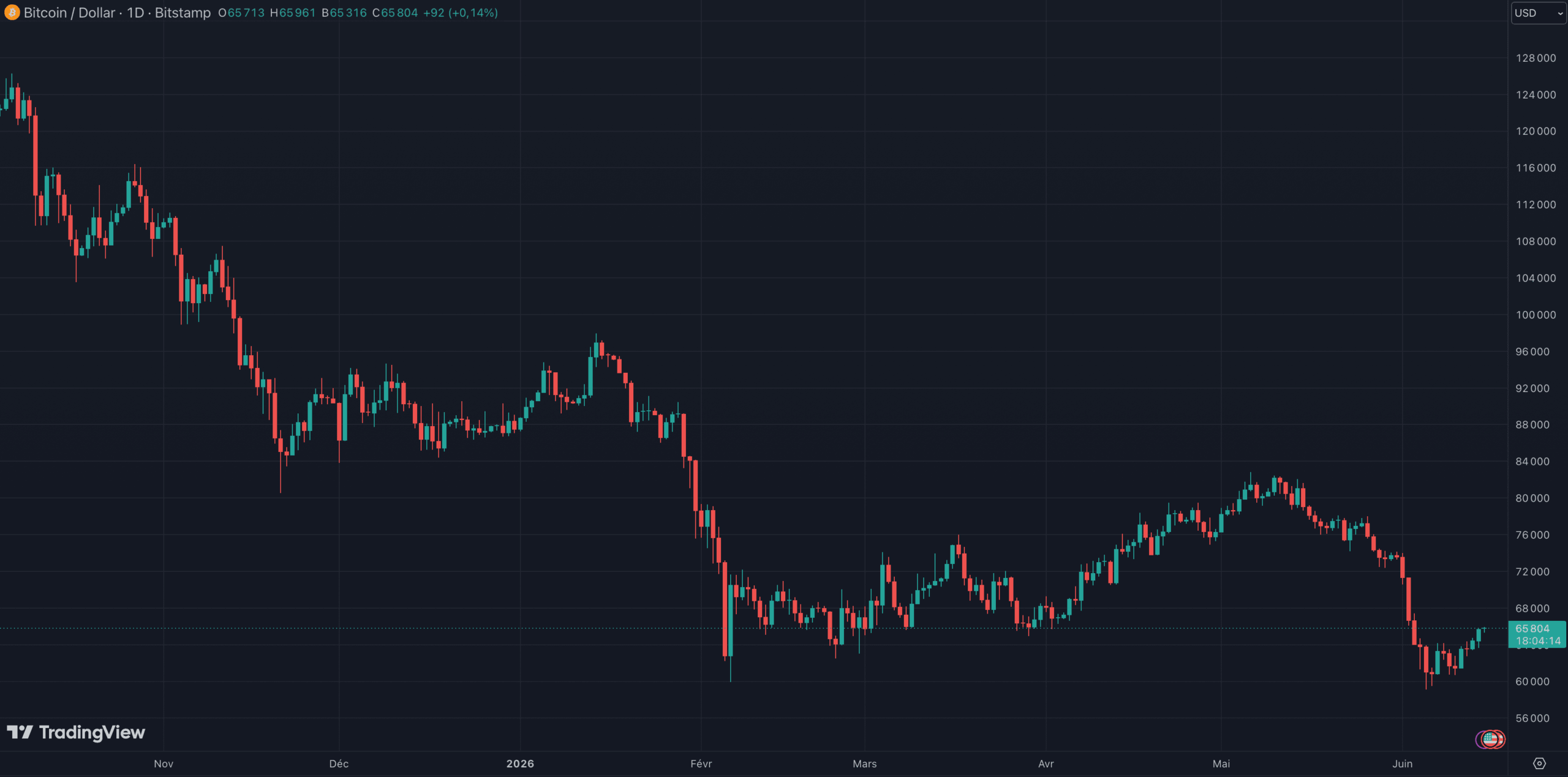
Kendrick’s argument is therefore straightforward: the panic move may already have happened. The most urgent sellers may already be out. The most obvious liquidations may already have been absorbed. And the market could now be entering a more constructive phase.
But that does not mean everything has suddenly become easy again.
A market bottom is not always followed by an immediate rally. Sometimes Bitcoin spends weeks, or even months, building a base. It may bounce, fall again, retest support, and only later begin a more durable recovery. Crypto markets rarely offer clean and comfortable confirmations.
So Standard Chartered is not necessarily saying Bitcoin will explode higher tomorrow. The message is more nuanced: the risk of another major collapse may now be lower than it was during the peak of the panic.
ETF Outflows, Strategy and Sentiment: Why the Drop Was So Violent
To understand the recent market weakness, several factors need to be considered together.
The first is spot Bitcoin ETFs. These products were one of the major drivers of the previous rally, allowing institutional and traditional investors to gain exposure to Bitcoin through a more familiar structure. But once flows reversed, that support turned into pressure.
Billions of dollars left Bitcoin ETFs during the correction. This does not necessarily mean institutional investors have abandoned the asset for good, but it does show that appetite weakened temporarily. In an already fragile market, this kind of outflow can amplify downside moves.
The second factor is more symbolic: Strategy, formerly MicroStrategy, sold a small portion of its Bitcoin holdings. In absolute terms, the sale was not huge compared with the company’s overall reserves. But symbolically, it mattered. Michael Saylor had long represented the “never sell” philosophy — the belief that Bitcoin should be accumulated and held no matter what.
Even a limited sale was enough to shake market confidence.
For Standard Chartered, however, that pressure may be temporary. Kendrick believes Strategy could resume buying, as the company has done after previous periods of stress. If that happens, the message to the market would be very different: the sale would look like a short-term adjustment rather than a change in long-term conviction.
The third factor is macroeconomic. Bitcoin no longer exists in a separate bubble. Interest rates, inflation, global liquidity, U.S. equities and major technology trends now directly influence crypto markets. When investors find better opportunities elsewhere, or when they reduce risk exposure, Bitcoin suffers.
That is probably one of the biggest differences compared with earlier cycles: BTC is more institutionalized, but it is also more connected to traditional market flows.
Why Standard Chartered Remains Optimistic
Despite the correction, Standard Chartered is maintaining a $100,000 Bitcoin target by the end of 2026.
At first glance, that may sound ambitious. To return to that level, Bitcoin would need to recover a large portion of its recent losses. But the bank’s argument rests on several points.
First, deep corrections have often offered better entry zones than euphoric phases. Buying when everyone is confident feels comfortable, but it is rarely ideal. By contrast, periods of doubt and fear are sometimes when the risk-reward profile begins to improve.
Second, Bitcoin’s structural fundamentals have not disappeared. Its supply remains limited, the network continues to function, its status as an institutional asset has strengthened through ETFs, and its role as an alternative store of value is still defended by a strong base of long-term investors.
Finally, the market could benefit from a gradual return of flows if macro conditions improve. Lower rate pressure, renewed appetite for risk, or a return of inflows into spot ETFs could quickly change the atmosphere. In crypto, sentiment can reverse very quickly, especially when positioning has become too pessimistic.
That does not mean the $100,000 target is guaranteed. No price target ever is. But Standard Chartered’s view is based on the idea that the market has already absorbed the worst of the shock, and that investors looking twelve to eighteen months ahead may see current levels as an opportunity.
In other words, this is not a call for blind euphoria. It is a warning not to confuse short-term panic with the destruction of the long-term bullish cycle.
Caution: A Bottom Is Never Confirmed by a Single Statement
Even if Standard Chartered’s analysis is interesting, it should be treated with caution.
Markets do not reverse simply because an analyst declares that the bottom is in. They reverse when several signals align: stronger volumes, slowing ETF outflows, improving sentiment, renewed spot demand, a more stable macro environment, and Bitcoin’s ability to reclaim important technical levels.
For now, some signals remain weak.
ETF outflows have weighed heavily on the market. Investor confidence has not fully recovered. Altcoins remain under pressure. And Bitcoin still needs to prove that a defensive rebound can turn into a sustainable recovery.
That means investors should separate two ideas: the possibility that the worst is over, and the certainty that the bull market has resumed.
The first is credible. The second still needs confirmation.
For long-term investors, this period may be interesting, but it requires discipline. Buying gradually, avoiding leverage, keeping capital available, and not confusing conviction with overconfidence remain essential rules.
The bear market may be over.
But the rebuilding phase may only just be beginning.
And in Bitcoin, it is often this quiet period — between fear and the return of euphoria — that separates patient investors from market tourists.






