
The United States may now control an estimated 42% of the world’s bitcoin. That does not give Washington control over the network—but it reveals how a borderless monetary system is developing a distinctly American center of gravity.
Bitcoin was created as money without borders: no central bank, no national government and no institution capable of rewriting its rules alone. Yet the economic activity surrounding it is becoming increasingly concentrated in one country.
According to research published by Bitcoin financial-services company River, Americans may collectively hold around 42% of all bitcoin. That is an extraordinary share for a country representing roughly 4% of the global population, 26% of world GDP and 34% of global wealth. River consequently describes the United States as the world’s leading Bitcoin power. River’s figures extend beyond ownership: the country reportedly hosts 37.5% of global mining power, most publicly listed corporate Bitcoin reserves and the largest known government stockpile.
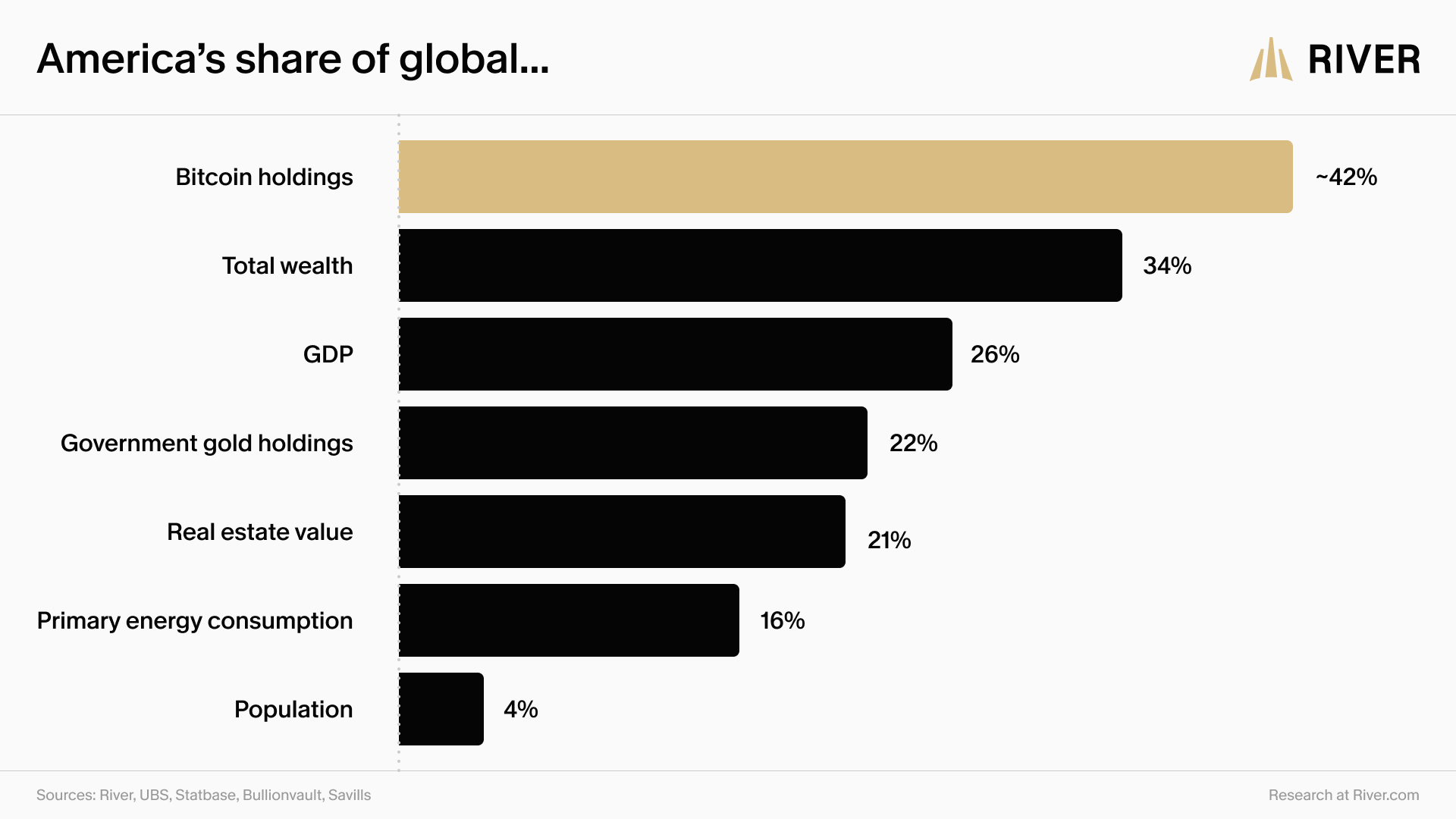
At first glance, this sounds like a contradiction. How can a decentralized asset become so heavily concentrated inside a single jurisdiction? The answer depends on what “decentralization” actually means—and on who truly controls the coins attributed to America.
America’s 42% Share Is Significant—but Not a Bitcoin Census
The first point to understand is that there is no definitive register showing where every bitcoin owner lives.
The blockchain records addresses and transactions, not names, nationalities or physical locations. One person may control hundreds of addresses, while a single address belonging to an exchange or custodian may represent the assets of millions of customers scattered across several countries. Dormant coins create another complication: some belong to committed long-term holders, while others may be permanently inaccessible because their private keys have been lost.
River’s 42% figure should therefore be treated as an estimate built from identifiable corporate reserves, government holdings, funds, custodians, market data and assumptions about private ownership. It is an indication of America’s weight within the Bitcoin economy, not proof that exactly 42 out of every 100 coins are beneficially owned by US citizens.
Exchange-traded funds make the distinction particularly important. Bitcoin held by an American ETF may be kept by a US custodian and reported through an American financial product, even when some of the fund’s investors live elsewhere. Likewise, a US-listed company may operate internationally, while an American exchange can hold bitcoin on behalf of foreign customers.
Nevertheless, several adoption studies support the broader conclusion that Bitcoin has gained unusually deep roots in the United States. The Nakamoto Project estimates that 18.6% of American adults own bitcoin—approximately 49.6 million people—compared with 10.8%, or 28.8 million adults, who own gold. Its research was based on a US-representative sample of more than 3,500 adults collected with Qualtrics in March 2025. The project’s methodology makes this a survey estimate rather than a count of verified wallets, but it still points to widespread public exposure.
The more important conclusion is not that every coin has been precisely located. It is that an increasingly large part of Bitcoin’s financial infrastructure now sits inside the American economic and regulatory system.
The American Bitcoin Machine Extends Far Beyond Retail Investors
Individual adoption is only one part of the story. The United States has developed an ecosystem where miners, listed companies, ETF issuers, asset managers, custodians and public authorities all hold substantial positions in Bitcoin.
River estimates that 37.5% of Bitcoin’s global hashrate—the computing power used to secure the network and produce blocks—is currently operating in the United States. The country is also home to more than 150 Bitcoin companies and over 50 large mining sites drawing at least 10 megawatts of electricity each.
Several forces helped create this advantage. After China’s crackdown on mining in 2021, operators moved equipment toward regions offering greater legal stability, access to capital and abundant energy. American states such as Texas attracted miners with competitive electricity markets, large energy resources and programs that reward industrial consumers for reducing demand when the grid comes under pressure.
The corporate imbalance is even more pronounced. US-listed companies reportedly hold around 1.24 million BTC, representing 92.7% of all bitcoin disclosed by public companies worldwide. River says these businesses added approximately 510,000 BTC over the preceding twelve months—more than three times the amount of new bitcoin mined during the same period.
Much of that concentration comes from Bitcoin treasury companies, particularly Strategy, whose enormous reserve dominates corporate rankings. The growth of spot Bitcoin ETFs has strengthened the same trend by giving pension funds, wealth managers and conventional brokerage clients a familiar way to gain exposure without managing private keys.
The US government has also become a major holder. River estimates its position at 328,372 BTC, largely accumulated through criminal and civil asset forfeitures rather than deliberate market purchases. Following the creation of a federal Strategic Bitcoin Reserve in 2025, seized bitcoin designated for that reserve is no longer treated merely as property awaiting liquidation.
Together, these elements produce a powerful cycle. Deep capital markets encourage companies to raise money to acquire bitcoin. Regulated investment products attract institutions. Institutional demand supports larger custody businesses, while a developed mining industry reinforces the political importance of the sector. Bitcoin remains global, but its most influential financial layer increasingly resembles Wall Street.
Owning the Coins Is Not the Same as Controlling Bitcoin
This is where the distinction between economic concentration and protocol control becomes essential.
Bitcoin is not a proof-of-stake network where owning more coins directly grants more voting power. Even if Americans genuinely held 42% of the supply, they could not use those coins to increase the 21-million limit, confiscate bitcoin from other wallets or approve invalid transactions.
Miners have influence because they choose which valid transactions to include in blocks and determine the order in which those blocks are produced. But they cannot unilaterally rewrite Bitcoin’s consensus rules. Full nodes independently verify every block and reject anything that violates the rules they enforce. Bitcoin’s developer documentation confirms that consensus is maintained because full nodes validate blocks according to the same rule set.
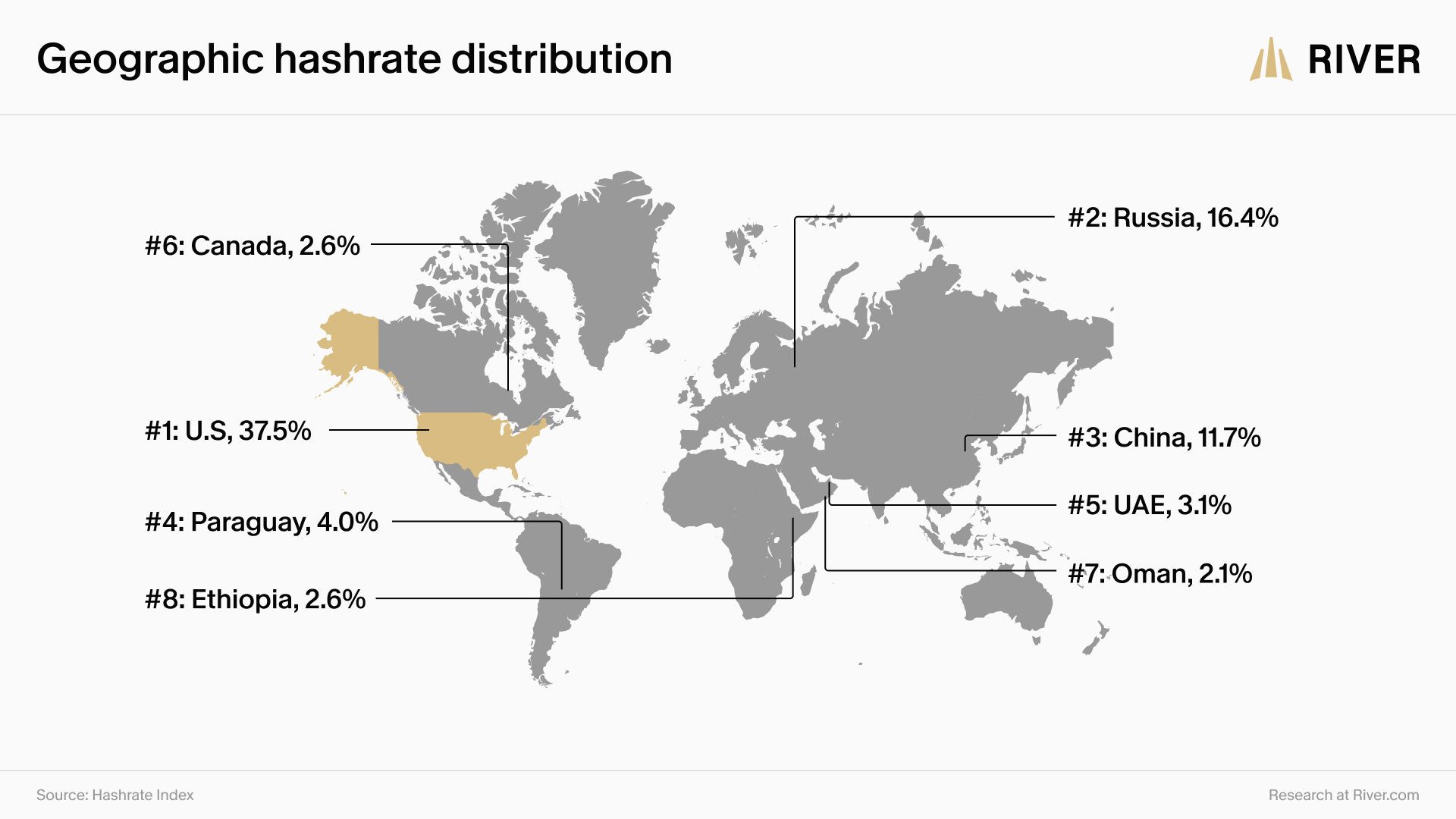
A country controlling a large share of mining power could still cause disruption. Coordinated miners might delay selected transactions, attempt reorganizations or apply regulatory censorship. Yet they could not create valid bitcoin from nothing or force fully validating nodes to accept an invalid chain.
Mining geography is also harder to measure than it appears. Estimates often rely on information supplied by mining pools, IP addresses or known industrial facilities. A pool may be headquartered in one country while coordinating machines located across several continents. Miners can change pools quickly, use proxy servers or conceal their location. Even the Cambridge Bitcoin Electricity Consumption Index emphasizes that network activity must be estimated because Bitcoin’s decentralized structure prevents direct observation of every participant. Cambridge’s methodology openly relies on models and assumptions rather than perfect measurement.
America’s position therefore does not mean that the US government controls Bitcoin. It means that American authorities may have considerable influence over the businesses through which many people buy, store, mine and sell it.
That is a different kind of power—and it should not be underestimated.
The Real Vulnerability Lies in Custody and Infrastructure
The greatest risk is not that Washington suddenly changes Bitcoin’s code. It is that a significant portion of the Bitcoin economy becomes dependent on a small number of regulated intermediaries.
If coins are held through exchanges, ETFs or custodial platforms, the beneficial owner does not directly control the private keys. Those assets can potentially be frozen, seized or restricted under court orders, sanctions and compliance requirements. A security failure at a dominant custodian could also affect several funds and millions of investors simultaneously.
The difference between nominal ownership and effective control is already visible in the United States. Analysis of the Nakamoto Project’s survey suggests that around 58.8% of American Bitcoin owners leave their holdings on exchanges, while only about 4.2% of all US adults—roughly 11 million people—hold their own keys. In other words, widespread exposure to Bitcoin does not necessarily translate into widespread financial sovereignty.
Corporate concentration creates market risks as well. A forced liquidation involving a major treasury company, ETF or government reserve could produce substantial selling pressure. Even without touching the protocol, decisions made by a handful of institutions could move the price, influence liquidity and shape public confidence.
Mining faces comparable pressure. Large US operators depend on permits, electricity contracts, access to banking and specialized hardware supply chains. Coordinated regulation could affect a significant share of global hashrate, at least temporarily. The network would continue operating elsewhere, but the adjustment could be disruptive and expensive.
This is the paradox at the center of Bitcoin’s institutional success: the easier it becomes to purchase through traditional finance, the more ownership may accumulate inside the same intermediaries Bitcoin was designed to make optional.
Decentralized Money, Centralized Gateways
The claim that Americans hold 42% of all bitcoin should neither be dismissed nor interpreted too literally. It is best understood as evidence that the United States has built the world’s most powerful Bitcoin industry.
That leadership does not give the country ownership of the network. Bitcoin’s consensus remains distributed among miners, node operators, developers, businesses and users around the world. A government can regulate companies within its borders, but it cannot order independent nodes everywhere else to accept invalid blocks.
Still, a network can remain technically decentralized while its economic gateways become concentrated. If most users rely on a few exchanges, most funds use the same custodian and much of the hashrate operates under one legal system, Bitcoin’s protocol may survive censorship while many of its users remain exposed to it.
The real test of decentralization is therefore not simply where the coins appear to be located. It is whether owners control their keys, whether miners can move or switch pools, whether nodes remain geographically dispersed and whether users can route around institutions that refuse to serve them.
Bitcoin may have no nationality. But the infrastructure growing around it increasingly does—and for now, its passport looks unmistakably American.






