
In this post, we briefly compare digital security of crypto and banks accounts.
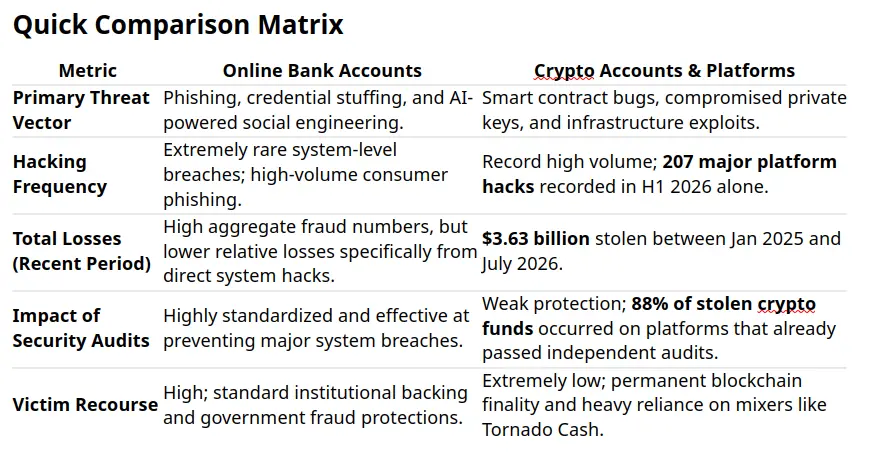
Cryptocurrency accounts and platforms suffer a significantly higher rate of successful hacks and severe financial losses than traditional online bank accounts. While traditional online banking remains a major target for high-volume fraud (such as phishing and account takeovers), 97% of banking fraud relies on social engineering rather than infrastructure exploitation. In contrast, cryptocurrency systems face aggressive, direct infrastructure breaches—with over $3.63 billion stolen from crypto platforms between January 2025 and July 2026.
Core Differences in 2026 Threat Realities
1. System Vulnerability vs. User Manipulation
Online banking architecture is incredibly resilient against direct cyberattacks. When banking security fails, it is usually because a consumer was manipulated via fake calls or phishing emails into revealing passwords. Conversely, crypto platforms face structural threats. In the first half of 2026, smart contract exploits accounted for 125 unique attacks. Hackers easily target flaws in decentralized protocols, bypassing audits entirely to drain pools of capital.
2. The Rise of State-Sponsored Aggression
Crypto networks deal with a unique tier of highly sophisticated adversarial threat actors. State-sponsored groups, particularly from North Korea, were responsible for 66% ($643 million) of all stolen crypto losses in the first half of 2026. Massive single-day infrastructure attacks—such as the $292 million exploit of KelpDAO and the $285 million breach of Drift Protocol—simply have no parallel in modern commercial online banking.
3. Institutional Recovery Frameworks
If an online bank account is compromised, centralized banking security teams can flag, freeze, and reverse unauthorized wire transfers. For cryptocurrency accounts, blockchain transactions are irreversible. Once malicious smart contract permissions are signed or private keys are stolen, funds are immediately routed through mixers or cross-chain protocols, rendering asset recovery near impossible.
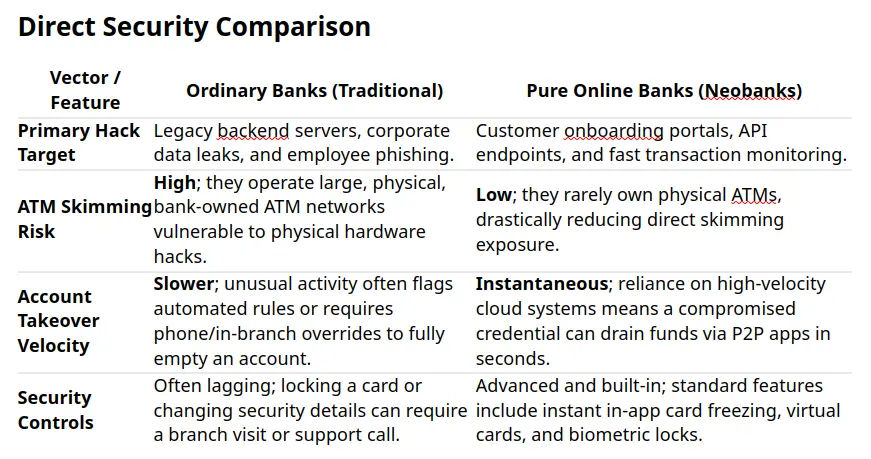
Pure online banks (neobanks) generally experience higher rates of individual account fraud and user-targeted "hacks" than ordinary traditional banks, though the nature of the security vulnerabilities differs significantly between the two. While traditional banks suffer far more corporate data breaches due to their reliance on sprawling legacy systems and human staff, pure online banks face a massive surge in automated credential attacks, identity fraud, and account takeovers.
The primary differences in their hacking rates and risk profiles break down as follows:
Fraud & Account Takeover Prevalence
Pure Online Banks: Because online banks prioritize a frictionless, fast user experience, their automated sign-up and transfer systems are prime targets for cybercriminals. Neobanks face rapidly escalating costs trying to prevent fraud, with average fraud-prevention spending spiking significantly to combat automated attacks. Fraud complaints and identity-theft "hacks" at digital-only entities often outpace their customer growth rates.
Ordinary Banks: Traditional banks feature more rigid, slower, and often in-person verification steps. While this frustrates users looking for speed, it acts as a massive speed bump against automated script hacking and quick identity spoofing.
Corporate Data Breaches vs. Employee Risk
Pure Online Banks: According to cybersecurity research, online banks experience a tiny fraction (less than 0.5%) of corporate financial data breaches. Because they operate without physical branches, they have vastly fewer employees. Since roughly 74% of all data breaches are enabled by human error or insider collusion, pure online banks have a smaller operational surface area for hackers to exploit.
Ordinary Banks: Traditional banks represent nearly half of all major financial data breaches. Hackers target them because their staff can be phished, and they run on layers of decades-old "patched" legacy infrastructure that is highly complex to secure.
The "Fintech Middleman" Security Risk
A unique risk to "pure online banks" is that many are actually unregulated fintech companies that partner with smaller, chartered banks to hold your money. If a middleman tech provider or API platform connecting the online bank to its partner core gets hacked or collapses, your account can be instantly frozen or misallocated without immediate FDIC intervention. Traditional banks hold direct bank charters, completely eliminating this third-party middleware risk.
Ultimately, an individual account at an online bank is most often hacked via social engineering (phishing, text scams, and credential stuffing) rather than a breakdown of the bank's core security or encryptions.
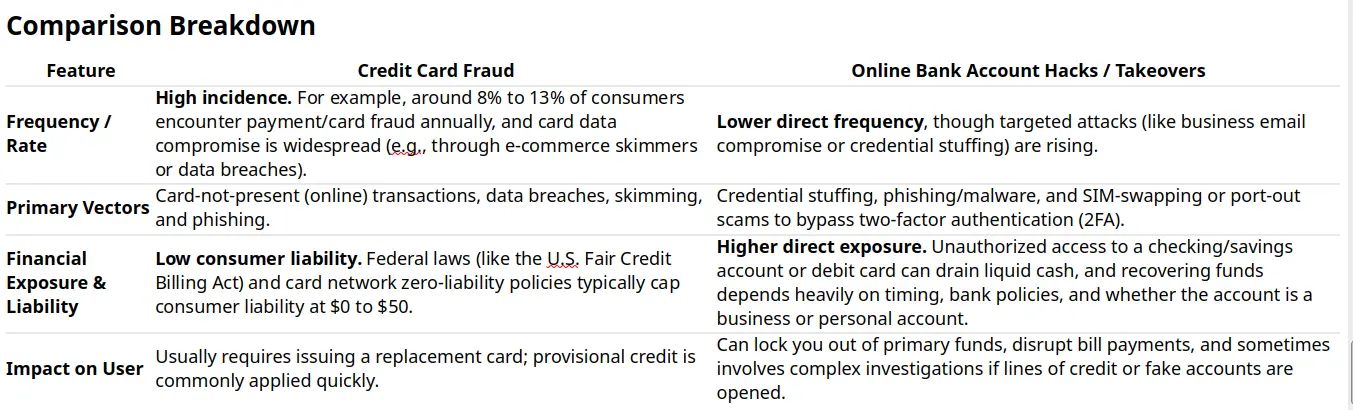
Credit card fraud happens much more frequently than direct hacks or takeovers of online bank accounts, but online bank account hacks—when they do happen—tend to involve higher direct risk and harder recovery.
Immediate Triage & Action Steps if Compromised
If you suspect credit card fraud or an online bank account hack, take these containment steps immediately:
Freeze or Lock Your Accounts: Use your mobile banking app or call your issuer to freeze/lock the credit card or bank account.
Change Credentials: Reset your online banking passwords and email account passwords from a clean, secure device. If your passwords were generated with dynamical passwords generators (DPGs) then you can change only the date and use the same key to create new strong passwords.
Revoke Digital Tokens: Remove stored card tokens from digital wallets (Apple Pay, Google Pay) and delete unverified third-party app permissions.
Report to the Institution: Contact your bank or credit card fraud department immediately to dispute unauthorized charges or unauthorized account changes under consumer protection limits.
Check Credit Reports: Place a fraud alert or credit freeze with major bureaus (like Equifax or TransUnion) if personal identifying information was exposed.
CONCLUSION:
Despite the fact, that crypto industry is over 17 years old, security of digital crypto infrastructure is significantly weaker than security of digital infrastructure of online and regular banks.






