
The reason that oil leads to stock market crash. How cryptocurrencies behave in the face of enormous pressures on international markets. Lessons from the course of gold and Bitcoin.

It all started on Sunday at noon. The Kuwait Stock Exchange stopped trading when the main index reached -10%. Saudi Arabia closed at -8.5%, with Aramco falling for the first time below the price it made in its public offering. It was obvious that something was wrong with the oil. Was it because the Arab countries did not meet on Friday (Friday and Saturday remain closed), that prices were falling behind international markets?
In the afternoon, the crypto market began to decline sharply, which remains open 24 hours a day, 7 days a week. Usually something hides behind such a significant fluctuation. A shocking new or powerful catalyst. Could it be because of Russia's disagreement with Saudi Arabia on lowering production to support prices? It was not a simple dispute but a price war has begun. Oil started with the biggest dip in its history, at -30%, while US indexes were at -4%. They are currently stuck at -5%, only because they are not allowed to go below preschools. Since the peak of $ 65, following the assassination of General Qassem Soleimani in Iran, oil prices have only had one direction: down.
But why are the markets so upset because of cheap oil? It sounds absurd. Reduced energy costs are growth-promoting. Cheaper raw material for petroleum derivatives, less costs at factories for production of products, reduced freight for freight.
Indeed, all of this is positive, only overshadowed by one huge negative: debt. Sounds strange, but the raw material for the growth of the world economy is not oil but debt! Companies borrow money to build new factories, buy machinery, raw materials, to fund research efforts. States to build the necessary infrastructure, ports, roads. To operate universities, schools, hospitals. But mostly they refinance their old debts. From taxation it is enough to pay only the interest, not the capital.
When everything is working properly, it is in the interest of all involved. Investors get a decent return on their economies by buying bonds (ie debt, private or public) in order to secure more interest than they would get if they deposited it with banks. The insurance funds, for the same reason, place their members' contributions and so on.
But if the borrowers stopped paying? Because there can be no wrong choices or fraud cases. As long as these cases were the exception to the rule, they did not pose a threat to the financial system. But it turned out to be a few. In 2008 it was revealed that the opening was so big, that investors were no longer willing to lend their fine money. Why; Because they realized they were in danger of getting their money back. This is how the Central Banks took action. They "printed" money to fill the void.
Only that excessive "printing" had a significant side effect. He did not deal with the problem drastically. He moved it. The Central Banks simply kicked the bucket further. We have mentioned several times the systemic issues raised by the so-called "printing", but we will dwell on a point we had mentioned a while ago:
The next crisis in the US is by no means unlikely to start with corporate debt. There are generally two types of debt-bonds. Those that are ranked in some degree, depending on how reliable they are, and the "trash". The problem is that almost 50% of corporate loans are at the limit. What limit? To fall into the category of "rubbish". If their credit rating is downgraded, the problem will be huge. Not only are pension funds and other large funds not allowed to invest in them, but if they are in their possession, they must sell them.
On a large scale, it will create a liquidity domino in the bond market. A regular tsunami. Why the problem has not yet appeared? Because a significant portion of the easy loans are directed to refinancing older ones. This allows businesses that have failed, though doomed, to continue to operate. As zombies are still walking, turning the environment next to them toxic, distorting competition. But when?
If we were to distinguish some corporate debt that is in the danger zone, it would be energy companies. There the situation is not far from being considered dangerous. The big patient is not just the oil companies. Tight are dancing tango with the banks, which are more open than usual in the industry. Only US shale companies, the first to be hit by low oil prices because they cease to compete, account for more than 11% of the high yield bond market. In order to avoid confusion, the price of oil must not drop below one point. What is this? Published analysis points to an average barrel cost of $ 40.
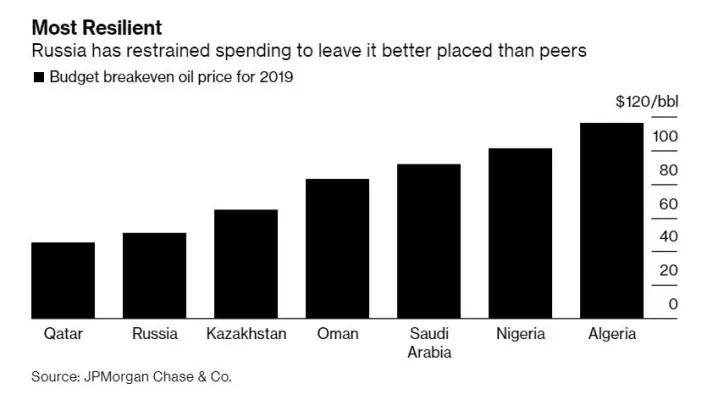
All the nice things are over, like easy money. The global economy is preparing to take a severe blow. The coronavirus is the trigger that triggered a huge domino effect, unraveling all the underground imbalances in the system.
Where is Bitcoin in all this context? As we have explained, it has a great peculiarity. This is an asset that is not affected by economic conditions. Its monetary policy is determined and predetermined, regardless of changes in GDP, unemployment, inflation, corporate profits, growth.
Like about gold. That is why investors are turning to the crisis there. They know that governments and banks can double the amount of money they put into the market if they want, but they cannot influence the amount of gold.
In the digital age, besides the traditional solution of precious metal, the alternative of Bitcoin was introduced. And indeed, both have been standing up to date. They are the only ones saved by the stock market tsunami. Their value is about the same level as when the coronavirus was present. But that does not necessarily mean that they will eventually float. Gold, in the period of panic following the collapse of the Lehman Brothers, declined to a large extent, regardless of whether it then rose sharply. Bitcoin has not been tested in such difficult conditions as it was when it was born.
With regard to gold, Bitcoin has one disadvantage and an advantage, which at this stage may judge their difference. The downside is that it is considered a higher risk asset, so it may be one of the first to be scared by investors. The advantage is that you negotiate continuously. It never closes, so if something extraordinary happens, even on a weekend, you can move accordingly.
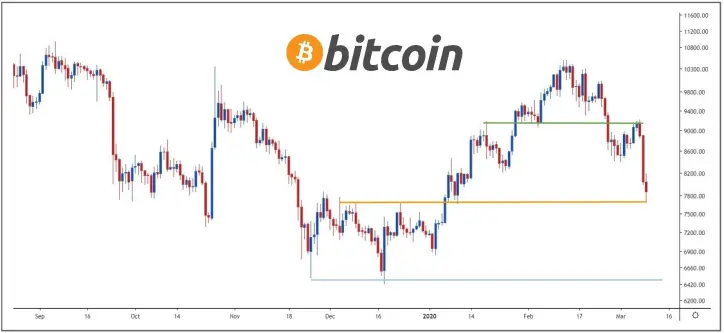
As for the Bitcoin price movement, as we see in the daily chart, after it failed on Friday to break the resistance of $ 9.100 (green line), it started to decline. The fall has found support at $ 7,700 (orange line). Should the support break up, it is unlikely that it will fall back to the $ 6,500 level.





