
If you were born around 1985, you’ve lived through a wild, unrepeatable chronological sweet spot. We are the last generation to remember the scratch and pop of a landline phone, the physical weight of a paper map, and the beautiful, lawless freedom of an internet that didn’t know your real name. Back then, if you wanted to write down a private thought, you bought a diary with a flimsy metal lock. If someone wanted to read it, they had to physically break into your bedroom and pry it open with a butter knife.
Fast forward to today, and the bedroom walls have completely dissolved. The modern internet has evolved into a hyper-monetized surveillance apparatus, and the rise of advanced artificial intelligence is threatening to turn what little digital autonomy we have left into ancient history. We didn’t get conquered by a sci-fi villain, we just slowly traded our privacy for frictionless logins, personalized recommendations, and targeted ads. But as AI models grow hungrier for data, we are rapidly approaching an architectural tipping point where privacy won’t just be difficult to maintain, it might become mathematically impossible.
From Dial-Up Disconnection to Total Digital Saturation

To understand how deep the rabbit hole goes, you have to look at the sheer velocity of technological growth over the last few decades. In the 1990s and early 2000s, being online was a conscious choice. You sat down at a family computer, endured a chorus of dial-up screeches, and entered a digital playground built on anonymity. Your identity was a handle like NeonRider85, and your data footprint was practically zero. When you shut down the computer, the internet stayed behind in the machine. It didn’t follow you to the grocery store, it didn’t track your steps, and it certainly didn’t listen to you complain about your boss over dinner.
Today, we live in a state of permanent, ambient connectivity where the offline world barely exists. Smartphones, smart watches, and home assistants track our locations, biometric baselines, and casual conversations in real time. For years, tech conglomerates assured us that this massive data harvest was safe because it was thoroughly anonymized. But data privacy researchers have consistently shattered that illusion. Pioneering work by computer scientist Dr. Latanya Sweeney, alongside modern data re-identification studies published in Nature Communications, demonstrated that an algorithm needs only a few distinct data points (like a zip code, a daily commute route, and a birthdate) to correctly identify a specific individual within an allegedly anonymous dataset. We aren’t anonymous, we are just filed under numbers until someone decides to connect the dots.
We willingly built a web where the default setting is aggressive extraction. Every single click, scroll, and micro-pause on a video is converted into behavioral surplus, packaged, and sold across real-time bidding networks to the highest bidder within milliseconds. We accepted this because it felt convenient to have our favorite shoes pop up on an Instagram ad exactly when we wanted them. The massive trade-off became clear only when an entirely new entity arrived on the scene, an entity capable of reading, understanding, and weaponizing every single drop of that spilled data simultaneously.
How Generative AI Ate the Public Commons
That entity has arrived, and it runs on large language models. The explosive growth of generative AI has triggered an unprecedented data gold rush, turning the public internet into a corporate training ground. AI companies didn’t ask for permission before indexing our digital lives. They simply deployed automated crawlers to vacuum up billions of blog posts, forum discussions, social media updates, and digital archives. If you wrote a heartfelt poem on a public forum ten years ago, congratulations, you are now an unpaid co-author of a trillion-parameter model.
This practice has pushed artificial intelligence and data privacy into a massive legal and ethical collision course. Tech giants find themselves facing high-stakes legal battles, including a prominent class-action lawsuit over unauthorized web scraping covered by Reuters, where plaintiffs argue that mass data extraction violates fundamental privacy and consumer property rights. The corporate defense usually relies on the legal concept of fair use, arguing that because the information was accessible on the open web, it is free for machine consumption.
There is a massive psychological difference between a human reading a public forum post and an AI digesting billions of them to map out the contours of human behavioral patterns. A profound analysis by the California Law Review on the ethics of the Great Scrape highlights this structural conflict, noting that large-scale scraping directly violates core privacy principles like data minimization and explicit user consent. When you posted a recipe, a family update, or a personal essay online a decade ago, you did so for an audience of humans. You didn’t expect it to be repurposed into a commercial engine designed to automate human labor and predict your next financial move.
Running Headfirst into an AI-Powered 1984
If the current trajectory continues unchecked, we aren’t just looking at a world with creepier targeted advertisements or better email autocomplete features. We are looking at a world that mirrors George Orwell’s 1984, but supercharged with machine learning algorithm precision. The ultimate danger of advanced AI isn’t that it will suddenly become sentient, develop a bad attitude, and rebel against us. The real danger is that it will work perfectly for the institutions that deploy it to automate surveillance and eliminate predictive friction. Traditional surveillance was always limited by human resources, because you needed actual people to sit in front of monitors and read transcripts. AI completely eliminates that bottleneck.
We are already seeing the foundation of this digital police state being laid in real time. Advancements in automated monitoring have allowed agencies to move past traditional resource limitations and cast an invisible dragnet over entire populations. Organizations like the ACLU have sounded the alarm on AI-powered predictive policing tools, warning that centralizing facial recognition, real-time location tracking, and algorithmic profiling allows institutions to monitor private spheres at a scale never before possible in human history.
Current reality has already caught up to these warnings. Federal enforcement agencies like ICE and CBP are actively bypassing traditional resource constraints by leveraging networks of AI-powered Flock cameras and Automated License Plate Readers (ALPRs). By gaining side-door access to localized, machine-learning camera feeds, federal authorities can track a vehicle’s specific physical characteristics, travel patterns, and daily habits across state lines. This automation effectively turns local neighborhood surveillance into a functional, real-time national dragnet for immigration tracking and predictive profiling. Will it only be used for immigration enforcement…only time will tell.
When an AI system can analyze your entire digital history, your private messages, your search queries, your spending habits, and your biometrics, it can build a psychological profile more accurate than your own self-assessment. It can predict your political leanings, your likelihood of protesting, or your mental health status before you even voice those thoughts aloud. When prediction becomes absolute, non-conformity becomes nearly impossible. The panopticon won’t just watch what you do, it will anticipate what you want, effectively policing behavior before it even happens.
Why I Built QuickPad
If the future of the internet is corporate data silos, forced logins, and omnipresent AI surveillance, then the only logical countermeasure is to build tools that explicitly break the extraction pipeline. We cannot sit around and wait for shifting state regulations or corporate promises of ethical data governance to save us. They won’t. Instead, we have to build privacy directly into the architecture of our software by default, making data collection physically impossible rather than just legally discouraged.
That specific frustration with modern software friction, heavy frameworks, and endless data harvesting is exactly why I built QuickPad. I was tired of opening a simple web app just to jot down a grocery list or a quick line of code, only to be met with a sign in with Google prompt, a cookie consent banner, and a tracking script running in the background. I wanted a writing space that rejected the toxic mechanics of the modern web entirely. QuickPad is a hyper-fast, serverless scratchpad that syncs instantly across your devices without requiring a login, an email address, or a credit card. You simply open the link, start typing, and use the web the way it was originally intended to be used. As a pure utility, not an identity trap.
To make a tool like this truly secure against modern interception techniques, it had to be engineered for total anonymity. QuickPad operates on a strict zero-knowledge architecture. The invisible decryption keys are built directly into the URL hash, which means the server only acts as a temporary relay for scrambled ciphertext that looks like absolute garbage to anyone trying to peek inside. Direct messages between users leverage military-grade RSA-OAEP 2048-bit encryption, making it mathematically impossible for anyone, including the hosting database, to read your conversations without your private key. I made the code open source so anyone can check it out and make sure it works as inteded.
Every single feature inside the application was designed around user autonomy. For instance, the Burn Notes feature allows you to create self-destructing links that erase themselves from existence forever immediately after they are read, ensuring no permanent digital footprint is left behind. If you want to collaborate without giving someone full control, you can generate a Read-Only link that lets others watch you write live while disabling their ability to alter your work. There is even a true offline mode that lets you keep drafting without a Wi-Fi connection, syncing intelligently once your device detects a secure network. Tools like this shouldn’t be an anomaly on the fringes of the web. They need to become the blueprint for how we interact online.
Tying the Ideas Together
We stand at a critical crossroads where our choices over the next few years will dictate the digital reality for generations to come. The cohort born in 1985 understands exactly what is at stake because we have lived on both sides of the great digital divide. We know what it feels like to exist without an algorithm grading our preferences, and we know how quickly that freedom can be chipped away under the guise of technological progress.
Artificial intelligence is an incredibly powerful tool, but if we continue to feed it every scrap of our personal histories without establishing cryptographic boundaries, we will willingly construct our own digital cages. The solution isn’t to disconnect from the modern world, throw our phones in a river, and live in isolation. The solution is to actively change our relationship with technology by supporting decentralized projects, demanding zero-knowledge security models, and intentionally choosing software that respects human dignity. Privacy isn’t a luxury asset to be traded away for convenience. It is a fundamental human right, and it is entirely up to us to keep it alive.
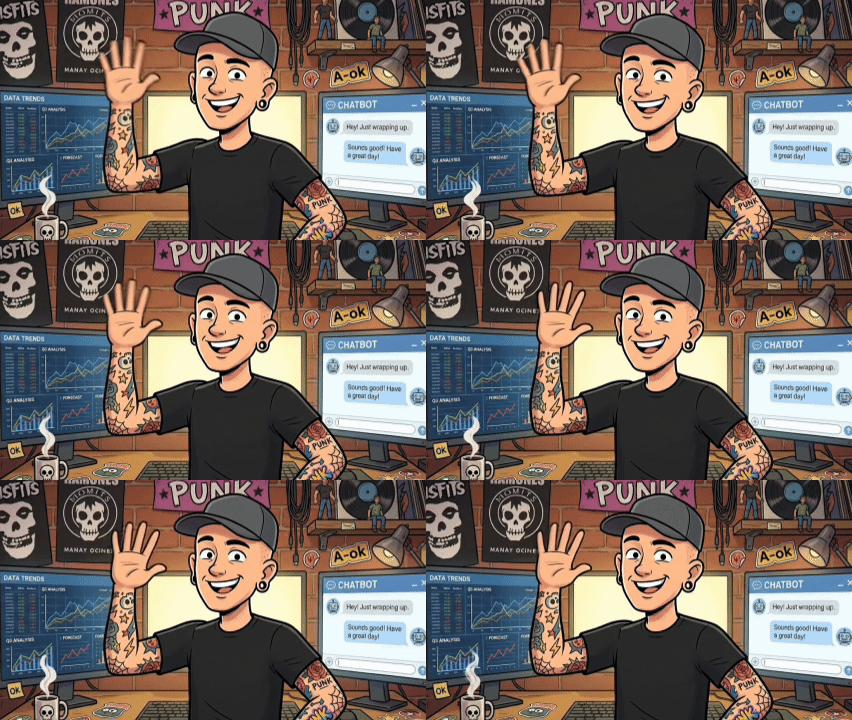
Thanks for reading everyone! Visit my site to learn more about me and explore what I’m building at Learn With Hatty. I hope everyone has a great day and as I always say, stay curious and keep learning.






