
Inflation is an important factor in assessing the value of money. We therefore see that this concept is often used in the debate on the value of the euro or the dollar. We think it would be a good idea to discuss Bitcoin's inflation in this article. Is there such a phenomenon there? We dive into the matter and explain in clear terms what the situation is with Bitcoin and inflation.
What is inflation and its counterpart deflation?
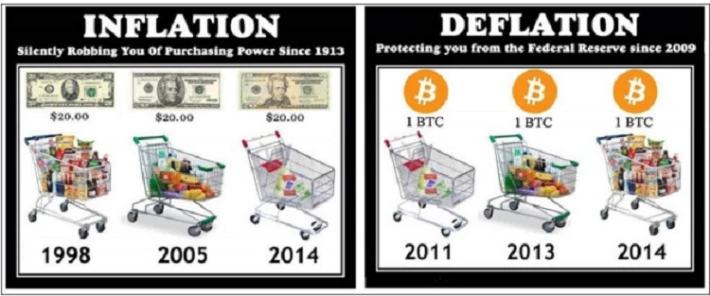
Inflation can be defined as follows: 'the decline in the value of money due to an increase in average prices (the general price level)'. This can easily be visualized by means of an imaginary basket of standard messages. When you pay for this basket at the end of each year, you immediately see the price difference. Are the groceries more expensive? Then you have to deal with inflation. You can then buy fewer groceries for the same amount of euros. Do you pay less at the end of the year for the same basket of groceries than the year before? This is called deflation.
How is Bitcoin's inflation regulated?
Bitcoin is currently very volatile. Prices can vary by 10% in one day. This would make the basket of groceries on 1 January of year 1 much more expensive or cheaper than the same basket exactly one year later. The cause, however, is not the increase in the average price level. This price difference is not called inflation. However, there is also inflation in the Bitcoin. The effect of this is explained in the Bitcoin white paper. It says that inflation is linked to the mining reward of the currency. This means that, according to the laws of Bitcoin, inflation will halve as soon as it halves in 2020. This means that inflation will fall from 3.71% now to 1.80% after the halving.
What is the impact of inflation on Bitcoin?
As Bitcoin's inflation is fixed at 1.80% after the halving and will fall further with a later halving, Bitcoin's historical inflation will prove to be more and more stable than the Euro. If we look at the historical and annual inflation of the Netherlands, we see that before its halving in 9 out of 10 in recent years, Bitcoin was higher than the inflation of the Euro. If we look at 'as/if' the situation after the halving in the last 10 years Bitcoin would have had a historical inflation only 3 times higher than the Euro. In the long run, Bitcoin seems to be a good way to avoid a depreciation of your investments.
What does this mean for the Bitcoin price?
As a result, Bitcoin's share price is expected to rise over time, partly due to controlled inflation. It is therefore worth considering, if you have a longer investment horizon, to consider Bitcoin as part of your portfolio on the basis of various arguments.





